This forum is archived information and is no longer active.

My Current Focus: HBP/PE2

Started by Nash, February 20, 2015 · 434 Replies · 25,461 Views

john_c

Nash


Have you tried supplementing with creatine. I take it regularly and it seems to give a a few more reps. Stick with it, I'm in the same boat so I would love to see you progress.


I honestly see no reason why somebody shouldn't supplement creatine, nor do I see any logical basis for the seeming 'fear' of this compound in society.

It's safe, it's healthy, it's cheap, and for most people, it just works. Get some Creatine Monohydrate, take 5g a day, and you're good to go.

If humans didn't make any in the body, this thing would be a vitamin. There do exist deficiency symptoms that result in mental retardation.[184] They're rare, but they pretty much establish the importance of this molecule as a vitamin-like compound.


Kurtis Frank


Creatine is quite well-studied, and seems safe and effective in enhancing some aspects of performance.

5g a day of the cheap monohydrate powder (no need for anything fancy) seems great for anyone who's looking to increase power output.

In short: if you do something like sprinting or strength training, it's probably worth taking.


Gregory Lopez
Coach Sommer
curtis said:

Nash- I'm going to echo the above comment. More volume has helped me to progress past sticking points. I'm still experimenting with finding the right amount of extra volume. It's fair to say the templates usually work just fine, until they don't. Sometimes you just need to change it up a little. Try adding 2-3 challenging sets of HBP PE4 or PE5 after your push ups. If it works for you as it has with me you will improve at two exercises simultaneously. I only concentrate move volume on one or two progressions per week since this is manageable (and enjoyable).

Very good solution. Easily monitored and implemented.

With the added benefit of beginning preparing you for working new progressions without significantly affecting your day's scheduled workout.

Yours in Fitness,

Coach Sommer

TomParr

to get a picture of you general strength, where are you in rc progressions?

Nash
Tom from said:

to get a picture of you general strength, where are you in rc progressions?

RC/PE3: 9r, 9r, 8r, 8r, 8r. 


Form good. Controlled and slow.


-Nash

Gordy

While it is maybe not advisable to obsess over pushup form based on the prior discussion, I've been speculating all day about why the athlete's mechanics might be advantageous and thought I'd throw some ideas out there in case they are helpful.


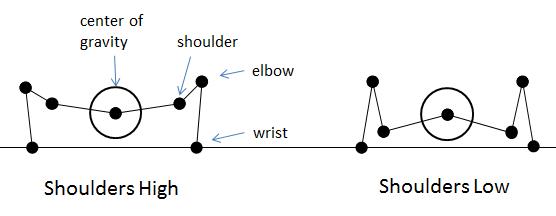
In bottom position from Nash's last video, where the shoulders are raised vertically /shoulder blades retracted and chest touching the ground, the shoulder joint might actually be above the center of gravity of the torso, which means the shoulder joint will be pulling the torso up rather than pushing it up.


Whereas if the shoulders are touching the ground with shoulder blades protracted as in the course video, the shoulder joints are more likely below the center of gravity of the torso, therefore they will be able to push it up.


Here's a rough sketch of the two alternatives, viewed looking towards the head. With shoulders low there is something like an arch effect, with the shoulder joints pushing up on the two ends of the arch. With shoulders high it is more like a rope with a weight hanging in the middle and the shoulder joints have to pull up on the ends of the rope. That seems more difficult. Maybe one reason is because with the arch, the arms can sort of brace each other using the arch to transfer the force. With the rope, each arm is more or less on its own to both balance and lift its end of the rope, or at least the linkage between arms is a lot mushier.


post-18774-0-25617900-1445384485_thumb.j


To be continued...


Gordy

...to continue, focusing on the arms:


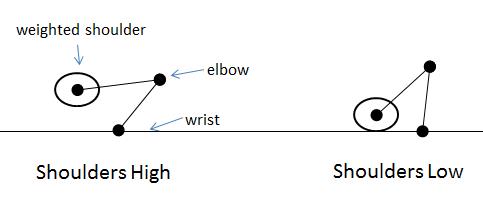
At the bottom of the pushup with shoulders low and forearm near vertical, the elbow is anchored in place (cannot move) because the ends of its two arms (upper arm and forearm) are in contact with the ground. Furthermore, gravity is not trying to pull the elbow clockwise or counter-clockwise, because the joint is balanced above the wrist so there is no moment of inertia.


In contrast, with the shoulders high at the bottom position, the shoulder/upper arm is not supported by the ground, it is being held up by muscle tension. Because the forearm is not vertical, there will be a moment of inertia on the forearm, gravity will be trying to rotate the elbow clockwise (in this sketch) around the wrist, causing elbow flexion, which must be counteracted with triceps tension.


post-18774-0-63388100-1445384736_thumb.j


This may not all be correct, maybe the effect of gravity on the elbow is insignificant, or time at the bottom too brief to matter. Nevertheless it seems like in the shoulders low position the triceps would get a little break at the bottom of every pushup, but not so with shoulders high.


Gordy

One more thought…


Maybe the arms in the pushup can be thought of as two tiny people trying to do good mornings, where the wrists are the tiny person's ankles, the elbows are equivalent to hips, and the shoulders to shoulders. The weight is on the tiny person's shoulders and they've bent way over past 90 degrees and aren't allowed to flex their knees. To lift a weight in that situation you would want to start by pulling the hips (elbows) back while lifting to get that weight moving up and toward the center of gravity over the ankles (wrists). You can no longer pull once the weight is level with the hips (elbows) otherwise you would be pulling it downward, so somewhere around that point you reverse the rearward movement of the hips (elbows) and lever the weight upward and back until you come to rest with everything stacked, shoulders, hips (elbows) and ankles (wrists). That's roughly  what the athlete's arm appears to be doing (although on second viewing the elbow doesn't pull back all that far).


With the shoulder high at the bottom of the pushup, the elbow can't start the pushup with much of a pull because it is already swung back behind the wrist and the shoulders are closer to level with the elbow from the start. When the upper arm is level to the ground, gravity is pulling the shoulder down at 90 degrees to the upper arm, exerting maximum torque around the elbow pivot. The only thing counteracting that is the triceps. So the more level your upper arm is at the start of your pushup the more torque the triceps will have to exert to initiate the movement. Better to use momentum to help get the "weight" (shoulder) past that sticking point like an Olympic lifter in the clean and jerk.


So, just a hypothesis, maybe part of the difficulty comes from the difference between having your arms "pull" two ends of a weighted rope up and down starting each time from a position requiring max torque vs having your arms do a bunch of clean and jerks of a stiff object with a technique that uses momentum to help get past that position of maximum mechanical disadvantage.


Nash

Dude. Coach is going to track you down and torture you. Start running!

Jason Dupree
Gordy said:

attachicon.gifpushups.jpg


There are some differences between your position at the bottom of the pushup and what is in the course video (comparison attached).

  • Your hands are closer together.
  • Your forearms are less vertical.
  • Your shoulders are both vertically higher and closer to your head.
Perhaps a scapula expert can describe what is going on there. Would that be elevation and retraction? 


I'm no expert and only read this thread because I just started HBP/PE2 this morning, but the position in the course video looks more mechanically advantageous although I can't describe exactly why. Watching the course video, it looks like the athlete is lowering his shoulders to the ground more than his chest.


It still seems like it ought to be possible to get 5x15 even with imperfect form though.

Honestly I think this is exactly the answer. Depression and protraction has been repeated over and over for these, but the smallest change with the biggest impact for me was moving hands juuust a little wider(as in, matching the course video exactly ). This completely stopped the elbows from flaring when tired, which made me feel like my muscles were actually working and fatigueing, instead of just giving out. Next week is week 2 of block 3 for me, so hopefully these will be mastered in 2 weeks.

Nash
Jason Dupree said:

Honestly I think this is exactly the answer. Depression and protraction has been repeated over and over for these, but the smallest change with the biggest impact for me was moving hands juuust a little wider(as in, matching the course video exactly ). This completely stopped the elbows from flaring when tired, which made me feel like my muscles were actually working and fatigueing, instead of just giving out. Next week is week 2 of block 3 for me, so hopefully these will be mastered in 2 weeks.


Good luck bro. I'll incorporate this change into my notes.

chuchodani

I agree with Gordy, for me I love to do pushups with shoulders and chest to floor just like the athlete in the video. I mastered this element that way. Back in the day when I did pushups with retracted scapula at the bottom, to me they feel horrible but since I did it with form showed in the foundation course everything improved.

TomParr

I think following Gordy's advice will see you through.


Was asking about RC progressions as they will aid in scapular depression strength.


As a guide for hand placement, at the bottom of the pushup relax and have the inside of the index finger just outside your shoulder. Thats what I found comfortable but it's an individual thing we all have differing sizes so no golden rule.


Also looks like your shoulders are tight as you descend and the elbows move behind your bodyline, try the stretch in HS1 similiar to the start of a reverse dislocate, don't know name of top of my head.

Jason Dupree

Having seen his shoulder mobility, his shoulders are not tight. It can be classified as "freaky" at this point.

TomParr

Okay that's not the reason but I was trying give a solution as to why Nash's forearms aren't vertical, as this would be the most advantageous position to push from in my experience. Perhaps it is just a question of hand placement then.


Nash have a look at gymnastics WOD(?), carlo paoli's site. He's got some pushup pointers on there that may help. I specifically remember him emphasising having a vertical forearm.

Mark Collins

Look at where you would be strongest with bench pressing the bar off the chest. The hands are low so the bar is on the lower chest. Same with a push up. The hands too high compresses the elbow fully and the tricep is at it's weakest due to it being in a lengthened position.

The end is near Nash.

Nash

I played with this a bit and I think I got closer to the athlete in the video. First 3 are the original way, next 3 are with shoulder rolled forward which is causing my forearm to go more vertical. Work in progress still. It's not very intuitive at first.


After watching the athlete's video a couple more times, it's obvious that he actively rolls his shoulder forward (most obvious is second rep). I'm thinking it's exactly to achieve a vertical forearm plus Gordy's points above.


PhilipP

I always thought rolling shoulders forward like that under load was terrible for shoulder health. Seems like when you do that you lose depression of the scapular. I think of dips the same way. You keep the shoulders neutral or back a little not rolled fwd or shrugged up to ears. don't take my word for it though cause I've been trying to find the correct way to move and control the scapula and shoulders in all the GB exercises to avoid irritating my cranky shoulders.

Nick Roy

You could just lay on the floor and press yourself up with just your scapula. You'll get a feel for what you need to do there and it will carry over. I saw a video of a guy doing scapula mobilization. He basically did sPL/PE1 then 5 reps in both the halfway point and bottom position of the pushup. The bottom position doesn't really have much ROM, but if that's what your trying to improve specifically you might try that just to get some kinesthetic awareness

Jon Douglas
Nick Roy said:

You could just lay on the floor and press yourself up with just your scapula. You'll get a feel for what you need to do there and it will carry over. I saw a video of a guy doing scapula mobilization. He basically did sPL/PE1 then 5 reps in both the halfway point and bottom position of the pushup. The bottom position doesn't really have much ROM, but if that's what your trying to improve specifically you might try that just to get some kinesthetic awareness


This is good. I got quite good at pushups doing a lot of PPP starting from the floor.

Mark Collins
PhilipP said:

I always thought rolling shoulders forward like that under load was terrible for shoulder health. Seems like when you do that you lose depression of the scapular. I think of dips the same way. You keep the shoulders neutral or back a little not rolled fwd or shrugged up to ears. don't take my word for it though cause I've been trying to find the correct way to move and control the scapula and shoulders in all the GB exercises to avoid irritating my cranky shoulders.

Always aim to keep the humeral head (ball) in the socket. If you deliberately roll the shoulders forward you are setting yourself up for rotator cuff injury.

Mark Collins
Nash said:

I played with this a bit and I think I got closer to the athlete in the video. First 3 are the original way, next 3 are with shoulder rolled forward which is causing my forearm to go more vertical. Work in progress still. It's not very intuitive at first.


After watching the athlete's video a couple more times, it's obvious that he actively rolls his shoulder forward (most obvious is second rep). I'm thinking it's exactly to achieve a vertical forearm plus Gordy's points above.


Nash,

You can still have the forearms vertical with the humeral head neutral. If you keep rolling your shoulders like that you will loading the rotator cuff in a way that will lead to injury.

Nash
Mark Collins said:

Nash,

You can still have the forearms vertical with the humeral head neutral. If you keep rolling your shoulders like that you will loading the rotator cuff in a way that will lead to injury.

Thanks for the warning. F--- injuries.

I played with this a bit and the only way I could go vertical with shoulders neutral was to bring my hands back and out.

Nash

Working on getting the form right this week. Focusing on keeping elbows at 90 without rolling shoulders. Definitely feels like a different movement when I'm not activating the back as much. Feels promising.

Nash

Today: 13r, 13r, 13r, 13r, 13r

Total Reps: 65

Notes:

- Changed form from using back muscles, protracting at the top and elbows touching torso on up & down to moving arms out about an inch on each side and keeping forearms at 90 degrees as much as possible without rolling shoulders.
- This feels much easier than using my back muscles as I was previously.

- I still have to pause at the top for a few breaths towards the last 2 sets. Pausing in this version gives me room for a few more reps instead of one at a time.

- Light at the end of the tunnel!

Daniel Taylor-Shaut

You were using your back muscles for the pushup?