This forum is archived information and is no longer active.

List of scapular positions for H1 exercises

Started by Krel, March 22, 2015 · 42 Replies · 5,341 Views

Krel

Scapular positions :

scapula-shifts.jpg
 
- Elevation : scapula toward the ears
- Depression : scapula away from the ears
- Retraction : scapula toward the spine
- Protraction : scapula away from the spine
 
Wrist Stretches :
 
Wrist Stretch #1-2-3-4 : Depressed and protracted. It will greatly increase the quality of the stretches.

 
Wrist Pushups, First Knuckle Pushups, Wrist Rocks, Fingertip Pushups :
 
- Preparatory Exercises (PE) : Depressed and protracted
- Specific Exercises (SE) : Depressed and protracted at the top ; depressed and neutral at the bottom
 

Freestanding Handstand - Strength :
 
- HS/PE4-5-6-7-8-9-10-11-12 : elevated and protracted
- HS/SE1-2-3-4-5-6-7-9-10-11-12-13-14 : elevated and protracted
- HS/SE8 : elevated and protracted at the top ; depressed and protracted at the bottom


Freestanding Handstand - Mobility :
 
- HS/PE1-3>iM : elevated and protracted. These are shoulder flexion exercises thus do NOT retract your scapula !
- HS/PE2-4>iM : depressed and retracted
- HS/PE5-6-7-8>iM : lift the stick/bar overhead and elevate your scapula as much as possible then push  the stick backward as you retract as much as possible
- HS/SE1-2>iM : depressed and protracted
- HS/SE5-6-7-8-9-13-14>iM : elevated and protracted
- HS/SE10-11>iM : depressed and protracted at the top ; elevated and protracted at the bottom
- HS/SE12>iM : elevated and protracted at the top

 
References :
 
https://www.gymnasticbodies.com/forum/topic/18319-elbows-in-hanstand/


Micawberian said:

First, that we elevate and PROTRACT our scapula during the handstand. I have indeed heard that in some circus circles some people retract (I've heard of it happening, but never seen it), but not in the GB world.


https://www.gymnasticbodies.com/forum/topic/19534-retract-and-internally-rotate-shoulder-in-inverted-cat-or-just-relax/


Coach Sommer said:

Never rotate or retract during shoulder flexion work.  This defeats the purpose; the focus here is on shoulder flexion and upward rotation of the scapula only.  Nothing more.
 
Yours in Fitness,
Coach Sommer


https://www.gymnasticbodies.com/forum/topic/16435-hspe2im-forever/page-4


Joshua Slocum said:

Regarding scapular position of this movement: Coach Sommer confirmed on reddit today that you want depression and retraction: http://www.reddit.com/r/bodyweightfitness/comments/2tknnm/coach_sommer_ama/co0eq1n?context=3


https://www.gymnasticbodies.com/forum/topic/16462-dislocates-transition-between-shoulder-flexion-to-shoulder-extension-how-to/


Mark Collins said:

In my mind this is how I do the dislocates.

1. Contract the abs, gluteus and quads to put myself in a slight hollow.
2. Lift the stick/bar overhead and elevate the scapula as much as possible so I feel my upper traps contract hard. At this pint I think of reaching the stick up to the ceiling.
3. As I move to the transition I focus on keeping the abs tight and not letting my chest lift. This keeps the spine still so I am only moving the shoulders.
4. I then push the the stick backward as I contract the rear delts and squeeze the scapula back.
5. As the stick goes back I think of making a big circle. The more I contract the mid traps and rhomboids the bigger the circle. At this point my chest wants to lift so I focus on abs tight..
6. Rising from the back up is the process in reverse.


Feel free to correct or to add something if necessary.

gbsj

Great post. Thanks for gathering this together in one spot.

I vote for a sticky!

brown.3794

I'm not sure how to vote for a sticky but this I'd amazingly helpful. I wish these diagrams were included in the courses.

Micawberian

Regarding the bit you quoted from me, I have since learned that one new increasingly popular man by the name of Emmet Louis (I think trained at NICA Australia) has advocated for retraction in handstand. Handbalancer on this forum said it's a bad idea. I thought it was interesting, thought I don't know Emmet Louis' reputation or abilities. But yea, in GB, protract + elevate.

Coach Sommer
Micawberian said:

Regarding the bit you quoted from me, I have since learned that one new increasingly popular man by the name of Emmet Louis (I think trained at NICA Australia) has advocated for retraction in handstand. Handbalancer on this forum said it's a bad idea. I thought it was interesting, thought I don't know Emmet Louis' reputation or abilities. But yea, in GB, protract + elevate.


Retraction in a handstand?  Without checking, I believe that we may already know all we need to know about Emmet's handstand abilities. ;)


Yours in Fitness,

Coach Sommer

Joshua Slocum
Micawberian said:

Regarding the bit you quoted from me, I have since learned that one new increasingly popular man by the name of Emmet Louis (I think trained at NICA Australia) has advocated for retraction in handstand. Handbalancer on this forum said it's a bad idea. I thought it was interesting, thought I don't know Emmet Louis' reputation or abilities. But yea, in GB, protract + elevate.

Retraction is generally a bad idea in the handstand, since it allows your shoulders to inlocate (e.g the arm can roll behind the back, as in the pronated weighted dislocate), increasing instability. 

Micawberian
Coach Sommer said:

Retraction in a handstand?  Without checking, I believe that we may already know all we need to know about Emmet's handstand abilities. ;)


Yours in Fitness,

Coach Sommer


Actually, here is the video: https://www.youtube.com/watch?v=vGhGnk3l6-o.

I made a mistake, he merely points out, but clearly doesn't make an argument for, that ukranian coaches teach to retract and elevate. Either way, it sounds like bull because the plethora of ukranian circus guys on youtube show very much otherwise. At the end of the day, I'm definitely going to take Mikael's word over anyone else (even you, coach, even you! :D )


Zach Armijo said:

Google search for Emmet Louis Handstand =  no pictures of a handstand?! :facepalm:  :facepalm:  :facepalm:

jules
Micawberian said:

Regarding the bit you quoted from me, I have since learned that one new increasingly popular man by the name of Emmet Louis (I think trained at NICA Australia) has advocated for retraction in handstand. 

Never heard of him, Doubt he went to NICA. (I'm from NICA).

I think he misunderstands the difference between open and closed shoulders. Open shoulders does not mean retraction. A lot of the Chinese do still practice old school form handstands (in circus, not gymnastics), and the difference is obvious. 

Nino Begovic

.

mike_ross

Really important post.


I have a question through experience with past teachers. With this vocabulary of retraction, protaction... etc. What does it mean to "open shoulders" and "to close shoulders"?

Does it have a meaning or is it just a vague concept?


Coach Sommer
mike_ross said:

Really important post.


I have a question through experience with past teachers. With this vocabulary of retraction, protaction... etc. What does it mean to "open shoulders" and "to close shoulders"?

Does it have a meaning or is it just a vague concept?


"open shoulders" = increase flexion

"close shoulders" = decrease flexion


Yours in Fitness,

Coach Sommer

Keilani Gutierrez

its based on anatomical positions, when we say "open" it's that point where if you lay on your back and with your entire spine in contact with the floor, the arms are raised overhead to make contact with the ground. this is called shoulder flexion. anytime the arms are going away (from overhead to out infront of your body and now behind us like in Im2) from this angle, it is shoulder extension.

"open shoulders" is when we are in this perfect shoulder flexion position.

"closed ahoulders" is anytime the angle goes from fully flexed to pushup position, it can either be a great distance or simply a few centimeters.

think about how coach says "almost straight is still bent". this is how we'd refer to any position not in full shoulder flexion(open shoulders)when we are talking about Handstand elements.

edit: you heard it from the man himself, coach beat me to it :)

Nino Begovic

.

Sergio Mgencasa

Great post!

I understand all positions and my shoulders feel better since I do them in every exercise (push ups, pull ups...) but I have a question:

Why these positions? For example, Why protraction when you finish a push up? Is it for "complete range of motion"? if I don't do that is like I'm not extending my elbows completely? 

I'm really curious about the reason.

Thank you!!

Léo Aïtoulha
On 07/06/2016 at 0:40 PM, Sergio Mgencasa said:

 but I have a question:

Why these positions? For example, Why protraction when you finish a push up? Is it for "complete range of motion"?

I would say that it is for maximizing strength and mobility. For instance, you need to have a certain degree of shoulder flexion if you want to have a good body alignment in a Handstand. An elevated and protracted scapula is required in order to flex the shoulders. --> This scapula position maximizes your shoulder mobility in a Handstand.


Sergio Mgencasa

Thank you Léo,

I was talking about more about physiological issue. I heard coach Sommer talking about bone against bone in his last interview at Tim Ferriss podcast.

Don't get me wrong your answer is also about physiology and I agree with it, but I'm looking for something more specific.

Any other?

Thank you Léo!

Cole Dano

In a push up protracting the scapula is important as it allows the head of the humerus to be in optimal position in the shoulder joint. Simply put, it gives the shoulder joint room to move.

In handstand the movement is more 'complicated' as it's a combination of elevation, outward rotation and protraction.

Anytime you elevate, your shoulder blades come closer to each other by virtue of the fact they are constrained to move on a circular path. Which can be confused with retraction, but it's not.

When you outwardly rotate the upper inner edges of the shoulder blade will move closer together, and combined with elevation, they will be quite close, on either side of the neck.

But the bottom tips will go further apart and 'wrap' to the sides. 

In HS the easiest way to determine protraction vs retraction to to  look at the bottom tips of the shoulder blades.

If they are flat against the body they are protracted, if they are flaring out, then it retraction.

Finally, just because the shoulder blades are in an outwardly rotated, elevated, protracted position, it doesn't mean the antagonist muscles are chilling out doing nothing, they are still active and contribute to stabilising the position.

Sergio Mgencasa

Thank you Cole, 

So with that protraction movement do you create more room in your shoulder? I mean you create more room not only at that very moment. Something like when you hang from a bar.

I think I'm starting to figure it out...

Cole Dano

It physically gets your shoulders out of the way of the body. It's simple geometry, protract shoulders further apart and slightly forward, arms and body don't interfere with each other. 

Retract, arms hit the body, shoulder joint isn't free.

Eva Pelegrin

Sergio,

To your original question, one of the physiological difference between different "styles" of HS relies between bone stress and myofascial strength and endurance adaptations.

Bone against bone is what our grandmothers complaint about in their knees, which is obviously not desirable for our joint health or performance, and often comes with the formation of osteopaths, bone stress reactions...

When bones are stacking against each other, you're relying on the skeleton structure to take the weight and the fascia is somewhat hanging in there, as seen in some yoga HS where bones are stacked. I think this is what Coach was referring to in his podcast. This "stacking" comes with very little (active) help from the fascial system. The way I see it, it's like a missed opportunity to strengthen our connective tissue.:)

One of the roles of the fascial matrix is to pull and lift, creating spaces between our joints. In HS this desired lift requires a lot of training hours under our belt as Cole described. For one, we're reversing our orientation to gravity 180°. Most of us haven't even spent 1/10 of our lives inverted. Think about it, it took us years to learn to walk and we never stop practicing. Two, it's harder to do it this way.

I think it boils down to training our myofascial system to actively participate in HS, so you can gain the physiological adaptations of developing strength, endurance and resilience throughout your connective tissue and muscles, including joint health!

Cole Dano

"active help from the facial system" ? That's some serious woo woo talk.

It's the muscles that need to be active here, to create the line. But once created it winds up being the most efficient way to do a HS.

It's true, for the most part, we don't want to rest in our joints. Thankfully that's exactly what all these GST progressions are teaching and gradually developing.

Eva Pelegrin

Cole, 

Per Sergio’s original question regarding bone against bone, my point was that fascia is also active and loaded in creating the HS line, not just "the muscles.” It’s not like we can have one without the other… I’m sorry if my choice of words sounded like woo woo talk.:facepalm: I was only referring to the role of fascia in creating the line and not resting in our joints. People understand that muscles do the work. 

Daniel Taylor-Shaut

Handstands are simple. Most of foundation exercises are simple. The problem is that simplicity does not equate to ease; because, uhh, straddle planche and front lever certainly aren't easy by most people's standards.

Sergio Mgencasa

Thank you all!

Yes, I wanted to get into a muddy paddle. hehe.

Totally understood!

Thank you! 

Daniel Lehnberg

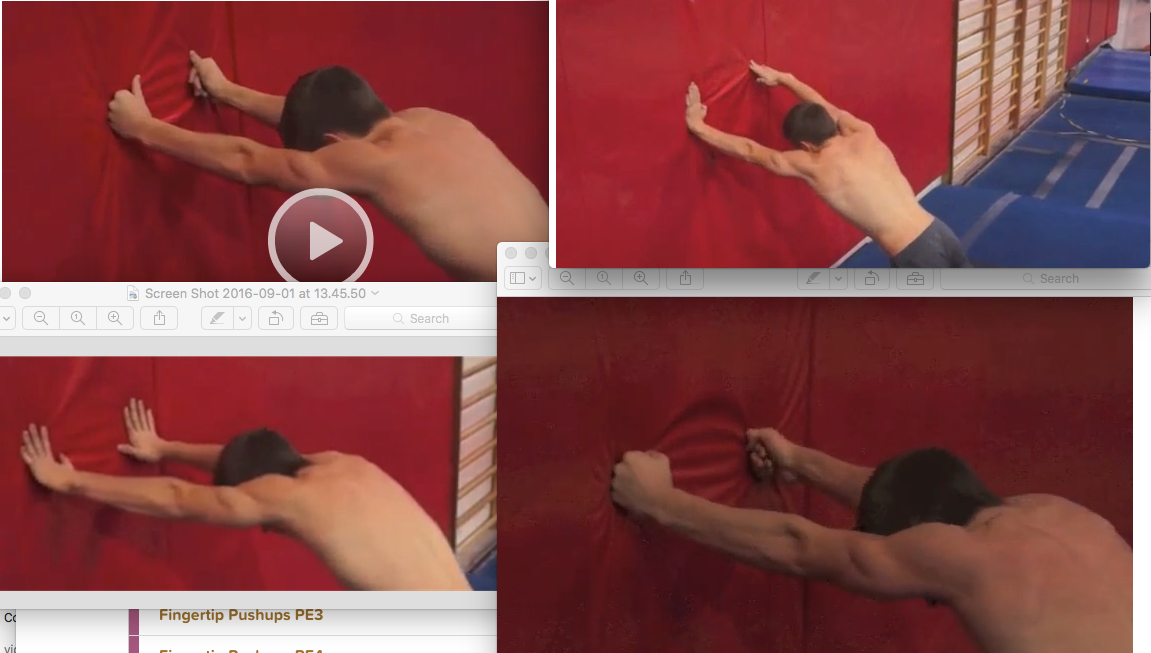
I have a question regarding the below, maybe @Cole Dano or @Léo Aïtoulha knows:

On 3/22/2015 at 1:31 PM, Léo Aïtoulha said:

Wrist Pushups, First Knuckle Pushups, Wrist Rocks, Fingertip Pushups :
 
- Preparatory Exercises (PE) : Depressed and protracted

Having depressed and protracted scapulas for these exercises makes a lot of sense to me. However, when I look at the PE2 exercises (long hollow body variants), the gymnast in the instruction videos appears (at least to me) to have elevated and protracted scapulas when he does the WP, FKP, WR, and FP sets (see pic).

Is it just my imagination / poor eyesight? :)And if not, should the scapulas be elevated or depressed here?

Thanks!

Screen Shot 2016-09-01 at 13.48.02.png