avancing through pre-reqs

Started by Karl Kallio, August 14, 2012 · 8 Replies · 4,645 Views

Karl Kallio

Hello all as I start to understand more about the GBsystem I've bumped into five more questions about the basics:

1) In dead Hang is supinated grip like a chin-up and pronated grip like a pull-up or the other way around?

2) When programming how much time to spend on each pre-req should I count supinated dead hang and pronated deadhang as two separate things or should i count dead hang as one thing then sub-divide it's alloted time into two?

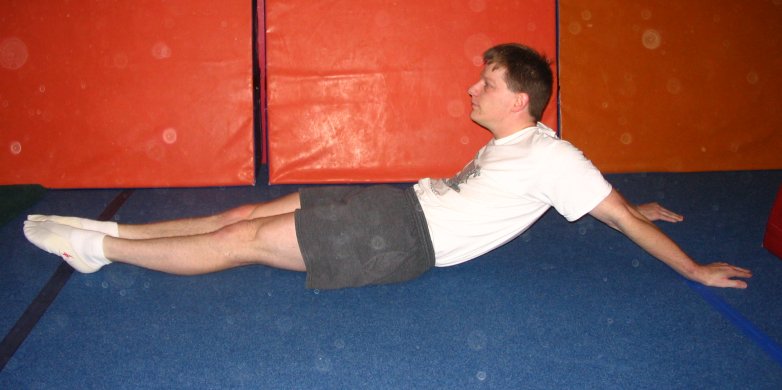
3) Is it possible that people with more pronounced fatty deposits on their backsides end up with a hollow hold that requires less abdominal strength? If so is there a way for curvy people to get a better contraction? It seems to me that when I add a bit of gluteal contraction to my hollow hold I end up supporting myself on my rump, or is it just that the gluteal muscles should be helping with pelvic positioning anyways?

4) Could anyone point me to some guidelines on how to start german hangs? We've tried to do them in a sort of experimental fashion, but they are so out of my experience base that I'm a bit spooked. (I was spooked about dead hangs at first too,but it turned out to be just the thing to help strengthen my swimmer's hyper-mobile shoulders)

5) With the stronger girls (can do decent pushups, ~10s l-sit, ~20s spotted handstand, can do chin-ups if i'm not picky about ROM) would it be Ok to include a bit of planche leans? It is similar to a skill they do in the water and I'm anxious to start.

Thanks for any and all advice.
Kevin Oka
synchroGENized said:
Hello all as I start to understand more about the GBsystem I've bumped into five more questions about the basics:

1) In dead Hang is supinated grip like a chin-up and pronated grip like a pull-up or the other way around?

2) When programming how much time to spend on each pre-req should I count supinated dead hang and pronated deadhang as two separate things or should i count dead hang as one thing then sub-divide it's alloted time into two?

3) Is it possible that people with more pronounced fatty deposits on their backsides end up with a hollow hold that requires less abdominal strength? If so is there a way for curvy people to get a better contraction? It seems to me that when I add a bit of gluteal contraction to my hollow hold I end up supporting myself on my rump, or is it just that the gluteal muscles should be helping with pelvic positioning anyways?

4) Could anyone point me to some guidelines on how to start german hangs? We've tried to do them in a sort of experimental fashion, but they are so out of my experience base that I'm a bit spooked. (I was spooked about dead hangs at first too,but it turned out to be just the thing to help strengthen my swimmer's hyper-mobile shoulders)

5) With the stronger girls (can do decent pushups, ~10s l-sit, ~20s spotted handstand, can do chin-ups if i'm not picky about ROM) would it be Ok to include a bit of planche leans? It is similar to a skill they do in the water and I'm anxious to start.

Thanks for any and all advice.
1) I would do the palms-out grip like a pullup if possible, as it is slightly more difficult.

2) When programming, set out to perform 1 minute of work regardless of what strength you are at. Just break it down into sets that you are capable of doing. For example: Deadhang - 10 sets x 6 sec, 6 sets x 10 sec, 3 sets x 20 sec, 2 sets x 30 sec, up to 1 set of 1 minute straight.

I was able to move to the next smaller amount of sets each week, so the example I showed, I finished in 5 weeks. Adjust to your needs.

3) It's hard for me to tell because I haven't experienced this, but I would say that if you don't feel as bad of a burn in your abs, you could decrease the angle between your upper body and legs, so that you will be forced out of resting on your bum.

4) Try getting used to it in this order, and if it doesn't work for you, repost the problem later on: Dead hang, Inverted hang, Rolling over with your feet over your head until you can drop to the floor, then do the same but don't drop - that's a German Hang!

5) If you do not feel uncomfortable while doing it, there should be no harm in doing it.

I hope this helps,

-Oka

Ralph Palutke

1) No i think dead hang with an overgrip is way easier than dead hang with an undergrip. The last one puts mutch more stress on the shoulders and will open them up. So in my view a dead hang with overgrip is a prerequisit for the undergrip

dead hang.

so long

Vincent Stoyas

1) Agreed with p5yx, the dead hang should be performed with a chin up grip. You can add in a pull up grip, but that's up to you.

okaxmasato said:

2) When programming, set out to perform 1 minute of work regardless of what strength you are at. Just break it down into sets that you are capable of doing. For example: Deadhang - 10 sets x 6 sec, 6 sets x 10 sec, 3 sets x 20 sec, 2 sets x 30 sec, up to 1 set of 1 minute straight.

I was able to move to the next smaller amount of sets each week, so the example I showed, I finished in 5 weeks. Adjust to your needs.

I hope you worked up to 3x60s sets for the prereqs before you moved on.

4) German Hangs can be made easier by not extending to the ground all the way. In the beginning I was standing on top of 4 books, I slowly got rid of them until I can just hang.

Blairbob

Dead hang with rings to the sides is easiest. Then rings with hands neutral.

Honestly, you should be able to hang in a pronated and supinated hang. This is basic stuff, people. Little kids who play on monkey bars can do this. A neutral hang probably irritates any shoulder problems less than either of these. But you need rings for those unless you have access to some bars that you can neutral grip on.

Start German Hang with the Reverse Plank. Then this stretch down below and then sort of combining them so the seat is in the air and the hands are way behind the shoulders. You can also start the german hang with the rings low and feet on the floor while squatting with the knees or with the body extended and just the tiptoes on the floor or a block.

sd005.jpg

I would wait to being proficient with a 60s straight arm plank before working the planche lean. Maybe 30s but bare in mind, many girls have weaker elbows than males. You'll tend to see more natural hyperextension. Do it with fingers forward at first. Many female gymnasts, optionals and L10 still find it uncomfortable on the elbows (because they are conditioned to it or strong enough).

Karl Kallio

Dead hang: we use the to bar of a swing set, so forget neutral grip. Since its a group workout we do 3, 4 or 5 circuits depending on time available with each individual completing approximately half a max hold time each set. Approximately. Some end up doing more than a minute total, some less. So the question is if I should designate two stations in the circuit, one for supinated and one for pronated so that total dead hang time doubles or should I designate day 1 to be supinated hang day and day two to be pronated hang day, or set 1 supinated and set 2 pronated. All this should be basic, but we are addressing some strength deficits.

Hollow hold: found an easy solution, lay on a mat or other raised surface with the rounded part of the butt hanging off into space. It permits a decent activation of the gluteus helpers without using the non muscular tissue to prop the legs up.

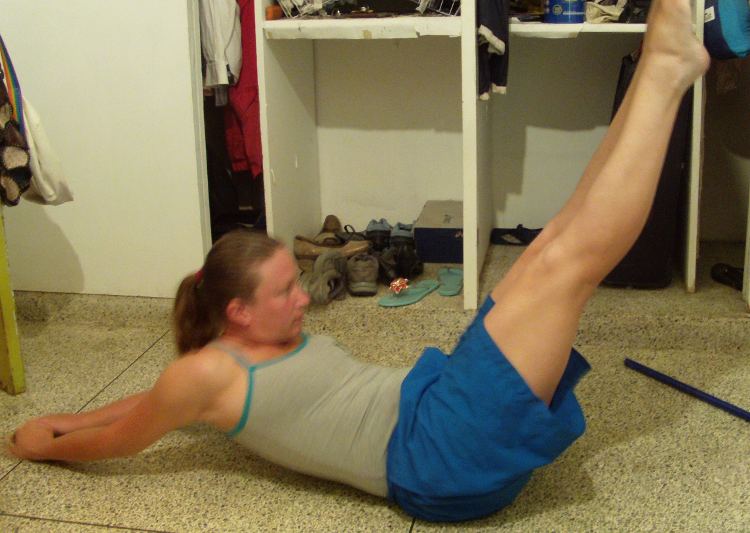
German Hang: We do the stretch frequently but passive (relaxing as deeply into it as possible) (Photo is of our version) The thing is that when I do a hybrid of reverse plank and the stretch, my elbows feel a lot of stretch. When I do a sort of mini-hang by gripping a window ledge and bending my knees my anterior deltoids feel a stretch and the head of the humerus starts moving down/forward in a bad way. I can't figure out how to translate it into a strength exercise either way as any tension i add goes directly to the joint long before any muscle is fully activated. post-50551-13531537379597_thumb.jpg

Kevin Oka
Vincearoo said:
1) Agreed with p5yx, the dead hang should be performed with a chin up grip. You can add in a pull up grip, but that's up to you.
okaxmasato said:

2) When programming, set out to perform 1 minute of work regardless of what strength you are at. Just break it down into sets that you are capable of doing. For example: Deadhang - 10 sets x 6 sec, 6 sets x 10 sec, 3 sets x 20 sec, 2 sets x 30 sec, up to 1 set of 1 minute straight.

I was able to move to the next smaller amount of sets each week, so the example I showed, I finished in 5 weeks. Adjust to your needs.

I hope you worked up to 3x60s sets for the prereqs before you moved on.

4) German Hangs can be made easier by not extending to the ground all the way. In the beginning I was standing on top of 4 books, I slowly got rid of them until I can just hang.

When I do the chin-up grip, my shoulders do not feel anything, and the muscles in my arm feel barely in use. When I do pull-up grip I feel much, much more strain on my forearms, which I find much more useful for beginning Support Hold, and it also crosses over to helping out with wrist pushups, if just a little. Perhaps my shoulders are already sufficiently flexible, but I tested them out before answering the OP's question to provide the most accurate answer I could provide.

And yes, I can do 3 sets of 3 minutes if I wanted to, it's just not worth my time anymore. I just maintain them.

Vincent Stoyas

Sounds good!

It just sounded like you were suggesting to just work up to 1x60s holds and that was it so I was making sure 8) .

Blairbob

The strength exercises you can use for that german hang shoulder extension are basically skin the cats to german and back or just from german to basket spotted, reverse planks/crab walk, and ag walks forward in reverse plank