This forum is archived information and is no longer active.

Daily routines for fixing posture (low back pain, thoracic mobility)

Started by Petra Kmecová, October 28, 2017 · 28 Replies · 1,004 Views

Petra Kmecová

Hi good people, 


Longer post in front of ya, ... this is me figuring stuff out for myself and seeking help from experienced.


So, unfortunately, I’ve been experiencing mild lower back pain for couple of weeks. Mild meaning that it is more of a discomfort than pain. I don’t need any sort of pain killers to function around house, it immediatelly gets better when I move a little, it never hurts while training, but it keeps bothering me.


I noticed it gets worse after long walks or tough day with kids (lots if bending forwards to pick them up, hip hinge is not always possible).


I want to get rid of it, so I went to see a specialist to get diagnosed. Fortunately, my spine is OK - no hernia or similar serious stuff (What a relief :-)). 


What seems to be causing troubles is my body compensating bad posture and unproper loading of spine - anterior pelvic tilt and rounded shoulders. I almost always carry child in one hand and do stuff with the other and that over the course of time caused a lot of imbalances. That my bodycompensates. I also breastfeed sitting in really bad curled position.


I was given couple of recommendations:

1. Most important - Body awareness - switch arms to carry a child, use hip hinge to pick something up, sit tall, etc. ....

2. Strengthen, strengthen, strenghten your core, but also hamstrings and glutes & stretch hip flexors, quads, mobilizing hips in general.

3. Strenghten middle and lower back & stretch pecs. Lots of thoracic mobilizing.


He gave me list of exercises that I can choose from for each group and recommended to do exercises daily with light to moderate intensity to supplement my other training that I do (I explained him all about GST that I do, and I was cleared to continue ... with jefferson curl being the exception - I’ll explain later).


I know almost all the exercises - some of the are part of foundations, some of stretch series, some I was doing in the past. For the last month I was doing those exercises here and there on daily basis - consistently but incoherently.


I realized that I should create myself routine that I would follow to be able to see results. I like things structured, organized ... :-).


So ... I did my homework, bit of research here on forum and put together 2 routines; one for lower body and core, one for upper body. 


What are your thoughts on those?


Brief warm up - From my short history with kettlebell comunity - strong first, I usually warm up with a flow of headnods, rocking, rolling, marching, bird dogs and, crawling - it’s called “The original strength system” or “pressing reset” (they have great ytb channel). For now I dropped all my kb training but that “pressing reset” feels so good to me, so I continue to do it on daily basis as part of my daily limber or warm up. Do you guys know it? Just out of curiousity I would like to hear your opinions... but back to the point.


Lower body/core routine:


2-3 sets of strengthening hamstrings, glutes and core:

- 10r glute bridges

- 30s bent hollow body hold - I currently work on (ehm ... struggle with) bent hollow body rocks, so revisiting those seems like a good idea

- 10r straddle running man

- 30s plank on elbows - I’m still on PE1 - scap shrugs 4*12r + additional set or two; sometimes hitting 15 on first two sets


1 set of stretches:

- 10r swivel hips

- 10r frog rocks

- 60s piriformis (I struggle with that one in my middle split training)

- 60s vertical lunge with bent leg R/L


—

Upper body:


2-3 sets of streghtening:

- 5r hanging scap shrugs

- 10r band pull aparts

- 10r band “Y” raises

- 30s “Swan holds” - something like arch body hold but with lower body on the ground


1 set of stretches:

- 5r cat cow

- 60s elevated cat

- 60s inverted cat

- 60s reach underneath R/L

- 10r dislocates (unweighted)


I’ve seen those cat stretches recommended here on forum a lot, as well as reach underneaths, so I think I give it a try. My thoracic mobility is the worse. I’m nowhere near splits, but at least I can finish front split and middle split series to the end and feel good about them. But thoracic series I “hate”, because I suck at it big time :-). The actual bridge part is undoable to me. I can’t even lift to an elevated bridge and when I help myself with a band or enter it from handstand, I immediately feel discomfort in my lower back. So for now I’m done after shoulder flexion press (that I do from a box :-)).


So what are your opinions guys? Any suggestions?


As for the jefferson curl - physio that I visited knows the exercise and is not against it in principle, but working in a small town like ours, has no experience using it in “rehab”. We talked about it a lot and agreed that I ask here for your opinions whether I should do it now or not. The thing is, I feel slight discomfort doing it - sometimes. I’ve dropped to 2,5 kg load. On way down I only feel discomfort on first rep of first set. Other reps are pain/discomfort free. On way up I do feel slight discomfort everytime I’m moving in lumbar area. It’s hard to explain it, but it’s discomfort that sort of feels good. Like something that haven’t moved for long time is waking up. I’ve never felt any sharp pain, or felt discomfort getting worse after j-curls. But to be honest I’m in doubt.

What do you think?


I’m sorry for such a long post, but I wanted you to know some of my background. I really hope it’s not bothering you and I can discuss some of my concerns with you.


thanks in advance, Petra

Everett Carroll

Hey Petra,

I'm sorry to hear about your back pain and wish you the best in recovery. My advice for your programming is to stick to the GB Course programming as best you can while also following the suggestions of your doctor. If they recommend you leave out Jefferson Curls for now, do it. And since you are experiencing discomfort during them,  I agree with their advice. Never train through pain. Avoid the discomfort and focus on healing your back. The upper body, lower body, and core workouts are already programmed for you, so only make changes to stay in line with your doctor's suggestions and avoid pain or discomfort.

I'm lucky to have a couple of close friends who are amazing physios and the way I prefer to implement their suggestions is as follows: I create a routine comprised completely of their suggestions. I then either do it as a completely separate session on training and active recovery days or as a warm-up for my GST. My GST and "physio" routine are organized separately. They are aware of my GST and the two programs integrate intelligently, but unless I have a specific suggestion from them to avoid certain movements in my GST for rehab, I stick to Coach's programming. Work with your doctor to create a smart routine for you, right now. Programming is, or at least should be, fluid. 

The main point I'd like to get across is that in the case of injury, we can't exactly comment on program manipulation. That must be left to your doctor. Please follow up with your thoughts and questions! :) This is a tough situation and topic for us to help with but we'll do our best. 

Petra Kmecová

Thanks @Everett Carroll for your reply.


“I prefer to implement their suggestions is as follows: I create a routine comprised completely of their suggestions. I then either do it as a completely separate session on training and active recovery days or as a warm-up for my GST. My GST and "physio" routine are organized separately.”


This is exactly what I’m trying to accomplish. To clarify my situation bit further ... I went to see a specialist with mild back pain because I’m causious about my back (having dad and younger (!!!) brother with back issues). I’m from a really small town, everybody knows everybody ... doctor is a long friend of my parents, so we talked more openly ... I’ve explained him all about GST and I’m cleared to do it as it is, which I am (j-curl out for couple of weeks) ... 


MRI came back fine and I was “diagnosed” only with bad posture and bas moving habits, not suited for hospital rehab programs - they are for more serious cases. Nr.1 cure for me should be body awareness - moving right all day long, not just when I train. Just to support that I was recommended to strenghten and stretch certain part of body - mentioned above. I was given something like “leaflets” ... clues on what to do when you have apt, upper cross syndrome ... “chose 1-2 exercises from each group and dedicate them 10-15 min a day on top of your training”. 


So ... in general, I don’t really need special rehab routine ... body awareness and sticking to gst would do the trick by themselves ... but I want to do those supporting exercises and want create routine out of them myself to have it organised, easy to follow. So I thought ... If I’m to chose exercises from those leaflets, why not pick those that are the same or similar to the ones I know from GST ...


For example ... for atp I shall strenghten my hamstrings / glutes and abs ... so I chose: 

Glute bridges (that I think will prepare me for PE9 im - hamstring curl ... i’m currently one progression below)

Straddle running man (I’m closing on PE1 in sPL)

Bent hollow body holds (I’m on fl/pe2 and revisiting those in my daily routine seems like a good ideal) .... and so on ....


This way I can benefit from those routines not only in correcting my posture, but also in my GST ... 


My main question for you with experiences was ... if those routine are ok from that point of view - helping me to correct posture and support my GST...


Oh, sometimes it’s so complicated to write things down the way you mean them .... in a foreign language :-)


Everett Carroll
20 hours ago, Petra Kmecová said:

My main question for you with experiences was ... if those routine are ok from that point of view - helping me to correct posture and support my GST...

The upper body section had some drills I'm not familiar with but everything else looks good to me. I do suggest you run the drills/routines past your doc and get his opinion as well.

Also be sure you keep sending in regular form checks and don't be afraid to make changes to these routines. Like I said earlier, my routine is always changing. Just like the course progressions, once something is mastered or if I'm not seeing improvement, a change is made. 

Petra Kmecová

Thanks @Everett Carroll. I’ll keep your tips in mind. 

It’s been almost a week since I’m trying to follow those routines and I found out, that on evenings after my upper body session I don’t feel like doing that strength part of upper body routine... stretches feel good though.... I won’t push it ...

so, I’m still in the phase of putting it all together ... finding the right dose for my body :-)

Everett Carroll

Perfect. Keep this thread going with updates :) 

Petra Kmecová

Hi everybody, 

checking in back after three weeks, mostly lower back pain free ... :-). I’ve been doing stretches every evening and specific strengthening exercises in warm ups or after my workouts. Lower back feels goooood!!!

What I’ve been thinking about (struggling with) lately is my execusion of manna progressions ... I’ve got this suspision that my flawed technique might have contributed to my lower back pain. 

I’m on pe2 and I was formchecked OK by @Leo Trinidadand @Jeffrey Bittner, but I have several question about the exercise concerning my lower back and posture overall.

So, after submitting my first pe2 formcheck, I was pointed out by @Guido Franchetti, that I wasn’t engaging my core properly. This instantly made sense to me and I started to execute straddle ups differently - engaging my core first and than straddle the legs. This correction felt immediately better for my lower back and since I started to do it lower back pain did not return.

Here is the video - first 3 reps are with corrected technique, another 3 reps with original technique.

This all got me thinking about how the proper core engagement should look like. I rewatched instructional videos for straddle ups and for tuck ups. On both, claire is lying completely flat on the floor - lower back touching the floor and the movement itself is smooth. 

Right now, I cannot lay relaxed on the floor with lower back touching the ground (picture 1). If I squeeze and engage my core, but try not to lift my torso and legs, I can get it lower, but not flat (picture 2). To get it flat on the floor, I have to lift my torso and legs (picture 4). 

07AE21A0-5DE1-4EA6-8FAE-CEA2C250CF42.thumb.jpeg.9b3f18ef3472ab853a3c6fe9f2ffca3a.jpeg

So finally - questions I would like answered are:

1. Should proper core engagement - starting position from which I start to straddle - be with legs, lower back and upper back touching the floor?

2. If so (because I’m pretty sure it should :-)), how to achieve it. My quess is, that the reason I cannot is lack of overhead mobility and hip flexor tightness. Or is it something else that needs to be adressed?

3. After considering all written above, I doubt whether I really mastered pe1. Here is video of one mastery set, done after my todays core session. More or less it represent form I considered mastered.

4. What should I do next with manna progressions? Revisit pe1 or continue pe2?

5. And finally, whatever progression I end up doing ... should I keep on engaging my core the way I do now (lifting legs & totso), until it gets better?


Thanks a lot in advance good people ;-)

Suzanna McGee

@Petra Kmecová, I was not able to fully press my lower back on the ground in the beginning. As I grew stronger, it became no big deal. Now even with the arms over the head, I can control the abs and push them down. I think focusing strongly on the PPT will help. I was trying (and actually still do) to engage my lower abs (and ppt) any time I was standing around, or doing things… just to develop the awareness… in your last video (PE1) my lower back is hurting just watching it :-)  I would for sure remaster it with a stronger abs engagement, I think you will find it pleasant and much easier than when you used to do it before. 

Guido Franchetti

Hi Petra,

for 1 the answer is yes, I'll leave 3-5 to more experienced people, but maybe I can give some suggestions for 2. Given your performance, I would imagine that is more lack of awareness/activation of the proper muscles rather than lack of strength which is preventing you from achieving a flat back on the ground.

As Suzanna said, it is mostly a matter of properly achieving PPT. When I do it, I mostly engage abs and glutei. To get a feeling for the proper position and action, the easiest is probably to stand with your back against a wall, feet slightly away from the wall and knee a bit bent. Start with shoulders, upper back and bottom in contact with the wall and flatten your lower back against the wall. You can then do the same exercise lying supine. If you are unable to do it with straight legs, bending your knee will make it easier. Hold it for time and/or perform reps! If you have the handstand course other exercises for PPT are described in the iMs of PE9 - SE4.

I think the static holds of the FL series (e.g. PE1, PE3) would also help as you need PPT and back flat on the ground for proper execution.

Petra Kmecová

Thanks @Suzanna McGee and @Guido Franchetti.. looks like it all comes down to PPT :-) ... starting to love’&’hate that word :-D

I’ll check those exercises in handstand series. I restarted handstand lately, because I flew through first headstand progressions and then got stuck on guess what ... :-D ... PE4, unable to push my lower back to the ground, thinking ... this is BS :-).

All in all ... after long years of general “working out” I’m finally learning what body should move like and the truth gets harder and harder ;-).

Petra Kmecová

One lesson learned for sure ... I’m never ever working on an exercise without regular formcheck and guidance .... and questioning every stupid thought I have ... :-D.

Leo Trinidad

Hi @Petra Kmecová, I did the same thing you are doing now. I was progressing and each time I went back, a lot of refinement and improvement has been made. Refining and getting better at the movement takes time. Just be patient with it. ;)

Petra Kmecová

Thanks @Leo Trinidad. I’m returning to pe1 then and I definitely submit formcheck right after friday’s session.

Could you please answer my 5th question? Coz right now, I’m confused and don’t really know what should I focus on.

thanks :-)

Leo Trinidad

Hi @Petra Kmecová,

My apologies for not answering that. Yes you need to engage everything until it gets better. Always do it with your current best form and range of motion.

Petra Kmecová

Thanks @Leo Trinidad. I really appreciate your help!

Petra Dvorak

I made exactly the same experience like you; in the "old" system you had to do level check before starting, so that the system could give you the apropriate level/step. Although i knew that i have a spondylolisthesis and therefore was worried about manna-progressions, i tried to give my best at the testing and bamm- low back pain hellooo!
After all soreness was gone, i started on step 1 (3x3reps) with very careful execution, posterior pelvic tilt by engaging abs intentionally before every rep.
It took me almost a year to get through tuck and straddle ups... but no more pain after core day!

Due to a long rehabilitaion of shoulder i returned to pe1 this summer, and this time even tried to maintain the tension of ppt between the reps, which makes it a bit harder ;-) like Leo says there's always something to work on.

So my answer to your question nr 4 is to return to pe1 on a step that you can do with good form, you'll get mastery soon again!

Good work and great analyse of body mechanics!


Petra Kmecová

Thanks @Petra Dvorak. I hope I’ll have the same positive experience! 

As much as I hate doing steps backwards (so frustrating after small steps forwards) ... this decision feels like good thing to do for my back, so I’m in for it! ... one primarily positive thing - I really enjoy iM of PE1 ... looking forward to that one :-)

Petra Kmecová

One more question @Leo Trinidad ... hope I may :-)

@Guido Franchetti mentioned above drills for PPT from handstand series. Would it be beneficial for me to add them into my daily routine? Thinking of starting with the first PE9im and so on ... I think it would, but I’m no longer in the bussiness of adding exercises above my current progressions (been there :-(, learned from my mistakes). So, what do you think about it?

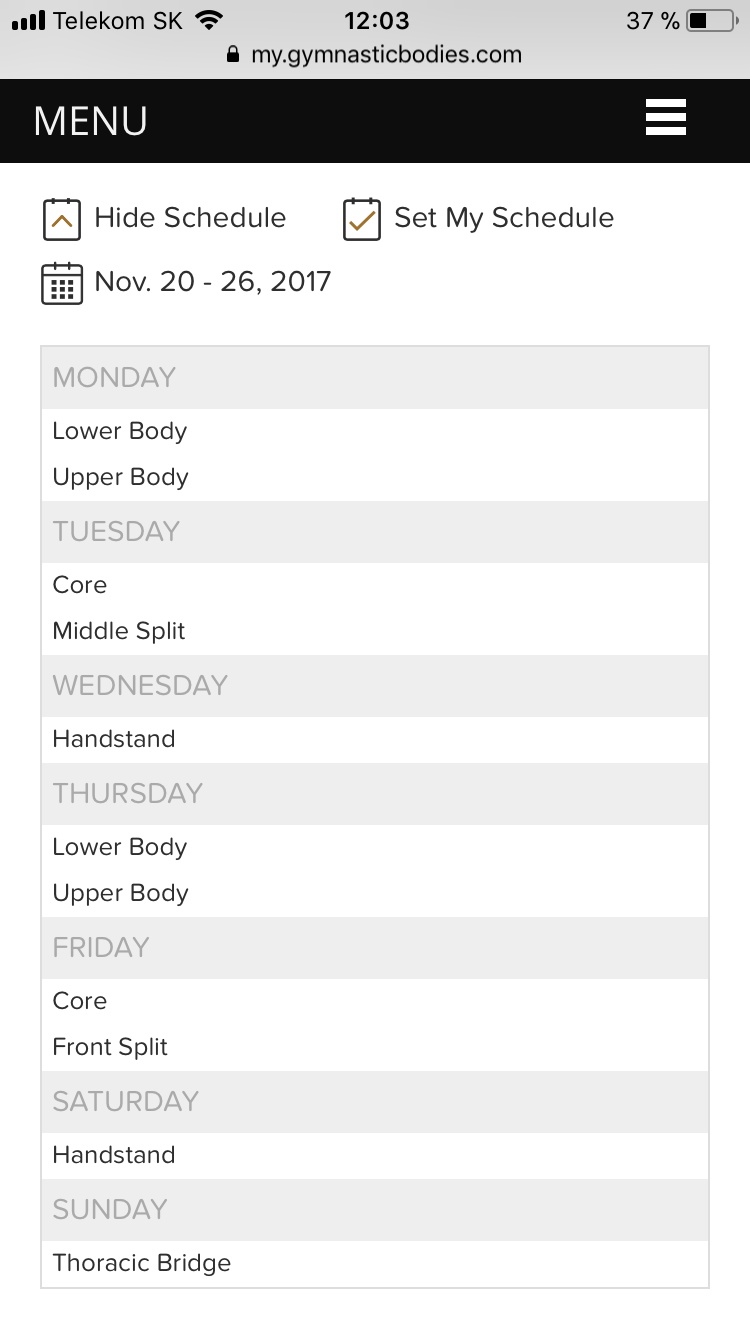
Just for better picture of my current schedule, I do: 

BF94FFB8-D0E9-43EC-845F-BADD0E2E1D5F.thumb.png.4881bd560a835b4288391606e73342e1.png

Might change days I do stretches here and there, but other than that - 100% consistent.

And on daily basis:

Brief warm up and then ...

1D7826A9-F3C4-4A17-B776-6EB312C6A3C9.thumb.png.bbf254c6b566d302eafad514b0a6b9d7.png

In my warmups I do 2-3 sets of band pull aparts and glute bridges (advised by my doctor for fixing posture) and previously mastered PEs before current PE. No other additional workout or strengthethening exercises.

Thanks in advance. ;-)

Leo Trinidad

Hi @Petra Kmecová,

Yes you can add them as long as you are able to finish your main workout/program. The problem is when people add too much and not finish their workout. (i am guilty of this too)

Petra Kmecová

Thanks @Leo Trinidad!! I’ll try them this evening and I’d rather post a formcheck ;-)

Petra Kmecová

Hello GB friends,

This is “I’m soo happy” sort of post :-))) ... hehe ... but seriously, I want to check in with some progress I made on my core activation and lower back pain I had because of flawed technique on tuck ups.

Since I started to pay attention to this, I feel no back pain what so ever. Using those PPT drills from HS1 almost daily I managed to engage my core lying on the floor with my arms outstretched so my lower back is touching the floor ... and with the slight lift of the torso the engagement feels even stronger ... 

I would say:

1. First picture - lower back flat on the ground

2. Second picture - lower back touching the ground

616B942B-04A9-40B0-9106-59126DF919F5.thumb.jpeg.c12e7c652a7344b82139f81b86e878c0.jpeg

Still a way to go, ... but tuck ups and almost all other exercises feel so so much better now :-))).

No question from me this time, just wanted to share my experience :-).

Have a nice day everybody

Étienne Lajeunesse

@Petra Kmecová

Nice way to go! Your shoulders are so much more open too :)

Petra Kmecová

Aaah, that would be thanks to almost daily elevated and inverted cat :-)

Guido Franchetti

Well done Petra!!

Sarah Gordon

@Petra Kmecová Great thread. Thanks for sharing as this is a great learning opportunity for me. And good to see your progress after doing the work......