This forum is archived information and is no longer active.

Xtra Morning Routine: Cardio or High Intensity?

Started by Ryan Bailey, December 14, 2015 · 28 Replies · 948 Views

Ryan Bailey

Hello,

I am looking for some advice. I have been trying different, extra morning sessions, ~20-30 minutes, to lean a bit for Foundation performance. (Maybe loose 4-5kg in a few months, nothing major).

I am wondering if people recommemd cardio (Jogging, bike, ect) or higher intesity, shorter durations skills, jump rope (or circuits) that will benefit the foundation elements. I see incredible videos out there of morning workout sessions but am struggling as a beginner to choose which route to go.

I have slowly built the capacity to be accustomed to this current schedule: (in the afternoons)

Monday: F7

Tuesday: HS,pHS, Stretch

Wednesday: F7

Thursday: HS, pHS Stretch

Friday: F7

Saturday: Tumbling 1 Stretch

Any tips on supplemental exercise plans in the morning for improved Foundation performance, or weight loss ?

Thanks,

Ryan

Daniel Taylor-Shaut

If you're a beginner and doing F7, my suggestion is to do it with fewer rests or to ramp up the tempo a bit. Doing it that way turns the workout into a bit more a cardio routine and will likely gas you a bit more. That was the case for me when I tried F7 and it whooped me.

Also, intermittent fasting has worked for me. Basically, on lighter exercise days eat lower carbs and more fats and protein. I don't count calories when I do this I just eyeball it and use my plate as a piechart, but simply put you go 12-15 hours without eating (8 of them being when you're asleep, dinner to the next day's lunch principally, so often if I workout in the AM, I do so fasted). It ends up making me ravenous after working out this way and I then eat a larger amount of carbs after working out and on days when I work out. You can go here to know more: http://www.nerdfitness.com/blog/2013/08/06/a-beginners-guide-to-intermittent-fasting/ 

These approaches have worked for me and I've gotten pretty lean as a result.  Another option are tabata protocols, I don't do them, but they can ramp up the metabolism burn post-workout (read: EPOC), but again if you're doing F7 at a pace with little rest I don't see the need for this. 

Ravn

If you're not training for anything specific cardio-wise, but just looking for fat loss and general well-being, just mix it up a bit. Do a jump rope session, a run, hill Sprints, whatever, and just have fun.

ausswe

if you live near a beach go play in the waves.  that'll fry you if the waves are big enough :D

Daniel Taylor-Shaut
ausswe said:

if you live near a beach go play in the waves.  that'll fry you if the waves are big enough :D

It will also relax any muscle tension via the hydrotherapy -- best of both worlds.

Ryan Bailey
ausswe said:

if you live near a beach go play in the waves.  that'll fry you if the waves are big enough :D

I used to in San Diego; a long surf session is great!

Now, living in Wisconsin, I see the lake waves may soon freeze over ;-)

Daniel Taylor-Shaut
Ryan Bailey said:

I used to in San Diego; a long surf session is great!

Now, living in Wisconsin, I see the lake waves may soon freeze over ;-)

Hit up that Wim Hof method -- get your ice bath on. 

-MR

It looks like you've got a full week of GST and may risk overtraining by adding more high intensity work.

Coach himself had recommended 2-3 days of light running similar to what he said the Chinese national team does. 


I added Maffetone style running and cycling workouts to my week and have increased my aerobic performance without ever feeling fried afterwards. You should look into it.


Although I initially hated it due to the embarrassingly slow pace I had to start at to keep my heart rate in the proper range, I've made some pretty rapid improvements and now really enjoy my runs while feeling like I can go right out again when I'm done.


Here's a decent link describing Maffetone's philosophy: http://philmaffetone.com/want-speed-slow-down/

Leonhard Krahé

If you choose to do IF, you could think about so called MAT (metabolic activation training) right after getting up in the morning. That's basically a Tabata workout (8*(20s work + 10s rest)) which you do fasted to supposedly give your metabolism some extra-boost. They recommended burpees but basically you can do whatever you like for that as long as it gets your heartrate up. It sucks, but for me, it seemed to work. And it really doesn't take much time.

It was part of a BB style "lose fat, gain muscle" training and nutrition plan I was following a while ago which helped me to initilally shed some pounds while simultaneously put on a bit of muscle (later on, it ended crushing me, but that was entirely my fault and I don't blame it on the program, even though I wouldn't follow something like that again).

MT Nordic

You don't have endurance work in your current schedule.  I'm partial to easy work in the morning, as it's hard for me to go hard right when I wake up.  I also agree with concerns about overtraining if you add high intensity work in the morning to your already neurologically challenging workouts in the afternoon.  An easy 30-45 min low heart rate run/etc in the am would perk you up, improve your aerobic base, and not stress your body too much.  Of course it depends on your goals. You mention weight loss, and that is really going to come more from your diet, as you're already exercising an appropriate amount.  HIT many be mildly better than slower endurance running for weight loss, but the absolute values are fairly minimal; but most research is suggesting that exercise alone is not going to result in much weight loss past a certain minimal amount.  It will improve how you look, feel, and perform, however :)

dritar

Jump rope is awesome. Personally I think it's the most GST'ey of cardio workouts. 

Adriano

I always wondered do gymnasts skip rope barefooted?

Jon Douglas
Adriano said:

I always wondered do gymnasts skip rope barefooted?


Ouch :S but probably yeah, as a convenience thing. Personally in my gym shoes are required, although I can get away with very light/minimalist footwear.

MT Nordic

I do barefooted, but damn it does hurt sometimes when you miss!

Daniel Taylor-Shaut

You guys jump rope barefoot?! That is ballsy. I wear some vibrams but maybe I'll give that a try (though I think that jumping rope as my warmup first thing in my workout, which is first thing in the morning, will likely lead to the inevitable)

MT Nordic

Just too lazy to want to put on shoes when i'm already barefoot for all my other stuff :)  A little suffering builds character anyway...

Ryan Bailey
-MR said:

It looks like you've got a full week of GST and may risk overtraining by adding more high intensity work.

Coach himself had recommended 2-3 days of light running similar to what he said the Chinese national team does. 


I added Maffetone style running and cycling workouts to my week and have increased my aerobic performance without ever feeling fried afterwards. You should look into it.


Although I initially hated it due to the embarrassingly slow pace I had to start at to keep my heart rate in the proper range, I've made some pretty rapid improvements and now really enjoy my runs while feeling like I can go right out again when I'm done.


Here's a decent link describing Maffetone's philosophy: http://philmaffetone.com/want-speed-slow-down/


Do you guys ever use heart rate monitors?  This was an interesting read at the link above.  Made me bust out the heart rate monitor during the workout today just to see:

F7  (5 of the 7 elements are in week 11)

Time: 43 min 44 sec.

Average HR: 139 bpm  (~76% of Max Heart Rate Intensity)

What really sucked was cardiac demand and the intensity of the final three elements, which were SLS, HBP, RC.  The heart rate jumped consistently between 158 and 168 making the last reps challenging (86%-92% mhr).   I wonder if this is why Coach has the schedule written out this way... with these elements at the end?


Looking at these numbers, I can appreciate the advice given so far regarding maybe a lower intensity aerobic activity earlier in the morning as a starting point. 

Although the barefoot wire jump roping sounds intense.

-MR

I don't use a HR monitor when I'm doing GST as I wouldn't change the intensity of the session based on my heart rate. I do use it for running, cycling, and (soon enough) x-country skiing to keep an eye on the intensity though, as I have a tendency to go hard from years of endurance racing when I was younger. 


In the spirit of full disclosure, Maffetone is a bit of a controversial figure in the running world and most of his recommendations come from his coaching experience rather than from peer reviewed research.


I also don't know what the effects of this type of training are on fat loss. For what it's worth though, while reading a review on HIIT and fat loss written by HIIT researchers, I couldn't help but notice that the protocols that included some steady state training in addition to HITT seemed cause more fat loss and increase VO2Max to a greater extent than those involving HIIT or sprinting alone. 


Here's a link to the paper: http://www.ncbi.nlm.nih.gov/pmc/articles/PMC2991639/#B8

Look at table 1, the Boudou and Mourier studies are the ones that used a combination of 2 weekly steady state sessions (75% of VO2Max x 45 min twice per week) and one of HIIT (5 x 2 min at 85% VO2Max with 3 min active rest at 50% VO2Max). I haven't taken the time to compare the groups in every study, so take these results with a grain of salt. 


If you're looking for fat loss without too much intensity, this type of protocol may be something to look into (and I think may be similar to what Maffetone recommends once you've built your aerobic base). 

Ryan Bailey
-MR said:

I don't use a HR monitor when I'm doing GST as I wouldn't change the intensity of the session based on my heart rate. I do use it for running, cycling, and (soon enough) x-country skiing to keep an eye on the intensity though, as I have a tendency to go hard from years of endurance racing when I was younger. 


In the spirit of full disclosure, Maffetone is a bit of a controversial figure in the running world and most of his recommendations come from his coaching experience rather than from peer reviewed research.


I also don't know what the effects of this type of training are on fat loss. For what it's worth though, while reading a review on HIIT and fat loss written by HIIT researchers, I couldn't help but notice that the protocols that included some steady state training in addition to HITT seemed cause more fat loss and increase VO2Max to a greater extent than those involving HIIT or sprinting alone. 


Here's a link to the paper: http://www.ncbi.nlm.nih.gov/pmc/articles/PMC2991639/#B8

Look at table 1, the Boudou and Mourier studies are the ones that used a combination of 2 weekly steady state sessions (75% of VO2Max x 45 min twice per week) and one of HIIT (5 x 2 min at 85% VO2Max with 3 min active rest at 50% VO2Max). I haven't taken the time to compare the groups in every study, so take these results with a grain of salt. 


If you're looking for fat loss without too much intensity, this type of protocol may be something to look into (and I think may be similar to what Maffetone recommends once you've built your aerobic base). 

Interesting results in these studies; nice gains in insulin sensitivity in the diabetic men study as well as the increase in VO2max.

When looking at the duration of High Intensity Exercise used in the various studies, it appears the Foundation 1 program already has this covered.  Not sure I'd want to add more High Intense training on top of foundations, after reviewing all this literature. 

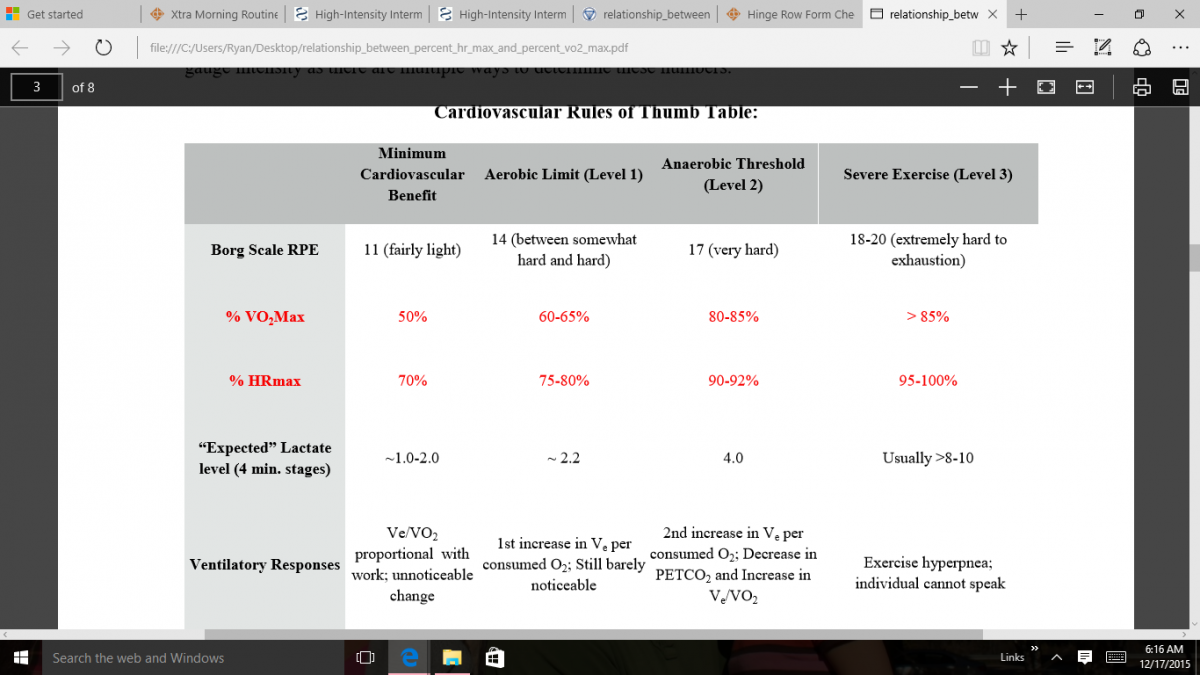
Considering the very rough estimates of %mhr (~80%-90%), 15 up to 17/20 Borg RPE found during the latter half of the F7 workout and how it may have a rough correlation to increased %maxVO2.

post-16980-0-69175400-1450354721_thumb.p


Although in these studies, it appears there may actually be a "rest" time... rather than Foundation program that is not as gentle;  integrated mobilities as the "rest" throughout the whole workout :).​


(*Note taken in the literature on the addition of SSE, 45 minute, 2x/week however*)

Correlates to what I have heard regarding GST and Foundation training.

Daniel Taylor-Shaut

So, in layman's terms, keep doing F7 and keep at it intensely and your cardio will be handled? I don't have anything beyond a basic cursory knowledge of exercise science, lol.

Ryan Bailey
Daniel Taylor-Shaut said:

So, in layman's terms, keep doing F7 and keep at it intensely and your cardio will be handled? I don't have anything beyond a basic cursory knowledge of exercise science, lol.

Sort of... the lower base aerobic intensities that have been discussed, say a mild jog/run twice per weeks is different than the cardiac demands of Foundation Training. This may do some good, when ready (such as not adding increased stress or taxing the recovery process), for the beginner athlete in all this; if building a lower aerobic base, mitochondrial density, and capillarization is an additional goal of the first 1-2 years of the GymnasticBodies program, prior to reaching higher levels of athleticism.

Ryan Bailey

Took some of the advise today and went on a low heart rate run.

Made it a self assessment using the maximum aerobic function (MAF) 5 mile test.  http://philmaffetone.com/want-speed-slow-down/

Very surprising having to keep such a slow pace to keep the heart rate down at the recommended level on this test.

Distance  Time (min:sec)

Mile 1: 11:30

Mile 2: 12:20

Mile 3: 12:40

Mile 4: 12:45

Mile 5: 12:46

Total time: 62:31

Average total heart rate: 137 bpm (also happened to be the maximum aerobic heart rate recommended under the 180 Formula)

Pathetically slow, not sure this looks too good for my current state of aerobic conditioning.  And yes, this pace felt almost the same as an old lady power walking at times  :)

DBeckerman

I can completely sympathise as I went through a stage of HR monitoring whilst running and keeping in that aerobic range. Damn I had to run slow

Ryan Bailey
DBeckerman said:

I can completely sympathise as I went through a stage of HR monitoring whilst running and keeping in that aerobic range. Damn I had to run slow


Curious: Does a series of lighter, low heart rate (or aerobic range) runs over a long period of time really help in building an aerobic base?  I don't want the grandma and her walker to pass me.

In the past I've trained for soccer, basketball, outrigger canoe 1-2 hour race events with higher intensity aerobic/anaerobic practices and training, so not used to this slow approach.

Daniel Taylor-Shaut

Anecdotally speaking Mark Allan, (the elite Ironman competitor and champion from the late 80s and early 1990s, who also happens to be a family friend to some degree) swears by this technique. He said it helped him over time to bring his heart down and eventually build up aerobic capacity and running pace. After a certain while, aerobic capacity and pace met at a crossroads (so, essentially his pace increased while his HR remained the same), he said it can take a few weeks or months of consistent training, but that once his pace was to a good clip (5-6, maybe 7, minutes a mile) he started working in speed or sprint days that weren't specifically HR-focused. Now, maybe that's not a good enough example, though he did win 7 Ironmen competitions, so, do with that what you will. So, if that's your focus I say stay with this for a few weeks wherein you do it a few days a week and your capacity should catch up, the F7 work will likely help get your HR in gear, too.


I played with this technique earlier in the fall and some progress with it, too, but I found my calves too sore (since I was also jumping rope and doing FSs) and preferred to just focus on work capacity and strength, since I don't care much for running long distances.