This forum is archived information and is no longer active.

Psoas (hip flexor) release

Started by Mark Collins, September 3, 2015 · 73 Replies · 4,895 Views

Alessandro Pantanella
1 hour ago, Ryan Van Fleet said:

Nice. I've done a similar stretch in yoga. They really don't do that stretch enough. 

I've also done myofascial release with a lacrosse ball and a kettlebell like this. Seemed to help a lot.


Your facial expression says it all ;)

It seems extremely pleasant...

Mark Collins

The lacrosse ball and kettlebell can be good, but also dangerous. Sometime people put the ball on an internal organ or the aorta. There has been cases of people getting damaged bowells from releasing the wrong bit.

Alessandro Pantanella
22 minutes ago, Mark Collins said:

The lacrosse ball and kettlebell can be good, but also dangerous. Sometime people put the ball on an internal organ or the aorta. There has been cases of people getting damaged bowells from releasing the wrong bit.

How do you know if you're releasing the muscles or are instead doing some damage?

I sometimes use a med ball or any other mid size balls I can find and lean on it. It's great but of course doesn't go as deep as the lacrosse ball.

Suzanna McGee
On September 5, 2016 at 2:58 PM, Mark Collins said:

I do find that one side is worse, but generally both are tight due to our sitting culture. I am not sure why one side is worse. It could be that our body is not symetrical and it is a normal variation.

@Mark Collins I think it's because everything we do in life is slightly asymmetrical. Even driving a car (manual or automatic transmission), the right leg is doing more stuff, the left one just hangs, often externally rotated… Imagine those hours people spend driving. Same with our arms, using the computer mouse, phones, kitchenware, tools, etc with mostly your dominant arm. When we sit or stand, we often have a preferred uneven position with unevenly distributed weight over the feet. These little things compound over time into big problems and large left-to-right differences… I am a tennis player (and performance coach for tennis players) and I see this at quite horrible levels in the aging tennis players. They are so out of balance (left and right, and even front and back), that they get injured all the time. The older they are, the worse it gets (more accumulated imbalances). 

Daniel Lehnberg

Thanks for sharing this @Mark Collins, fascinated by the thread.

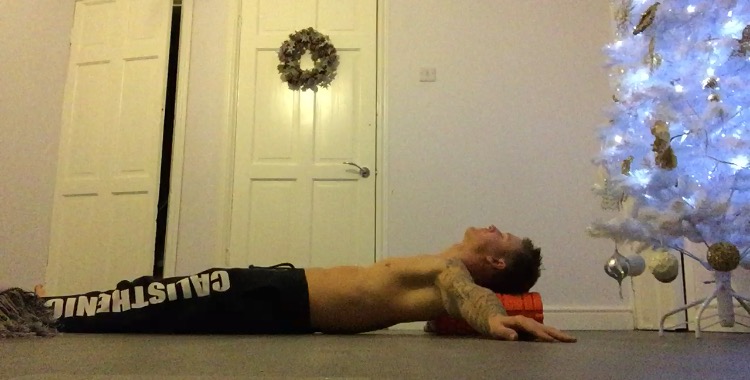
I was struggling a bit with understanding how to do the release properly, so thought I would give it a go, see below. I try a couple of different positions, but not sure how to position the stretch block (is it even ok to use a stretch block here?) in relation to the scapulas, how far up/down etc. 

Any feedback/pointers would be appreciated. Thanks! :)


Mark Collins

As you are tight you need a higher pillow. You are really tight and need more time in this position. You will find as you get further along into Foundation and stretch you body will be restored back to optimal mobility. The first stage is awareness, now you just need to keep disciplined and week in week out do what needs to be done.

Mark Collins
23 hours ago, Alessandro Pantanella said:

How do you know if you're releasing the muscles or are instead doing some damage?

I sometimes use a med ball or any other mid size balls I can find and lean on it. It's great but of course doesn't go as deep as the lacrosse ball.

If you feel nausea or a sick feeling you are not releasing the muscle.

Max Wallach
58 minutes ago, Mark Collins said:

As you are tight you need a higher pillow. You are really tight and need more time in this position. You will find as you get further along into Foundation and stretch you body will be restored back to optimal mobility. The first stage is awareness, now you just need to keep disciplined and week in week out do what needs to be done.

Hey @Mark Collins,

Is the priority to first set hamstrings on the floor and then to use whatever size block, pillow, foam roller to prop yourself up so the hamstrings don't come off the floor?  Are we supposed to be in ATP?

Thanks,
Max

Mark Collins

As long as both the lower back and the hamstrings are approaching and eventually get to the floor it does not really matter. 

The pelvis will be in slight PPT. 

Martin Jones

I think I'm being dense but you could please clarify. In your photos @Mark Collins is the first one when you got into the release position (relaxed) and the second after a period of time and your psoas relaxed naturally or are you engaging your quads, glutes, abs etc to show an optimal end goal?

Mark Collins

The first position shows a non optimal position due to overactivity. The second position is fully relaxed and ideal. If you need to tense something to get in the correct position then you have too much muscle tension at rest. 

Martin Jones

Okay, so if I understand correctly, your starting position will be somewhere in between the two photos depending on your individual tightness. Ideally, after your 30 minutes plus, you should aim to achieve the second picture without any tension in the body to 'cheat'. If the second picture is not achievable it is because of muscular tightness in your body and associated stretches and mobility work is required.

p.s. Thanks!

Mark Collins

That's correct.

Leigh Kettle

Hi mark love this post and your advice I'm learning things with you guys I never dreamed of so thank you. This is the first time I've done this release are you able to tell me if I'm doing it correctly and anything else you can point me in the right direction of in terms of my positioning/things you can see from pic etc . 

Many thanks in advance Mark image.jpeg

Mark Collins

Place a pillow under the head so the neck is not hyperextended. Rest the hands by the side. When you place the hands out to yhe side try having the palms up and thumbs touching the floor. This will give the pecs a good stretch whilst you are releasing the psoas.

Leigh Kettle

Thank you Mark and thank you for the tips 

I actually started with hands by my side but I was concerned you wouldn't be able to see my positioning so I raised them to where they are in the pic.

from this pic are you able to give me any feedback on what you can see in terms of tightness etc and how it looks to you, areas I need to address from the outset etc 

once again many thanks 

Leigh 

Mark Collins

The mid thoracic spine is extended and not flexing. You should see a nice convex curve from the lumbar to the thoracic spine. However you have a flat spot in the thoracic spine.

I recommend doing more cat cow stretches focusing on flexing the thoracic spine. The inverted thoracic flexion stretch in the thoracic bridge series will work well also.

Leigh Kettle
2 hours ago, Mark Collins said:

The mid thoracic spine is extended and not flexing. You should see a nice convex curve from the lumbar to the thoracic spine. However you have a flat spot in the thoracic spine.

I recommend doing more cat cow stretches focusing on flexing the thoracic spine. The inverted thoracic flexion stretch in the thoracic bridge series will work well also.

Thank you once again Mark. Appreciate your feedback 

i have the middle split series and the thoracic bridge is my Christmas present :-) so I'm looking forward to starting that asap.

kind regards 

Thomas Nordman

Great post Mark!

Like most people sitting around in the office all day, my hip flexors (among other things) are tight. The last 6 months I've been stretching the area daily and this has made a huge difference (naturally). The easiest way for me to measure the progress has been by using the standard assessment where you lay down flat on your back on the floor, then with your hands pull one knee against the chest (which presses the lower back to the floor), to see how much the other extended leg elevates from the floor. And ideally that leg should not move at all.

You mentioned that there is a difference between stretching and releasing and I understand (at least I think I do) how they differ. Stretching increases the ROM (ROM measured when muscles are relaxed). Releasing makes the overactive/contracted muscle to relax and thus use that ROM fully. Correct?

But how can you tell if a muscle is overactive (need release) or if it just tight with limited ROM (need stretch)? I'm definitely going to add the releasing you recommend to my daily routine but how will I know if my focus should be on stretching or releasing?    

Thanks


Ronnicky Roy
On 12/31/2016 at 7:09 AM, Thomas Nordman said:

Great post Mark!

Like most people sitting around in the office all day, my hip flexors (among other things) are tight. The last 6 months I've been stretching the area daily and this has made a huge difference (naturally). The easiest way for me to measure the progress has been by using the standard assessment where you lay down flat on your back on the floor, then with your hands pull one knee against the chest (which presses the lower back to the floor), to see how much the other extended leg elevates from the floor. And ideally that leg should not move at all.

You mentioned that there is a difference between stretching and releasing and I understand (at least I think I do) how they differ. Stretching increases the ROM (ROM measured when muscles are relaxed). Releasing makes the overactive/contracted muscle to relax and thus use that ROM fully. Correct?

But how can you tell if a muscle is overactive (need release) or if it just tight with limited ROM (need stretch)? I'm definitely going to add the releasing you recommend to my daily routine but how will I know if my focus should be on stretching or releasing?    

Thanks


Overactive muscles will flex when they're not needed or take over a movement that another muscle should be the primary mover. For example feeling your neck muscles firing during ab exercise, when their only job is holding up your head. They need to be released, rather than stretched. 

Thomas Nordman
23 hours ago, Ronnicky Roy said:

Overactive muscles will flex when they're not needed or take over a movement that another muscle should be the primary mover. For example feeling your neck muscles firing during ab exercise, when their only job is holding up your head. They need to be released, rather than stretched. 

Yes I guess in some cases it is obvious. But if a muscle is constantly overactive it is harder to tell since it's become the normal state so to say. You're not really aware that the muscle is activated. In my case I'm not sure how to tell if my psoas is overactive or just tight (or both).

Ronnicky Roy
On 1/3/2017 at 6:00 AM, Thomas Nordman said:

Yes I guess in some cases it is obvious. But if a muscle is constantly overactive it is harder to tell since it's become the normal state so to say. You're not really aware that the muscle is activated. In my case I'm not sure how to tell if my psoas is overactive or just tight (or both).

Been there lol. Your best bet is focusing on stretching first and later in the day or the following day you'll get more of a feel for what you need most. The psoas is more a special case tho, because it directly effects your hip mobility and posture. Once you stretch them out you'll feel when they should be released almost immediately. Like after long bouts of sitting.

Thomas Nordman

That's good advice Ronnicky. Thanks. I'll continue stretching and mix it up with the suggested release. I need to open my thoracic region anyway. :)

Mike Brennison

@Mark Collins , on the presumption my psoas is stupid tight, after doing this for 30 minutes and low back still is not touching the floor, would you say it'll take days to make any noticeable progress or that I might be doing this wrong or it's a different problem altogether? 

Thanks!