This forum is archived information and is no longer active.

Head Position

Started by Washienko, May 29, 2015 · 8 Replies · 298 Views

Washienko

I am sure this has been answered a million times but I can't seem to find it.  Sorry if this is a repost.


Can someone please talk in a little bit more detail about the proper head position in a handstand?  I can't quite see where Allen is looking in the videos, although he does appear to be looking slightly down.  I find that keeping my chin tucked makes my line tighter and the balance easier.  Is that ok?


Just looking for someone to hold my hand a little with this detail.


Best

Michael

Washienko

Thank you, but that is for a tripod headstand.  I am asking about just a normal handstand

Coach Sommer

Think of pulling the neck into your chest, keep the ears in between the arms and looking at your thumbs thru your eyebrows using your peripheral vision.  If you can see your thumbs clearly; your chin is too high.


Yours in Fitness,

Coach Sommer

Washienko

Thank you!

Mats Trane
Coach Sommer said:

Think of pulling the neck into your chest, keep the ears in between the arms and looking at your thumbs thru your eyebrows using your peripheral vision.  If you can see your thumbs clearly; your chin is too high.


Yours in Fitness,

Coach Sommer

This was/is one of the best tips I got from Coach at a Seminar a few years ago! Really improved my HS instantly!

thecolin

At a recent handstand workshop with Yuval, he stressed over and over that we keep looking at our hands when starting to learn the handstand. This helps you align your body over your hands in a consistent position and maintain a correct line. Without it, if you don't already have the right body sense, you're literally working blind.

I tend to go into over flexion, and this modification has shown a big improvement for me.

He talked about other positions as well (neutral, chin to chest) but for starting out he said looking straight down (or is that up? :P ) is best, and I've definitely found this to be true.
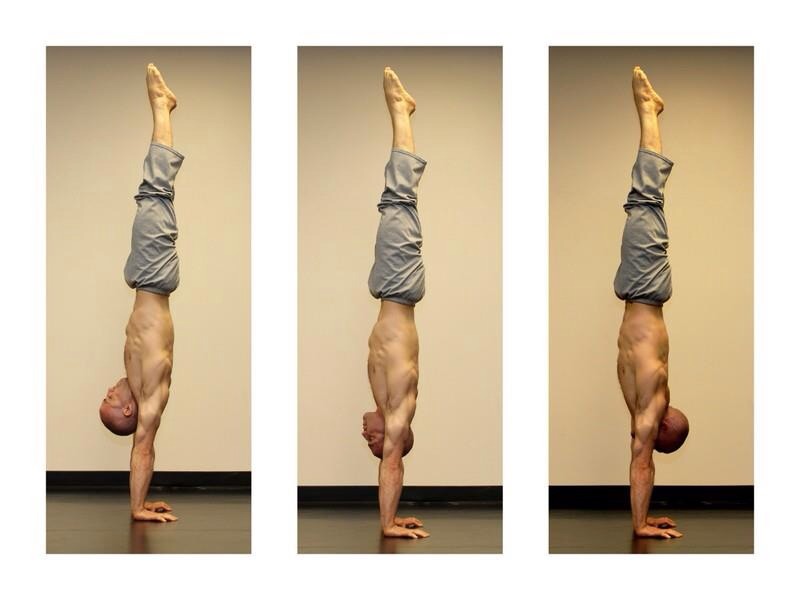
If I recall correctly, he also said that he still maintains this head position for one arm handstands.

Micawberian
thecolin said:

At a recent handstand workshop with Yuval, he stressed over and over that we keep looking at our hands when starting to learn the handstand. This helps you align your body over your hands in a consistent position and maintain a correct line. Without it, if you don't already have the right body sense, you're literally working blind.

I tend to go into over flexion, and this modification has shown a big improvement for me.

He talked about other positions as well (neutral, chin to chest) but for starting out he said looking straight down (or is that up? :P ) is best, and I've definitely found this to be true.

If I recall correctly, he also said that he still maintains this head position for one arm handstands.


So you are saying to not just look barely at the thumbs as coach suggests, but to look at the entire hand?

-----

I have to say, when I look at all the professional hand-balancers, I see many of them stick their heads out quite a bit. I like this better. The GB way I struggle to balance, I suspect something to do with visual input. If vision is such an important cue, why should I barely look at the thumbs? I'm just not sure the reason coach suggests a more neutral position, maybe b/c sticking the head out makes it more likely for the ribs to flare? I'm just thinking out loud here. Can even see Handbalancer sticks his head completely out

thecolin

Yuval said that the idea is to draw an imaginary line intersecting a consistent point, around the knuckle of your index finger. Keep your eyes above that line to keep your shoulders centered above your hands.


Like I said, Yuval was specifically talking about when he does one arm handstands. But I think he practices all head positions:


post-3734-0-83948000-1433051734_thumb.jp


But that in terms of balance and body position, he said looking at your hands is best. It makes sense, if you don't have a visual point of reference you're relying entirely on proprioception, which will make it more difficult if you don't already have a lot of handstand experience.


It's like standing on one leg and closing your eyes, it instantly becomes more difficult because you remove all visual references for balance. Looking at the ground gives you instant feedback of your shoulder position relative to your hands. And it allows you to find a more consistent line every single time.