I just bought H2 and I'm going to start PE elements alogside with H1, can you comment my form for this element:
PE1:
PE1-iM
Anything else wrong with PE1 except rounded lower back? I'm still working on hips/hamstrings for that. What about iM?
Thanks!
This forum is archived information and is no longer active.
Started by mlaen, February 2, 2014 · 27 Replies · 953 Views
I just bought H2 and I'm going to start PE elements alogside with H1, can you comment my form for this element:
PE1:
PE1-iM
Anything else wrong with PE1 except rounded lower back? I'm still working on hips/hamstrings for that. What about iM?
Thanks!
For PE1 you have to press your feet against the bar and not to put them on the bar, it make a big difference in term of difficulty when you have to press in the pike position from the push-ups position.
(something I saw) when you go from Plank(protracted/depressed) to the downward dog position(elevation/ protraction) in that transition, there is no retraction or anything like that, just protraction/depression to protraction/elevation.
i'll be honest, i played with this yesterday( i couldnt resist!) and it felt wierd. it opened my eyes to how close in relation Handstands are with planches.
KeilaniG said:... it opened my eyes to how close in relation Handstands are with planches ...
Interesting. To my mind it illustrates how the scapular position of planches and handstands/press handstands are exactly opposite of each other.
Yours in Fitness,
Coach Sommer
mlaen said:I just bought H2 and I'm going to start PE elements alogside with H1, can you comment my form for this element:
PE1-iM
What about iM?
Thanks!
For the iM put your head in a more neutral position keep you chin closer to your chest.
Cant tell but are your feet ON one of the bars?
Take your video and compare it to the one in the course.
Mats Trane, my feet are not on the bars! I tried but it seamed like the bar is at the edge of the breaking! Is it really nesessary to keep them on the bar? Is there an alternative?
if you are afraid of breaking bar. use another stall bar too. left arm left leg on one stall bar,and right arm right leg on second stall bar. so no full weight on one. is just my fast idea,when i see gym in this video 
Coach Sommer said:Interesting. To my mind it illustrates how the scapular position of planches and handstands/press handstands are exactly opposite of each other.
Yours in Fitness,
Coach Sommer
no disagreement there, what I was refering to was how closely linked they are....like you can arrive at one or the other through a transitional movement (then I saw planche presses and it made sense.)
I post here, no reason to open another thread.
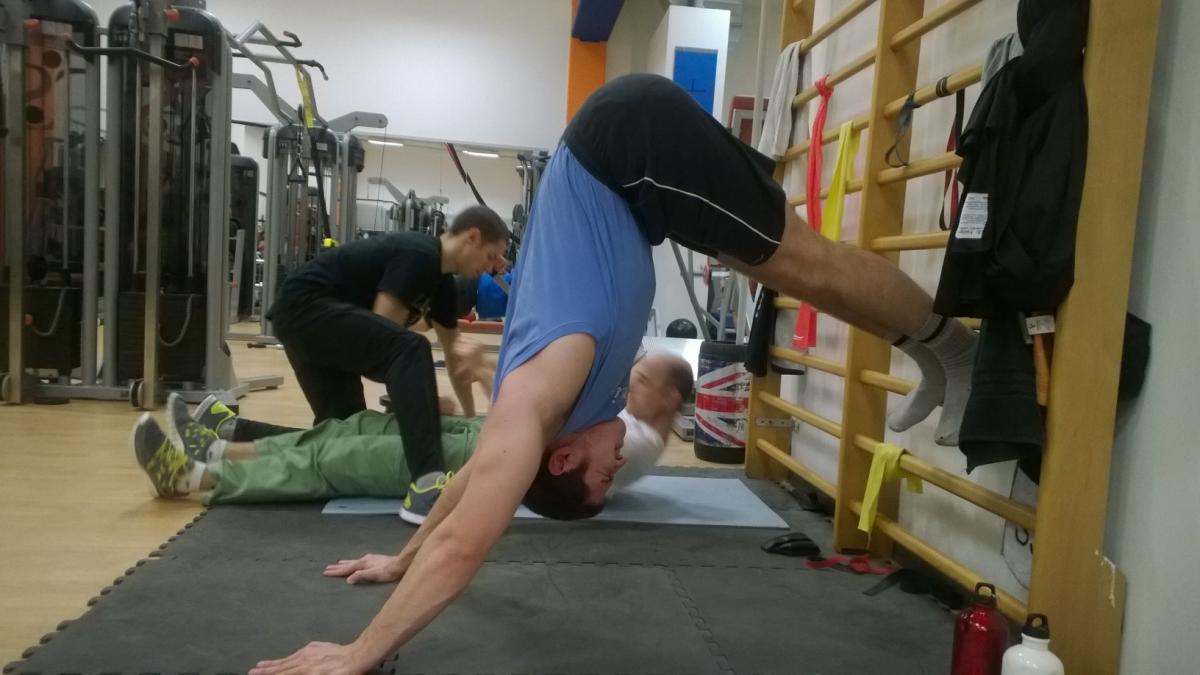
is acceptable?
I don't know if i've not understand correctly the exercise or not, so correct me if i'm wrong, but in my opinion the feet should not "rest" on the bar to support a part of your bodyweight, you should press against the bar (like if you try a planche with your feet against a wall) with your toes near the 3rd bar (on your picture) and your heel on the 4th.
I've done both execution at my first session and it's much harder when you have to press constantly on the bar rather than rest (even a little) on them.
Any feedback on this one?
Also, this is my first form upload, if it doesn't appear a youtube window in the forum, how do you make it so?
Low rises a good point, actually to engage the traps you need to work against the weight. imagine that you are resting in the same position (a wall planche), you need to use shoulders to resist the weight. moving the joints on other angles moves the weight elsewhere. in this new configuration you need to push you near the stall bar to overcome the weight and this lets to traps activation or in general on the upper back. how much you feel it depends on the level of strength you developed on H1 Im's element's while the ability to protract depends on your efficiency on F2 elements. Rest on the stall bar passively it's not the best choice. of course if you rest with the arms far from stallbar the work you're feeling on traps is very low, as you move closer you can start to feel the work also if you are not pushing against it.
Probably if you feel that you are resting could be for 2 situation:
-your traps are far more strong that what you need so you can decide to lower the feet down
-you feet are too high and you are not opening the shoulders to much
Daniel in your case i would use the bar just below your feet so that shoulder and feet are at the same height, or feel are lower
Have a look at these lines :


Cheers Alex87 and Jaz!
Hmm, haven't thought of putting lines on stuff... Really good tool!
i have a question regarding PE1>IM
right now i do not have access to stall bars. i tried to do the inverted pike pulls on the smith machine though and that seemed to work quite well. i raised my heels so the ankle flexibility is no longer the limiting factor. can i continue like this or is there something i am missing which makes this variation a bad idea?
Pe1>iM puts a lot of stress to my low back - in the 3th set today I had to stop because my low back started to hurt. 
How should I adress this?
mlaen said:Pe1>iM puts a lot of stress to my low back - in the 3th set today I had to stop because my low back started to hurt.
How should I adress this?
Have you already mastered F2? It does not sound as though this is the case.
Yours in Fitness,
Coach Sommer
No I haven't! I've read that PE elements in H2 can be trained along side H1 so I started with it (the fact that they are corequisites made me think that H2 PE elements can be trained even if I'm still at the beginning of F1). I guess that I should stop H2 completely until I finish F2?
Yes, F2 is actually a prerequisite for H2, you must have missed it somehow.
Prerequisite for H2 is to have finished through F2. H1 can and should be trained along side.
jaz said:Have a look at these lines :
Note that the photos on the right do not illustrate a flat back with ribs pulled in, nor is the student looking at his thumbs while his hear/ears remain in between his arms.
In the photos on the left note that at completion the lower half of the body is 'stacked' from the hips to the shoulders to the elbows to the wrists; all one single straight line that is neither piked nor arched.
Yours in Fitness,
Coach Sommer
Well, I guess I'll see you here after i finish F2 (not so soon) 
Any good advice as how to pull in the ribs?
Not sure I get exactly what that means.
Thanks for feedback Coach!
Look at H1/PE4 focus points. I think that is the first place where this consept is introduced. It means that the ribs should'n stick out when in full shoulder flexion as in a handstand.
In my opinion if tihis is happaning it is a indication of a stiff upper back or just bad control over the position.
mitko said:... In my opinion if tihis is happaning it is a indication of a stiff upper back or just bad control over the position ...
Correct on both counts. However if someone has faithfully mastered the H1 iMs, 'ribs out' is primarily be due to a lack of focus.
Yours in Fitness,
Coach Sommer