This forum is archived information and is no longer active.

SL/PE1 Arch Body Hold (ABH)

Started by Bobby Bogdanovski, March 5, 2013 · 467 Replies · 32,074 Views

thecolin
Amir Giles said:

This video explains what I've been trying to say, that the shape of the lumbar vertebrae allow far more extension/flexion than the thoracic vertebrae, but the thoracic spine allows more rotation:


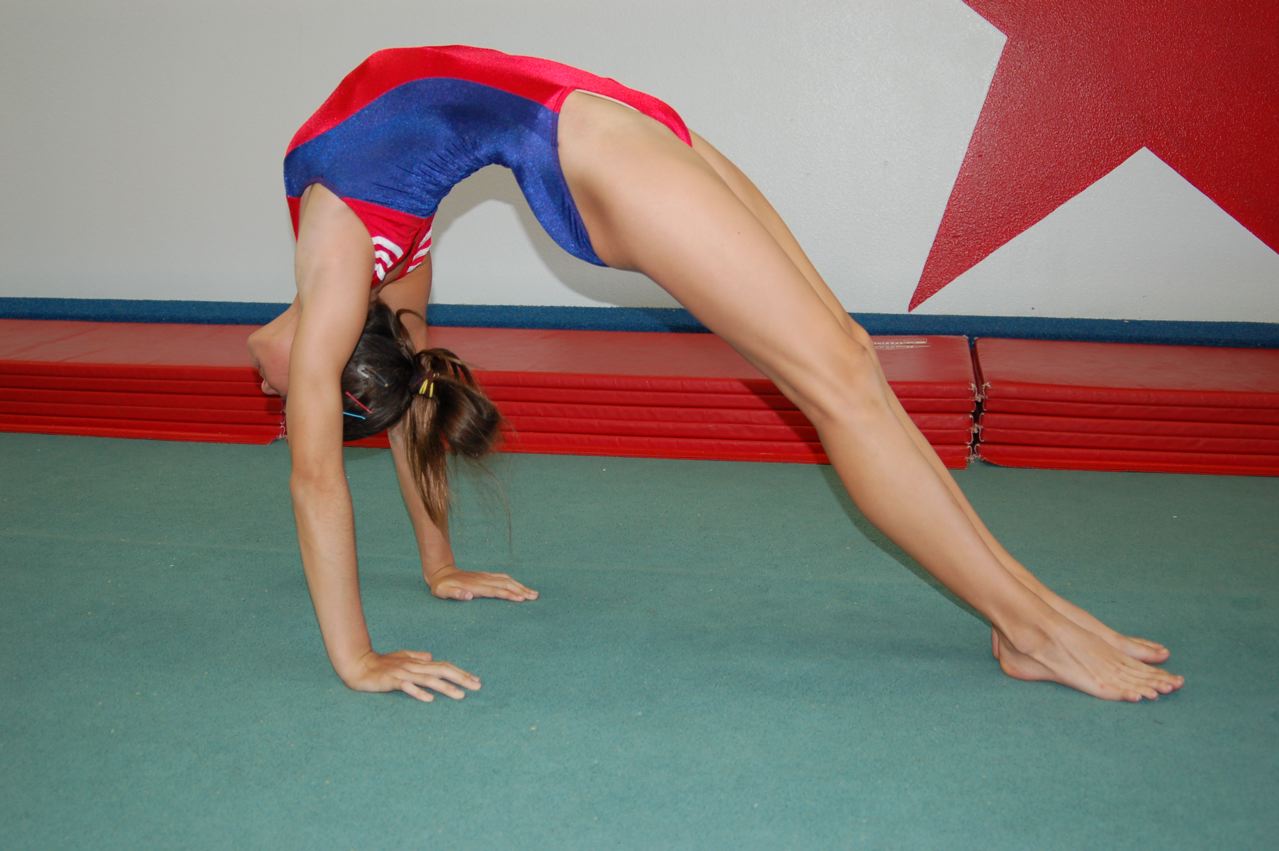
I think that there's a bit of confusion around goals and terminology here. The goal here is to build a strong arch, not to bend backwards and put your feet between your head. The latter is more of a goal for yoga, where mobility is the primary goal. A strong arch with proper muscle activation and full body tension is a foundation that can be built upon towards later gymnastic skills. Imagine doing a back handspring in the hyperextended position that you showed, bad things would happen.


An arch that focuses on the lower back may allow for more ROM, but it's extremely unstable. People probably naturally bend at the lower back because it comes more naturally and it's easier, as you've pointed out. But in terms of gymnastics strength, and even engineering, a strong arch is rigid equally across the entire arc. And since the lower back does tend to bend quite easily, proper form should focuses on bending at the hips and upper back, and the lower back will follow along naturally. If you focus on tensing the lower back, you're creating more of a V shape, as well as a point of weakness, not a strong continuous arch.


Back to the original point of stability and flexion in the spine. It seems to me that the lumbar spine should be stabilized because it tends to overextend, and the thoracic spine should be mobilized because it doesn't tend to bend. While the pictures you showed may demonstrate the natural tendency of the spine to bend, in terms of balancing strength and mobility, it is not ideal.

Agile
Hmms said:

Lower Cross Syndrome has everything to do with how the spine moves. Go learn exactly what it is and if you want to learn more/need more understanding of what it is then let me know.

I believe I understand what it is.  If you can explain how it is relevant then that would be great.  I would also really appreciate the source for your stats on lumbar vrs thoracic extension since I can not find anything similar online, most sources stating that lumbar extension is around 20 to 35 degrees, not 14.


There are numerous sources about how the way facets overlap limit extension in the thoracic spine and allow it in the lumbar, I've stuck a couple below as examples but via google there are obviously countless.


There are a few sites that measure the overall extension of the thoracic as greater than lumbar, (example) although I wonder if that is measured using the forward curve as a starting point, in which case that natural curve of the lumbar gives it an absolute advantage in contributing to a back bend.


In summary, given that the thoracic spine is limited by the way the vertebral joints overlap and further limited by being connected to the ribcage which is restricted by cartilage etc, I don't understand how the thoracic spine can have more backwards ROM than the lumbar.  And if it does, how come it never looks like that in pictures of highly trained flexible people eg :People


Examples of sources regarding limitations caused by facet joints:


“In the lumbar spine, rotation is prevented by relatively sagittal orientation of the facets while flexion and extension is free

[in the thoracic spine] Restriction of flexion and extension due to articulation with fixed ribs T1 T1-T9,  Axial rotation tolerated

• 3 degree per level flexion and extension between T1 and T5. Increases progressively downwards.

• Lateral bending limited in the entire extent of the fixed ribs, increasing below that.† 

- Biomechanics of the Spine, Shashwat Mishra


“..the facets of the thoracic vertebrae… allows lateral bending, rotation and some flexion and extension.  The lumbar vertebrae have facets…[which] allow almost no rotation but flexion, extension and lateral bending.â€

…movement is largely limited by the intervertebral joint facet orientations… Flexion-extension movements are greates in the cervical, lower thoracic and lumbar spine; rotation is greatest in the cervical and upper thoracic spine.â€

- Foundations of Osteopathic Medicine. link


Page 5 of this article on spine biomechanics here

Agile
thecolin said:

Back to the original point of stability and flexion in the spine. It seems to me that the lumbar spine should be stabilized because it tends to overextend, and the thoracic spine should be mobilized because it doesn't tend to bend. 

This is close to what I've been trying to say.  You seem to agree that the lumbar spine naturally extends more than the thoracic.  (and I agree that for that reason, to create a strong arch the focus should be on mobilising and strengthening the extension of the hip and thoracic spine)


BUT there have been a couple of posts that imply that the thoracic spine is anatomically more able to extend than the lumbar spine. 

So to repeat my two questions, 

1.  how does this make sense given the anatomical restrictions in the thoracic that I've posted about.

2.  if this is true why does it not look that way in any of the videos of athletes in F1, who are presumably well trained.  

Jon Douglas

Holy crap, I'm glad I'm like Daniel and find ABH really easy for whatever reason.


Just FYI, an active PPT has eliminated the occasional stiff/soreness in my lower back from overdoing bridge training, and has moved the stretch entirely to my shoulders/chest. I know the bridge thing was only a passing reference here, but I feel it's an important point to be aware of for those who, like I did, have a tendency towards excessive lower back flexibility to compensate for tighter shoulders.

Murray Truelove

Aren't we just supposed to try to look like the guy in the video for 60 seconds?

Adam R. Durst

In the time it took me to read this...I've mastered it! Lol!

But seriously on to the rocks!

wheezer
Murray Truelove said:

Aren't we just supposed to try to look like the guy in the video for 60 seconds?


I love the geeky physiology stuff, but appreciate the lol.

Alan Tseng
Amir Giles said:

I believe I understand what it is.  If you can explain how it is relevant then that would be great.  I would also really appreciate the source for your stats on lumbar vrs thoracic extension since I can not find anything similar online, most sources stating that lumbar extension is around 20 to 35 degrees, not 14.


There are numerous sources about how the way facets overlap limit extension in the thoracic spine and allow it in the lumbar, I've stuck a couple below as examples but via google there are obviously countless.


There are a few sites that measure the overall extension of the thoracic as greater than lumbar, (example) although I wonder if that is measured using the forward curve as a starting point, in which case that natural curve of the lumbar gives it an absolute advantage in contributing to a back bend.


In summary, given that the thoracic spine is limited by the way the vertebral joints overlap and further limited by being connected to the ribcage which is restricted by cartilage etc, I don't understand how the thoracic spine can have more backwards ROM than the lumbar.  And if it does, how come it never looks like that in pictures of highly trained flexible people eg :People


Examples of sources regarding limitations caused by facet joints:


“In the lumbar spine, rotation is prevented by relatively sagittal orientation of the facets while flexion and extension is free

[in the thoracic spine] Restriction of flexion and extension due to articulation with fixed ribs T1 T1-T9,  Axial rotation tolerated

• 3 degree per level flexion and extension between T1 and T5. Increases progressively downwards.

• Lateral bending limited in the entire extent of the fixed ribs, increasing below that.† 

- Biomechanics of the Spine, Shashwat Mishra


“..the facets of the thoracic vertebrae… allows lateral bending, rotation and some flexion and extension.  The lumbar vertebrae have facets…[which] allow almost no rotation but flexion, extension and lateral bending.â€

…movement is largely limited by the intervertebral joint facet orientations… Flexion-extension movements are greates in the cervical, lower thoracic and lumbar spine; rotation is greatest in the cervical and upper thoracic spine.â€

- Foundations of Osteopathic Medicine. link


Page 5 of this article on spine biomechanics here

The lower cross syndrome explains why creating extension in lumbar spine, while as an aside upper cross syndrome explains why extension should be created in thoracic spine. I'm currently out of the country until the 15th so I don't have access to many

Stuart McGill will have the relevant info regarding lumbar spine movement

thecolin
Murray Truelove said:

Aren't we just supposed to try to look like the guy in the video for 60 seconds?


So you're saying that if I dye my hair brown and shave my beard I'll get be closer to mastery?!  :P


Jon Douglas said:

Holy crap, I'm glad I'm like Daniel and find ABH really easy for whatever reason.


Hey, we don't serve the naturally talented in this thread, zombies only.  ;)


Amir Giles said:


2.  if this is true why does it not look that way in any of the videos of athletes in F1, who are presumably well trained.  


I don't think we're seeing the same things. And I'm certain they are well trained. Regardless, I can guarantee you that you're not going to draw Coach into a discussion to explain this any more.


I enjoy talking about this stuff theoretically, but it seems like you're more interested in questioning the programming. I can't explain it with any greater detail. But after hours and days and months of ABH training, I can tell you that from my experience, Coach is correct. At a certain point, you just need to turn off the analysis, trust in Coach's well established reputation and get to work.

VegVeg

The conflict comes when strict standards meet "don't overthink it".


A person can't satisfy both of the above statements , in order to achieve the high standard, to own, to master, one must question and understand completely. That's my point of view anyway.


So unless we'll just cut ourselves some slack with what a 'true mastery' is or get a thorough guide (a video is hardly a guide), the questions will probably keep on floating. 

Which is not a bad thing in my experience, by asking, experimenting and discussing movement we get to understand movement.


And there is nothing wrong with questioning the program you are following, as you said it yields quite enjoyable debates :)

Agile
thecolin said:

I don't think we're seeing the same things. And I'm certain they are well trained. Regardless, I can guarantee you that you're not going to draw Coach into a discussion to explain this any more.


I enjoy talking about this stuff theoretically, but it seems like you're more interested in questioning the programming. I can't explain it with any greater detail. But after hours and days and months of ABH training, I can tell you that from my experience, Coach is correct. At a certain point, you just need to turn off the analysis, trust in Coach's well established reputation and get to work.

Sorry not sure where I gave the impression that I'm question the programming or using this as an excuse not to ABH.


 I'm simply curious as to the apparent contradiction between all the sources I've posted and the below two statements regarding which part of the spine has most range of motion.


Adam R. Durst said:

Lumbar spine is an area of stabalisation in the body...limited mobility compared to others.


Hmms said:

  The reason why Lumbar Spine should be stabilized is because all the vertebra added together has a total of 14 degrees range of motion compared to the Thoracic Spine where each vertebrae as range of motion of up to 8-10 degrees.  So as you can see the thoracic spine should be very mobile.


Both these statements, unless I have misunderstood them, imply that the lumbar spine can bend less than the thoracic.  All the numerous sources I've posted imply or clearly state the opposite; that the thoracic has less ROM because of joint structure and being attached to ribcage.  


So either the above statements are wrong or the research I've posted is wrong and I would love to know which.  

(Or I've misunderstood and would appreciate being enlightened.)

thecolin
VegVeg said:

The conflict comes when strict standards meet "don't overthink it".


A person can't satisfy both of the above statements , in order to achieve the high standard, to own, to master, one must question and understand completely. That's my point of view anyway.


So unless we'll just cut ourselves some slack with what a 'true mastery' is or get a thorough guide (a video is hardly a guide), the questions will probably keep on floating. 

Which is not a bad thing in my experience, by asking, experimenting and discussing movement we get to understand movement.


And there is nothing wrong with questioning the program you are following, as you said it yields quite enjoyable debates :)


I think to truly master, one must experience that moment when something clicks. No amount of explanation has gotten me to that point. I love to talk about these things and hear about other people's experience, but the only thing that has really helped has been doing and doing again.
 
The forums and seminars exist as additional resources to help people, I don't think it's expected that you acquire perfect knowledge from a single video. Lots of studying, dedication and exploration is required. I question and examine all the time. But when Coach comes on and says ABH is about thoracic and hip extension, and advanced athletes who practice it say the same thing, it's time to stop doubting and start doing. If there are additional problems or mobility deficits, then those are separate and perfectly valid conversations. But in terms of doing the ABH with good form, I'm at a loss at seeing what information is missing.
 
Would more information be useful in the Foundation course? Sometimes I think so, other times I'm not so sure. Coach certainly doesn't think so, it's not by accident or laziness that it's set up the way it is.
Joshua Slocum
thecolin said:


Would more information be useful in the Foundation course? Sometimes I think so, other times I'm not so sure. Coach certainly doesn't think so, it's not by accident or laziness that it's set up the way it is.


For the majority of people, simply seeing the video is enough - some focus points are mentioned if they are particularly important or non-obvious. Having a whole essay for each PE and iM would just make most people over-think the exercise. If a person struggles to understand the movement from the information given, the forums are there to provide additional help and information.  The online courseware is not designed to exist in isolation: the forums are an integral part of the courses. 

Coach Sommer
VegVeg said:

The conflict comes when strict standards meet "don't overthink it".


A person can't satisfy both of the above statements , in order to achieve the high standard, to own, to master, one must question and understand completely. That's my point of view anyway.


Almost correct.


There comes a point where after it has been explained several times and the discussion becomes circular, we arrive at 'stop talking and start training' because the theoretical discussion does not/can not provide the same degree of mastery as actually having physically mastered the skill.


Gentlemen, we are currently at that point.  Enough discussion.  Go sweat.


Yours in Fitness,

Coach Sommer

Adam R. Durst
Amir Giles said:

Sorry not sure where I gave the impression that I'm question the programming or using this as an excuse not to ABH.

I'm simply curious as to the apparent contradiction between all the sources I've posted and the below two statements regarding which part of the spine has most range of motion.

Both these statements, unless I have misunderstood them, imply that the lumbar spine can bend less than the thoracic. All the numerous sources I've posted imply or clearly state the opposite; that the thoracic has less ROM because of joint structure and being attached to ribcage.

So either the above statements are wrong or the research I've posted is wrong and I would love to know which.

(Or I've misunderstood and would appreciate being enlightened.)

I think your missing the critical point.

Sure the lumbar spine can bend a massive amount! If you force and encourage it to.

But you don't want it too! Unless you want a back-injury and movement disfunction!

Seriously look up Stuart McGill, probably the most respected back pain expert in the world.

You want to treat the lumbar spine as a relative point of stability. Maintain the natural curve (~15degree) when possible.

Now this will create a whole bunch more controversy and discussion here...because what will come out is the gymnastics training, especially forward flex of the spine into pike, or toes to bar, but also bad bridges...is accumulating strain on the discs that may become an issue later. However developing a strong back and creating mobility/movement in the hips (tip the hip/hamstring length in forward bends) will mitigate the risk to a degree.

As for the Arch...it's just most effective to use the cues people have provided...unless you don't want to achieve mastery...and want your low back spazzing at you every time you do it.

Jon Douglas

I just had to share this;

My mother has been dabbling in some F1mobility. Today she asked to try a basic workout.

She passed bent hollow rocks, bent vups, deck squats and arch body hold on her first try.

Five minutes of abh, no issue, by a early 60s lifelong corporate mother of two whose strength training is cycling to work and back, and tennis on the weekends.

Now, Im not saying anyone should feel bad (because obviously my mother was a ***damn boss lady from the start), but to paraphrase Coach;

Gentlemen, consider the gauntlet well and truly thrown.

thecolin
Jon Douglas said:

Five minutes of abh, no issue, by a early 60s lifelong corporate mother of two whose strength training is cycling to work and back, and tennis on the weekends.


Good for her, now we see where you get your natural gymnastic talent from.   :)

Agile
Adam R. Durst said:

I think your missing the critical point.

Sure the lumbar spine can bend a massive amount! If you force and encourage it to.

But you don't want it too! Unless you want a back-injury and movement disfunction!

As for the Arch...it's just most effective to use the cues people have provided...unless you don't want to achieve mastery...and want your low back spazzing at you every time you do it.

Actually that is close to what I've been saying;  the lumbar spine has more mobility than the thoracic.  I think I've been misunderstood to be be arguing about the cues for ABH.   This has never been my intention - I've said a few times that I agree the focus in ABH should be on extending the thoracic spine.  


My posts have simply been in response to your post and a post by hmms which imply that the lumbar spine HAS less mobility than the thoracic   I understand this to simply be anatomically incorrect.  


 I think the confusion is caused because when I say 'the lumbar has more mobility than the thoracic' people think I'm saying that we should focus on bending at the lower back during an ABH.  That is not what I'm saying.  To be extra clear:  when attempting ABH I think you should follow the cues given by Coach, Kit etc etc that you want to focus on bending from the hips and thoracic.


But if Coach was to say that in a plank you should lock your elbows, then someone else said  'this is because the elbow does not flex very much'.  Then I would post and say, 'but the elbow can flex a lot!'  I'm not arguing with the instruction but with someone else's anatomical analysis to justify it.  


to quote HMMS again:  "The reason why Lumbar Spine should be stabilized is because all the vertebra added together has a total of 14 degrees range of motion compared to the Thoracic Spine where each vertebrae as range of motion of up to 8-10 degrees."


As far as I can research this, the part where he says that all the lumbar vertebrae added together have a total of 14 degrees ROM is simply wrong.   But if I'm directed to research that shows this I'm happy to be proven wrong.  (reading McGill so far has not.)


One last time:  I'm not arguing here against the cues given for ABH or about if the lumbar should be stabilized.  I'm saying the lumbar spine is naturally more mobile than the thoracic.  And I'm saying this because we work with our bodies and I think its useful to have a reasonable understanding of how they function.  

Joshua Slocum
Jon Douglas said:

I just had to share this;

My mother has been dabbling in some F1mobility. Today she asked to try a basic workout.

She passed bent hollow rocks, bent vups, deck squats and arch body hold on her first try.

Five minutes of abh, no issue, by a early 60s lifelong corporate mother of two whose strength training is cycling to work and back, and tennis on the weekends.

Now, Im not saying anyone should feel bad (because obviously my mother was a ***damn boss lady from the start), but to paraphrase Coach;

Gentlemen, consider the gauntlet well and truly thrown.

Better watch out, or soon she'll be the one curling you!

Duff
Jon Douglas said:

I just had to share this;

My mother has been dabbling in some F1mobility. Today she asked to try a basic workout.

She passed bent hollow rocks, bent vups, deck squats and arch body hold on her first try.

Five minutes of abh, no issue, by a early 60s lifelong corporate mother of two whose strength training is cycling to work and back, and tennis on the weekends.

Now, Im not saying anyone should feel bad (because obviously my mother was a ***damn boss lady from the start), but to paraphrase Coach;

Gentlemen, consider the gauntlet well and truly thrown.

Well, that's all the motivation i need.

wheezer

I put together a summary of all the content in this topic (as I see it).

Joakim Anderson
wheezer said:

I put together a summary of all the content in this topic (as I see it).


Nicely done, saves a lot of beginners a lot of time! Let's hope your modest little link doesn't get lost in the neverending flood of posts here. Maybe a "best answer" would be in order.

IcedDante

Thanks Wheezer. Out of curiosity- where are you at in the SL Progression?

wheezer
IcedDante said:

where are you at in the SL Progression?


PE1 Week 1.


I was at 4x48s a few weeks ago, but I'm focusing on max arch intensity now. I've learnt so much taking notes from this thread that it feels like a whole new element.

Destiny

Failed 4x48 today, had it last cycle and a few more before that. I hope it's because my form is getting better. Very frustrating! Probably gonna step back to 4x24 or whatever week 5 is.