This forum is archived information and is no longer active.

What is the reasoning behind heavy lunges?

Started by Justan Human, September 7, 2023 · 4 Replies · 99 Views

Justan Human

Howdy y'all! 

I had an awesome time training lower body today and put a little overview together:

https://www.instagram.com/p/Cw3LuudO4tI/ 

(NGL a little star struck that Coach Sommer like :icon_biggrin:!) 


Since single leg squats came easy and early (well before I started GB) to me, I am very curious about the reasoning behind why weighted lunges are the strength exercise of choice for level 4 for a number of reasons:

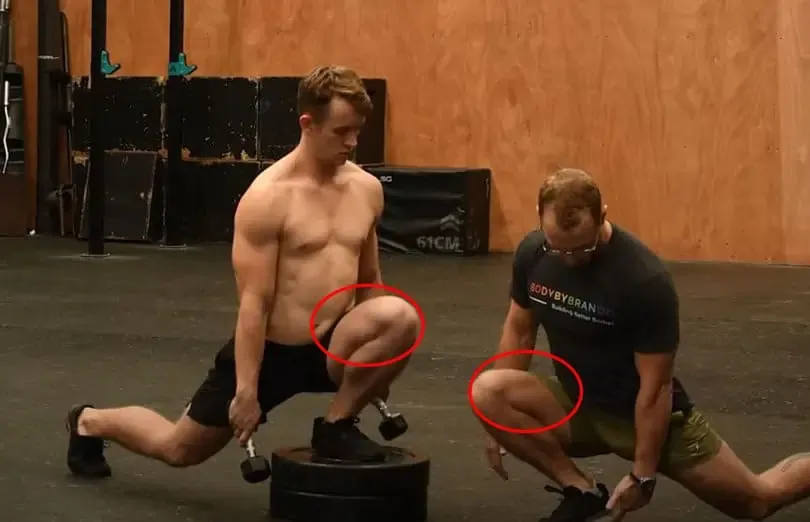
  1. The lack of mobility or stretching in the exercise. The videos show the athletes with only 90° knee bend with both legs. Wouldn't a ATG split squat with maximum front knee bend, minimum back need bend, and stationary feet be a far superior exercise with the added benefit of front split gains? Which can be scaled down by elevating the front foot and scaled up by elevating the back foot. image.png.eb2b5e77fc17c7ff3d5f94ce72faee9c.png
  2. The use of heavy weight. While I am not a calisthenics purist that shuns all weight, Coach Sommer himself describes GB programming as "body weight fitness" in his latest podcast interview, Acta Non Verba. While I do have access to a gym with weights, I am afraid the 5x5r with 100% BW will add unnecessary mass to the legs that will make all leverage skills way harder :facepalm:. I love using weight for weighted mobility with full ROM and stretch, but dislike moving weight for weight's sake. Also, was the 100% BW number taking 180 lbs. big boys into account?
  3. General Physical Preparation (GPP) vs Specific SPP. Apart from hip flexor strength and split mobility needed for Ring, Pommel, Highbar, & Pbars, it seems to me that powerful legs are only needed for vault and floor. And with both of those events, it is more sprinting, ballistic, polymetric, rebounding power which heavy lunges seem to do little for. Wouldn't box jumps for height, box depth jumps, straight leg rebounding hops, sprints, and box/sled pushes/pulls be superior for developing power?
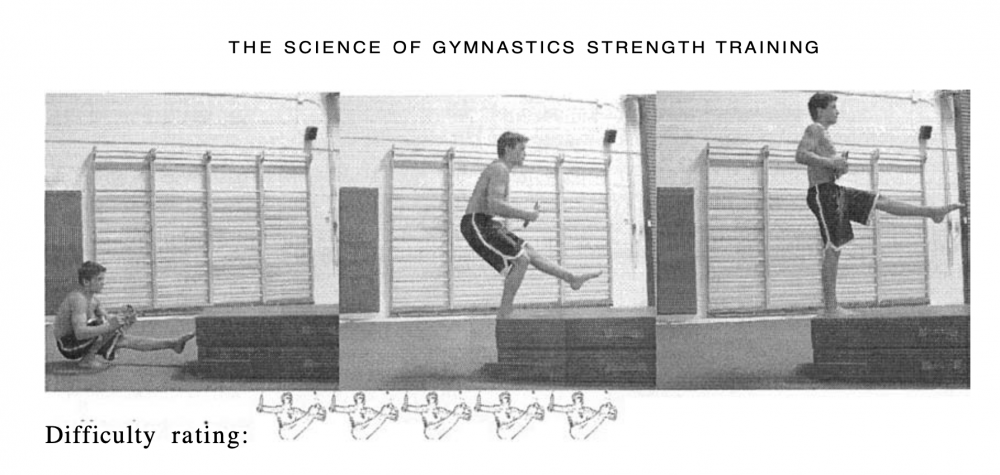
  4. What happened to "weighted jumping for distance & height" from Building the Gymnastic Body? Was this removed due to concerns of people hurting themselves? image.thumb.png.2780457b38fbe949ab70e9122a5394e8.png
  5. Is end range training/stretching for middle and front splits a better investment of time for those with already "fairly" powerful legs? Considering these are actual elements in and of themselves (and are a part of other floor elements) in the code of points.
 

Just for fun, what are some top-tier skills (moves) and metrics (i.e. vertical jump, box jump) that would be great for setting a high bar to strive for!?

Alessandro Mainente

My answers follow, consider that you must think in terms of the goal of the courses that is potentially to prepare the body for the  dynamic leg part like jumping, absorbing etc...only to specify..for high jump is much more important hip extension rather than knee extension.


The lack of mobility or stretching in the exercise. this is a possible reason but again...glutes and hips extensors and dominant in the gymnastic tumbling part and also in the landing.

The use of heavy weight. While I am not a calisthenics purist that shuns all weight, Coach Sommer himself describes GB programming as "body weight fitness" in his latest podcast interview, Acta Non Verba. While I do have access to a gym with weights, I am afraid the 5x5r with 100% BW will add unnecessary mass to the legs that will make all leverage skills way harder . I love using weight for weighted mobility with full ROM and stretch, but dislike moving weight for weight's sake. Also, was the 100% BW number taking 180 lbs. big boys into account? Mass is added in case of muscles failure  + mechanical tension + longer time under tension (aka methabolic stress). in the case of a 5x5 you only have mechanical tension but for sure no long time under tension and no training to failure.  if the caloric intake is held out of hypercaloric then there is low probability to add mass like in a bodybuilding approach. Also if you use a proper weight with fast concentric the 5x5 will fall in the intermuscular coordination that for definition increases strenght without increasing the mass because the contribute is mainly to the technique.

General Physical Preparation (GPP) vs Specific SPP. Apart from hip flexor strength and split mobility needed for Ring, Pommel, Highbar, & Pbars, it seems to me that powerful legs are only needed for vault and floor. And with both of those events, it is more sprinting, ballistic, polymetric, rebounding power which heavy lunges seem to do little for. Wouldn't box jumps for height, box depth jumps, straight leg rebounding hops, sprints, and box/sled pushes/pulls be superior for developing power? foundations that is the program available on the GB portal has the purposes to build up basic strenght in order to prepare for posible power training. since the power trianing is usually done with the 50% or less of your 1rm, if you can do lunges with your bodyweight added for reps then you can train power with your own bodyweight for reps (because it is the 50% of your 1rm). % depends on the type of power, generally power training with high weights is reserved to olympic weightlifting while in gymnastic there is power (single event like vault), power endurance like floor and "power negative" that mean stick the landing like in the shortest time as possible...and this is typical of the most of the events. the higher the basic strenght the higher those movements can be repeated. i have experiemented it by myself, before to implement serious wotrk for hips extension the chronic repetition of lnading and reboinding and repulsion leds to groin inflamation (my old coach does not have the proper knowledge). then i have implemented strenght protocol  and after conversion into power (refer to Tudor Bomba and Carlo BUzzichelli book for more information) i've never had issue to groin.

What happened to "weighted jumping for distance & height" from Building the Gymnastic Body? Was this removed due to concerns of people hurting themselves? yes. BtGB offers a progression too much "shorter" that can also lead to injury, like training back lever prematurely. so it was revisited...

Oliver Croft

I'm doing the weighted lunges.

I'm up to 100% for 3x2r so far... (I weigh 71Kg)

I have noticed that my quads are not getting any bigger, just stronger. Also my butt is stronger now...because of the lunges...


Justan Human

Thank you Alessandro and Oliver!

On 9/7/2023 at 9:29 AM, Alessandro Mainente said:

if you can do lunges with your bodyweight added for reps then you can train power with your own bodyweight for reps (because it is the 50% of your 1rm).

Wow, although obvious, this is a big paradigm shift for me and will now factor much more into my training. 

And thank you so much for the Periodization : theory and methodology of training book recommendation! I just downloaded the sixth edition. I have a high level overview understanding of periodization from Steven Low's Overcoming Gravity, but this book looks super dense with nitty-gritty details.


From here, I would like to pivot this post into three directions.


1. Could you please advise me on how my form is looking when performing the exercise (is one of these reps better than the others?) If not, could I get a famous Alessandro illustration to show what should be emphasized? 

I started with a 45 lbs barbell last month, and have to admit that I did get sore from the initial new weighted motor pattern.  Over the weeks I have easily worked 5x10 up to 60 lbs dumbells which is 2/3 BW for me. Is there a particular reasoning for the particular BW percentages in the programming? Is there any difference in adding a linearly adding 10 lbs per session in typical progressive overload fashion? 


2. Are there any pros and/or cons of how the weight is held? I prefer dumbells over a barbell since I can just grab the weight and go without having to load the barbell. Also the lower center of mass feels more stable and allows for a small degree of adjustments. Also, it feels good to engage my shoulders and traps as in a "farmer's carry." Is it recommended to use any other equipment or barbell positions (overhead or front racked) to emphasize different aspects?


3.  https://www.instagram.com/p/CpdxLDYj6i7/
Any update? It sounds like this new program is separate from GB. It that so? Will it use this same forum?

Should the discussion here on the forum be limited to existing GB programming, or can we discuss and recommend plyometric training?

In the case of this post, would training jump rope double unders (and eventual triple +) every other day be a good approach?


Screenshot 2023-10-13 at 6.39.44 PM.png

Alessandro Mainente

Hi Justan i have ridden the very first version of steven low's book back in 2011 and i'm sorry but there is an abyss of difference. If you have not compeltely understood and studies multiple simes the book of Bompa you cannot say to know periodization...and some of the last version of this books have the participation of the best Bompa's student that is Carlo BUzzichelle. Well i have attended a presensation on GST at Carlo's courses in italy for couple of years.

one the pure periodization is fully understood you are welcome to take some books and put then into the bin.

for your execution...if the major goal is to train the glutes you have to persform the lunge with step behing as "last progression" and try to avoid knees moving in fron of the fingers of the foot. do no confuse....knees can move past fingers...but not in the lunges or other exercise where glutes are the major goal.