This forum is archived information and is no longer active.

Subacromial pain when NOT doing pullups

Started by Christian Gabel, June 13, 2021 · 6 Replies · 95 Views

Christian Gabel

Hey there,

I have problems with subacromial pain syndrome aka impingement syndrome. It lasts a certain time to figure out a solution: When I do a few sets of pullups after a day the pain is away for about four days, then it comes back slowly. No PT has ever explained, why this happens and no other exercise helped a bit ...

My question is now: Has anybody any idea, what's going on in my shoulder? :D
Which muscles are probably responsible for that? Has anybody similar experiences?

In F1 I only have reached RC2, but I have to incorporate pullups to stay pain free ...
Alessandro Mainente
20 hours ago, Christian Gabel said:

Hey there,

I have problems with subacromial pain syndrome aka impingement syndrome. It lasts a certain time to figure out a solution: When I do a few sets of pullups after a day the pain is away for about four days, then it comes back slowly. No PT has ever explained, why this happens and no other exercise helped a bit ...

My question is now: Has anybody any idea, what's going on in my shoulder? :D
Which muscles are probably responsible for that? Has anybody similar experiences?

In F1 I only have reached RC2, but I have to incorporate pullups to stay pain free ...

I had many many many students. The subacr syndrme occurs in 2 phases. In the beginning, it is sporadic then it begins to be stronger at the point that it affects other gestures or daily movement. it is mainly linked to posture and pullup technique. if you post the execution of your pullup i can tell it if the technique is the problem.

Mikel Perez

Hi Christian:

The shoulder is a very complex area, but according to what you explain, I'd say that you may have a Latissimus Dorsi and/or Long Head of Biceps inhibited (i.e: not working properly).

When you rise your arms, the head of the humerous needs to slide down on the glenoid cavity. Both Lat Dorsi and Long Head of Biceps perform this action. If they are inhibited by any reason, the head o the humerus will be too high and will compress the subacromial bursa, jam the supraspinatus tendon and elicit the subacromial pain syndrome. If not addressed properly, it can lead to inflammation and eventually tear of the supraspinatus tendon in the long term. In that final stage, surgery to scratch the lower surface of the Acromion to make room for the tendon is required, but your case seems far from that point.

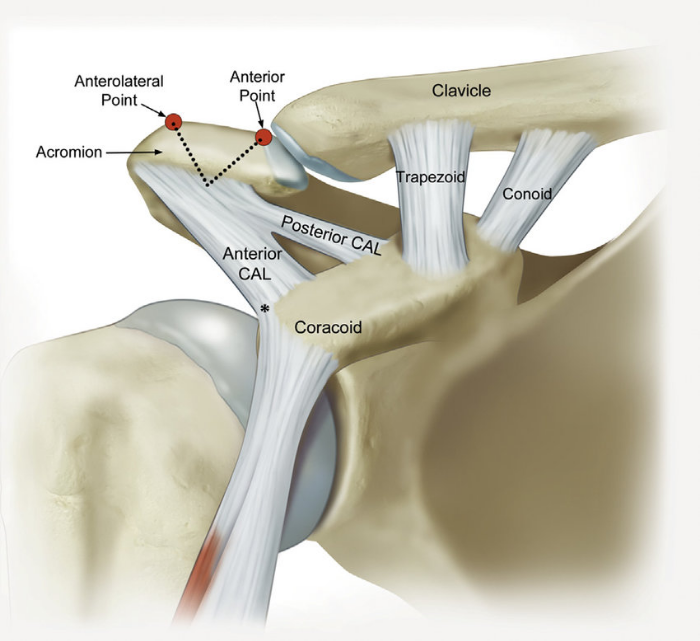
With no previous trauma, a possible cause may be a dysfunction of the coracoacromial ligament (CAL) which inhibits both muscles. Maybe you can sometimes also feel pain between the spine and the scapula if the dysfunction is deep enough, because this ligament may also inhibit intercostal muscles.

Of course I should check things to know better, but I presume that is your main issue. Activation of Lat Dorsi and Long head of Biceps ipsilaterally by addresing the root of that dysfunction may resolve the problem. A specialist in Functional Neurology in your area would be my most valuable piece of advice.

If you don´t know where to find one you can contact me. I'll try and find the closest one to where you live.

Best wishes and good luck.

1483745157_CORACOACROMIALLIGAMENT.png.64f400758f75a62bdbb8db923bbcb5c2.png

Christian Gabel

Hey guys,

thank you for the replies :)

12 hours ago, Alessandro Mainente said:

I had many many many students. The subacr syndrme occurs in 2 phases. In the beginning, it is sporadic then it begins to be stronger at the point that it affects other gestures or daily movement. it is mainly linked to posture and pullup technique. if you post the execution of your pullup i can tell it if the technique is the problem.

The pullups don't cause the problems, they solve the problem for a few days.

1 hour ago, Mikel Perez said:

[...] I'd say that you may have a Latissimus Dorsi and/or Long Head of Biceps inhibited (i.e: not working properly). [...]  With no previous trauma, a possible cause may be a dysfunction of the coracoacromial ligament (CAL) which inhibits both muscles. Maybe you can sometimes also feel pain between the spine and the scapula if the dysfunction is deep enough, because this ligament may also inhibit intercostal muscles. [...]

Interesting! I never thought of ligaments as a cause for shoulder pain ... you say, that the lat and the long biceps is inhibited (perhaps by the CAL) and when I do pullups, I activate those muscles for a few days, so that they work properly in this time. Is that your theory?

I never feel pain between the spine and the scapula. But when I let my arms hang down, the shoulders are on the same height. In times, when the shoulder hurts and I lift arms up in front of me until they reach a horizontal position, the hurting shoulder is more elevated and protracted. Does that match your theory?

Mikel Perez
13 hours ago, Christian Gabel said:

Interesting! I never thought of ligaments as a cause for shoulder pain ... you say, that the lat and the long biceps is inhibited (perhaps by the CAL) and when I do pullups, I activate those muscles for a few days, so that they work properly in this time. Is that your theory?

Ligaments send proprioceptive information to the brain and are responsible for the proper activation of their associated muscles. That's their role in the body. If you have a dysfunction in, let's say, the CAL, Lat. Dorsi and/or Long Head of Biceps can be inhibited all the time. In that scenario, when you perform a pullup your nervous system is not able to recruit these muscles and you are compensating with other ones to complete the task. Pain is an action signal of something not working properly and is the alarm your body uses to warn you.

In your case pullups act as an antistimulation, and compensate for the issue for the four days afterwards.

Pain between spine and scapula is another possibility, depending on how deep the dysfunction is you can have one muscle, two or three of them inhibited by your nervous system so that you don't hurt yourself.

I should test your shoulder muscles personally to know for sure, but that seems a plausible possibility (not theory). As you know, the shoulder is more a complex of five joints (sternoclavicular, accromioclavicular, coracoclavicular, scapulothoracic and glenohumeral) than just a joint. All of them must work properly or there will be instability which can elicit pain as an action signal.

21 hours ago, Christian Gabel said:

 when the shoulder hurts and I lift arms up in front of me until they reach a horizontal position, the hurting shoulder is more elevated and protracted. Does that match your theory?

When you rise your arm one shoulder is higher and protracted to avoid and compensate for the issue. Again, a Specialist in Functional Neurology is your best option according to my knowledge.

Feel free to contact me personally if you feel like.

All the best


Christian Gabel

Hey Mikel,

thanks for the explanation. Sorry, I'm not a native speaker. What do you you mean by antistimulation? Do I stimulate muscles, that compensate the dysfunction of the lat and long biceps? Is there a possibility to test a lat dysfunction for myself i.e. by filming my back when performing pullups and look for imbalances? Can dysfunctional muscles be restored by training them?

David Pardy 340028

Hi Christian,

It might also be worth looking into Dr John Kirsch's book about shoulder pain.  He utilises hanging from a bar to correct what he designated the acriomohumeral joint.  It made a significant difference after years of shoulder impingement for myself.