Just curious on which muscles, apart from shoulders I guess, does the bridge hold work? Any carryover to arch ups (SLPE4)?
Thanks!
This forum is archived information and is no longer active.
Started by Felipe Garcia Rosa, March 17, 2018 · 8 Replies · 115 Views
Just curious on which muscles, apart from shoulders I guess, does the bridge hold work? Any carryover to arch ups (SLPE4)?
Thanks!
Hi Felipe,
The thoracic bridge works primarly your shoulders and upper back. If these areas are tight the TB work will have a great carryover to arch ups 
Hi Pauline,
Thanks for your answer. So it doesnt work lower back right? Arch ups and other SL PEs would be the only exercises targeting erector spinae muscle?
Hi Felipe,
Hi don't think it's fully complete, but it gives a good idea :
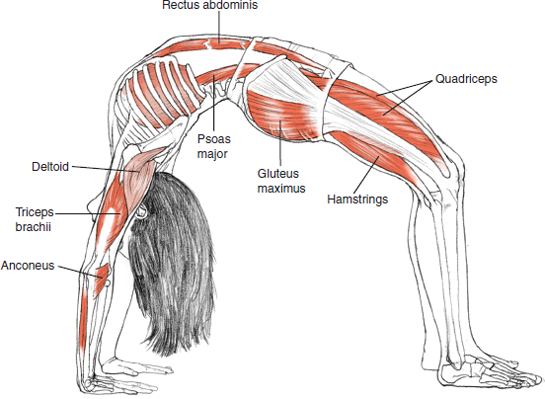
For you question, the lower must work to stabilize the core, but it has to be flexible to work in that range.
The Bridge, which is nothing more than a Handstand with extreme core expansion (this is the opposite of core compression) to the point that your feet touch the ground, has the following characteristics:
Muscles maximally contracted:
Muscles maximally stretched:
If the feet touch the ground, it will mostly be a mobility exercise. If the feet do not touch the ground like in a Handstand, the level of required strength will be higher & the level of required mobility will be lower.
The mobility required is maximal when the feet are touching the ground while the strength required is maximal at a degree of approximately 90° (see picture).
The opposite of the Bridge is the Manna, which has exactly the opposite characteristics:
Muscles maximally contracted:
Muscles maximally stretched:
Nice chart Étienne!
Didnt think of Manna as being the oposite Léo. Amazing description, will study it carefully!
@Léo Aïtoulha Is it fare to say that in a handstand (180 degrees instead of 90) the same muscles maximally contracted as in the bridge will be involved but with less mobility required?
14 minutes ago, Felipe Garcia Rosa said:@Léo Aïtoulha Is it fare to say that in a handstand (180 degrees instead of 90) the same muscles maximally contracted as in the bridge will be involved but with less mobility required?
Yes. In a regular Handstand, there is no core expansion. Therefore, much less core mobility is required regarding the mentioned stretched muscles above.
It is also interesting to note that people who spend a lot of time sitting on a daily basis will often have rounded shoulders & anterior pelvic tilt because of an overused & therefore tight anterior chain. The consequence of this is that they will have troubles to even perform properly a basic Handstand with 180° shoulder flexion and neutral/posterior pelvic tilt, which is much easier than the Handstand with core expansion 
1 hour ago, Léo Aïtoulha said:It is also interesting to note that people who spend a lot of time sitting on a daily basis will often have rounded shoulders & anterior pelvic tilt because of an overused & therefore tight anterior chain. The consequence of this is that they will have troubles to even perform properly a basic Handstand with 180° shoulder flexion and neutral/posterior pelvic tilt, which is much easier than the Handstand with core expansion
That sounds very familiar to me Lol.
Very helpful answers. Thanks!
