This forum is archived information and is no longer active.

joints, ligaments and teacups

Started by Michael Vetter, August 30, 2017 · 8 Replies · 238 Views

Michael Vetter

Hi,

I read some fairly good thread here some time ago, now I cannot find it anymore to re-read it :-/

It was touching on the topic of healthy ligaments, joints tendons, how to train them, their recovery rate etc.


Since I cannot find it I decided to start this rather specific thread.


So I did various martial arts before coming here. Often I encountered exercises like the "teacup".

Two example videos:

https://www.youtube.com/watch?v=z0m1GRGBHrY

https://www.youtube.com/watch?v=ZSjh9oGJF-8

Might not be the best examples but I guess the movement is visible on them.  Especially the first guy looks quite stiff and making strange movements but anyway.


What I noticed is various teachers taught this different:

- some said to do them for time (15 minutes) every day for at least one year, just the hands no weight

- some said 100 reps on one day per week, just the hands no weight

- some said to use weight, starting with 500g and going up, doing few reps


So it was always a believe on authority thing. I never understood why they taught it differently and what the end of each version would be and whether any of them does not make any sense at all.

I believe some people on this forum could explain this to me quite easily.

Any takers? :-)

Michael Vetter

Found the thread, containing:

Quote

Joaquin, different types of tissue adapt at different rates. In general, an injury will occur if one or more of three things happens:

Tissue does not have time to recover between training sessions.

Your body (especially the parts involved in the exercise) experiences something with a load larger than the tissue can withstand.

Your body experiences something unexpected.

Tissues respond to training at different rates:

The nerves/brain adapt first - you learn a new skill, or movement; it's awkward at first, but you can perform the movement. To get really comfortable and fluid, though, might take years.

Muscle adapts next. If you lift something heavy, you'll be sore for a few days, and adaptation will occur over 1-2 weeks or so.

Tendons adapt more slowly than muscle. They are less vascular (less bloodflow). I'm unsure if different parts of a tendon (the part where the tendon joins muscle, the middle part of tendon, and the part that joints to the surface of bone) adapt at different rates.

The skeleton probably adapts more slowly than tendon (most bones have a reasonable blood supply, but then they are much larger than tendons)

Ligaments adapt more slowly than tendon or the skeleton (less vascular, again)

Articular cartilage (between joints) adapts slowest of all.


@Nick Murray maybe you can give me a few ideas?

Nick Murray

I'm definitely no authority. This is just my opinion from my limited reading on this topic.

Movement will often follow a path that is easiest. Easiest means:

  • familiar & fluid - the "program" in the brain's motor cortex that sends nerve messages to muscles to fire in a particular order. When a new movement is awkward (me trying to dance salsa, for example), the "salsa" program isn't very efficient, I use too many muscles without much coordination between them. Deliberate practice - with attention to form, and with an eye to moving gracefully - will make the program more efficient.
  • movement that is not impeded by articular (bone/joint) or soft tissue restrictions. Movement will move away from or out of a position where you feel a grind, or burn, or pull, or a stretch with a limb or your trunk or whatever.

There are no intrinsically "good" or "bad" movements or movement patterns - it all depends on what you are trying to achieve. A "banana" handstand might be ok in circus or other performing arts; here, the form requirements are more strict. There's no contradiction, just a difference in context.

So, to comment on the "teacup". What is it trying to achieve? Range of motion, fluidity, strength,  a peaceful state of mind? Or all four?

some said to do them for time (15 minutes) every day for at least one year, just the hands no weight

You'll probably get more fluid, and perhaps some more range IF you actively engage all the muscles that attach to the shoulder blades, forearm supinator/pronator muscles. Strength (unless you're recovering from shoulder surgery or have otherwise been immobilised) is not going to increase much after the first few weeks - there is not enough load to force any adaptation.

- some said 100 reps on one day per week, just the hands no weight

Less fluid, less strength than option 1. There is simply less dosage of the exercise.

- some said to use weight, starting with 500g and going up, doing few reps

This is where things get interesting. If you hold your hand out in front of you, you probably can't feel it - you're too used to the feel of your arm.

But add a weight, and the part of the brain that senses body position now has more to process.

More sensory input means that if you put a body part into a 'safe' (non-painful, but maybe a bit uncomfortable) position, but that is still at the end of your range of motion, the position-sensing brain functions should (in theory) adapt a little more quickly.

PNF stretching (the contract/relax, hold-relax and slow reversal variants) likewise aims to increase sensory input to increase the rate of change. Instead of a weight sensation, the brain senses a stretch sensation, and as you do more of it, the sensation becomes less intense, and the new range of motion becomes your new normal range - if you maintain it.

Weighted stretching WILL have a mechanical effect on tissue (weighted straddles for example) but the half-remembered articles I've read suggest that muscle tissue grows longer rather than actually physically stretching. There will always be a "neuromuscular effect" where the brain will protest a lot if you try to force a stretch. This being one of those cases: http://nypost.com/2017/08/24/cheerleading-squad-from-hell-busted-for-forcing-team-into-painful-splits/

So using weight, and gradually increasing the range of motion and the weight, will give you better results than Teacup options 1 and 2.

Here's another example.

In the picture with my arm in the air, I'm trying to stretch my left pecs. Ideally, my right arm should be parallel to the left. (As mentioned elsewhere, I've had both shoulder capsules (ligament tissue) sewn tighter.). This stretch doesn't really feel like much - the capsule tissue is just too tough. This corresponds to Teacup option 1. If I spent 10 years doing this I might get to arms parallel. It isn't a function of middle-trap/rhomboid strength.

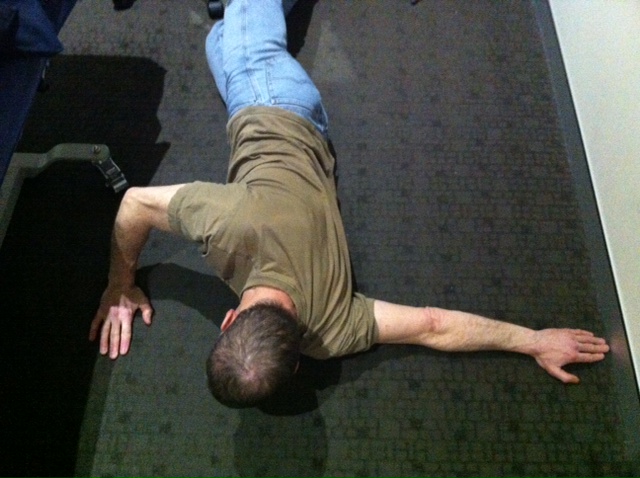
In the other picture, I'm using my right arm to roll my torso backwards over the left shoulder. It might not look like it but the stretch is way more intense. Plus, it feels "safer" as my right hand is giving my torso feedback (how hard I'm pressing vs how much roll there is in my torso). This is how the weighted teacup option works.

But as Coach/coaches have mentioned with shoulder dislocates, you really need the range before reinforcing the movement using weight.

I hope this answers your question.

As to why I wrote this much, I've hurt my lower back and can't do any SLS, MN or SL work :( Positions that used to be safe now hurt, and will for another week, so I have to find another way to train.
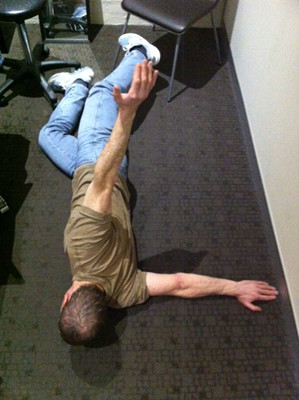
PSC unassisted.JPG

PSC assisted.JPG

Michael Vetter

Very nice. Thank you for this!


So to have some range of motion maybe first doing it without, but as soon as I have that range I should add some weight to really get good benefits?

Jin Liu

@Nick Murray you cannot hide anymore, you know too much! :D

From a workout junkie: I'd do method #2 if I'm a complete novice, then #1 to increase the frequency once I feel comfortable, then #3 once I know the movements by heart (coordination adapted) but want more challenge. I agree that #3 is where the magic happens. For general conditioning, 1&2 are completely fine. For impact, such as fighting in this type of martial art (Pa Kua) tho, which use the hands/palms to both strike and block, and also grab and redirect the force from your opponent, I guess you'd better get used to training with a lot of weight...

Nick Murray
10 hours ago, Michael Vetter said:

So to have some range of motion maybe first doing it without, but as soon as I have that range I should add some weight to really get good benefits?

Yes. You need to know the movement first, then load it. A long time ago I recall trying to touch my toes by just flexing my lumbar spine. I didn't know what hips were. When I started Foundation and discovered the Jefferson Curl, that was a revelation (even all the massage training and anatomy and physiology hadn't helped a lot; the "stretching" subject was not very informative).

Just moving will give you SOME range of motion. Adding weight will give you more ROM over time. But then using weight in the movements of your chosen activity can sometimes be counterproductive. For example, doing a front split in the air (whatever that's called). Great to lie on your back, do an inverted split with ankle weights, and scissor the legs to get some more ROM. Doing a split in the air WITH the ankle weights on might lead to an injury though: since it's a dynamic movement, the momentum generated by the weight at the ends of the legs could put you in an oversplit.

The general principle is that the body adapts to the (training) demands you put on it. No-one performs with ankle weights, but use them to help get and maintain ROM if you need to.

Rayne-William Fitzgerald

For the sake of the topic....  From the professional rescuer's basic first aid training...Tendons, connects muscle to bone, take at least 12 weeks to develop/heal. Ligaments, connects bone to bone, take longer than 15 weeks, since there is very little blood supply. 

Michael Vetter

So for me there is only one question remaining: can you do too much of this stuff? Too much so it doesnt adapt/recover properly? How to find out when that is the point?

Everett Carroll

Here's my two sense, Michael. You can do too much of anything. As a general rule when it comes to mobility work, be conservative and use common sense. If you are constantly walking around too sore to train or are not improving despite mobilizing regularly, then you're likely doing too much. Find what works for you and stick with it.

There's more than one way to skin the cat which is why different instructors have different protocols for the drills you mentioned above. Also notice that consistency is a common factor in each of their protocols despite the programming being completely different.