This forum is archived information and is no longer active.

Full Squat Progressions - PE3

Started by Matt Robison, August 9, 2017 · 22 Replies · 478 Views

Matt Robison

I am on PE3 of single leg squat, which is full squat. PE1 and 2 were fairly easy to go through, as I have the leg strength from kickboxing conditioning. However, I can not remember the last time I've been able to do a full squat. I have two main issues, probably related: 

- My ankles just don't touch the floor. I can't get into anywhere close to a full squat position without my ankles being almost 2 inches off the floor. I've been doing some calf and ankle stretches for the past few months (one of which the one from Fundamentals), but have no idea how else to increase ankle mobility for this

- I lose my balance and fall backward, even while holding a 5 pound weight straight out in front of me. Part of it is probably because I can't keep my ankles down and so don't have a good base. But I don't know.

Are there any other ankle mobility exercises to do, or ways to improve balance on the full squat? All three of my kids (all under 7) do a full squat all the time like its the most natural thing in the world, and play in that position for minutes at a time. And of course, it should be a natural position. But man....

Thanks!
Everett Carroll

Hey Matt,

You're going to want to invest in the Front Split Stretch Series. The first quarter of the series is dedicated to achilles and ankle mobility. 

Holding your lowest squat position for 30-60s seconds throughout the day will also help. I believe @Mats Trane says he squats low while he brushes his teeth.

Please also send in a video of your current PE3 form and the PE3>iM.

Matt Robison

Thanks Everett. I am currently doing a pike progression/ front split stretch series, but it doesn't have any specific ankle movements. Glad to hear the Front Split series here addresses that. I'll look into.

But honestly, I can't even touch my toes. It's sad.

Jennifer Marie

Hi Matt, I totally agree with Everett. That Front Split series is great for what you're seeking. And, hanging out in the bottom of the squat, too, will help there and for me, it give my lower back a stretch to combat a sitting down job.

A bit of a scale you might try is putting a slight rise under your heels until your ankles and achilles give you a bit more range. In weightlifting, I've seen coaches slide two-pound plates under the heels of squatters who struggle with balance and depth. (Lifting shoes have a bit of a heel rise built in.) It might help you find the feel (sense of balance and depth) of a deeper squat until the stretching lets you get there without the lifts.

Either way, keep working at it. Mobility takes time, but the progress will sneak up on you if you stay consistent in your practice.

Matthias Schwartz

Hey Matt, to add to what's already been said. Inability to get into a full squat is more often hamstring flexibility and not ankle flexibility.

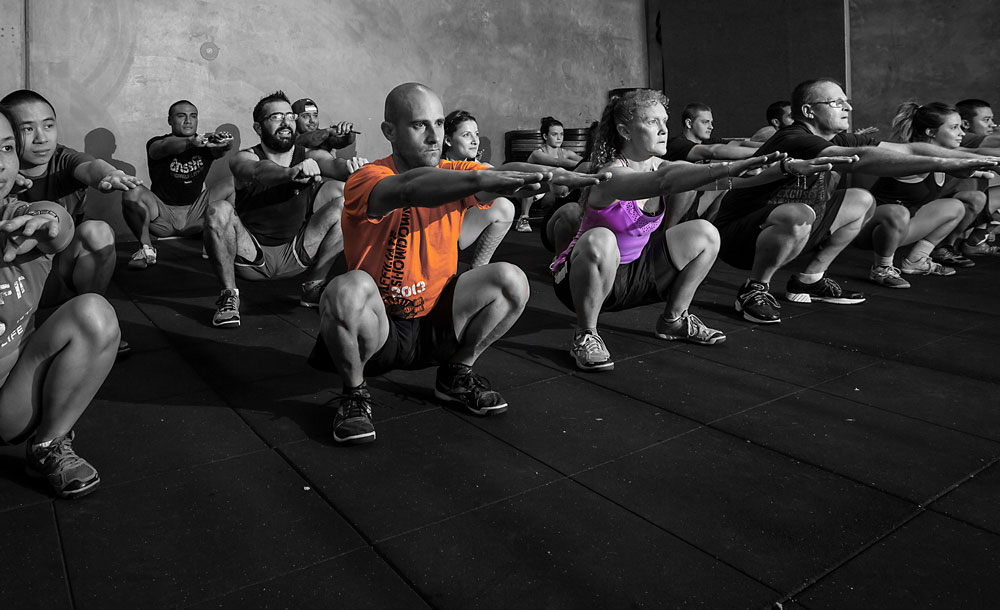
Good ankle flexibility can act as a crutch if your hammies aren't allowing you to get your hips down and back in a full squat. However, a proper squat usually doesn't require end-range flexibility in your ankles. A good squatter can generally squat in the equivalent of ski boots (for those who don't ski, that means, not a steep ankle angle). I've attached a photo to illustrate how a squat has the shins closer vertical.

Ankle flexibility is good to have but I think that hamstring flexibility is much more important for a squat. Either way, the front split course will be golden for this.

Best,

Matt

air-squat.jpg

Affan Osman

Is it better to squat as low as possible with heels lifting up or stop just before heels lift?

Jin Liu
1 hour ago, Matthias Schwartz said:

Hey Matt, to add to what's already been said. Inability to get into a full squat is more often hamstring flexibility and not ankle flexibility.

Good ankle flexibility can act as a crutch if your hammies aren't allowing you to get your hips down and back in a full squat. However, a proper squat usually doesn't require end-range flexibility in your ankles. A good squatter can generally squat in the equivalent of ski boots (for those who don't ski, that means, not a steep ankle angle). I've attached a photo to illustrate how a squat has the shins closer vertical.

Ankle flexibility is good to have but I think that hamstring flexibility is much more important for a squat. Either way, the front split course will be golden for this.

Best,

Matt

air-squat.jpg

This woman in purple demonstrates it beautifully. She had her knees behind the toes, and still kept a straight back. Getting the heels down to the ground is the first step. The next step (also harder) is to keep the entire back straight (esp. lower back, no butt wink) while in full squat. This is not critical for body weight squats, but is very critical for heavily loaded full squats. I always thought about pushing my knees forward to straighten my lower back, and ankle flexibility becomes crucial there. 

I have never thought about hamstrings! I'm always wondering how to straighten even more my lower back in a full squat without having to push my knees out excessively. Now I see exactly how this can be done. Good hamstring flexibility can bring the thighs very close to the body, and still prevent the hips from tilting forward. Am I getting this right? I'm definitely gonna work on my hamstring flexibility more now! Thanks for sharing this!

Matthias Schwartz
14 hours ago, Affan Osman said:

Is it better to squat as low as possible with heels lifting up or stop just before heels lift?

Generally, it's better to stop before the heels lift, since getting up on your toes will shift the load from the hamstrings to the quads. However, even better than stopping before you have to go on your toes is to hold onto something so you don't fall backwards, and then go down as low as you can while on flat feet. If you can get into a good bottom squat position while keeping your balance with an external support, you can play with the position and feel what the bottom position is like. You can also play with using less or more support help at the bottom to push your flexibility and balance in that position. I find that getting used to the end position (the bottom) with support helps people progress faster into a full squat.

Best,

Matt

Matthias Schwartz
13 hours ago, Jin Liu said:

This woman in purple demonstrates it beautifully. She had her knees behind the toes, and still kept a straight back. Getting the heels down to the ground is the first step. The next step (also harder) is to keep the entire back straight (esp. lower back, no butt wink) while in full squat. This is not critical for body weight squats, but is very critical for heavily loaded full squats. I always thought about pushing my knees forward to straighten my lower back, and ankle flexibility becomes crucial there. 

I have never thought about hamstrings! I'm always wondering how to straighten even more my lower back in a full squat without having to push my knees out excessively. Now I see exactly how this can be done. Good hamstring flexibility can bring the thighs very close to the body, and still prevent the hips from tilting forward. Am I getting this right? I'm definitely gonna work on my hamstring flexibility more now! Thanks for sharing this!

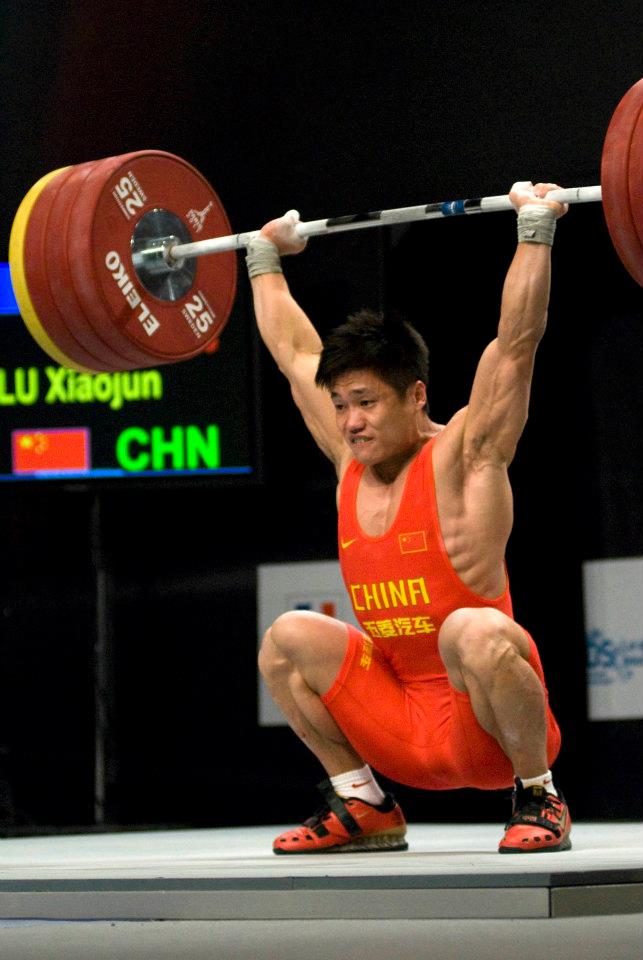
Yes, good hamstring flexibility reduces butt wink and allows you to compact your legs closer to each other and your body as you lower down. There's also another commonly ignored component to the squat, and that is groin/adductor flexibility. In a good squat, which is well-illustrated by the bearded fellow in the second row of the photo above, your hips don't end up behind your feet. The hips are actually slung between your feet, bringing your hips forward and allowing your torso and shins to be more upright. This is not commonly taught, but it is something that good deep olympic squatters do automatically. This requires some adductor flexibility in addition to the hammies.

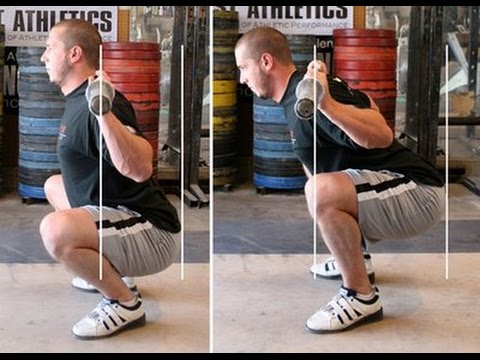
The olympic lifting photo illustrates well the concept of getting the hips forward in between the feet, which is even more critical in an overhead squat than a regular squat. The other photo is meant to show the difference between high-bar and low-bar squat but you can also see the difference in hip position as being in-between vs. behind the feet and how that influences torso lean. If the lifter in the second photo set had a bit better adductor flexibility he'd be able to get his feet an inch wider, pull his knees back, and position his hips even more between his feet and need to rely less on his ankle flexion to stay upright.

Best,

Matt

paris2011_776.jpg

hqdefault.jpg

Jin Liu
1 hour ago, Matthias Schwartz said:

Yes, good hamstring flexibility reduces butt wink and allows you to compact your legs closer to each other and your body as you lower down. There's also another commonly ignored component to the squat, and that is groin/adductor flexibility. In a good squat, which is well-illustrated by the bearded fellow in the second row of the photo above, your hips don't end up behind your feet. The hips are actually slung between your feet, bringing your hips forward and allowing your torso and shins to be more upright. This is not commonly taught, but it is something that good deep olympic squatters do automatically. This requires some adductor flexibility in addition to the hammies.

The olympic lifting photo illustrates well the concept of getting the hips forward in between the feet, which is even more critical in an overhead squat than a regular squat. The other photo is meant to show the difference between high-bar and low-bar squat but you can also see the difference in hip position as being in-between vs. behind the feet and how that influences torso lean. If the lifter in the second photo set had a bit better adductor flexibility he'd be able to get his feet an inch wider, pull his knees back, and position his hips even more between his feet and need to rely less on his ankle flexion to stay upright.

Best,

Matt

paris2011_776.jpg

hqdefault.jpg

I'd give you a thousand stars if I could! You answered so many of my questions lingering in the back of my mind. Some of them are why those great squatters look so damn compact from the side, whereas I have my entire thighs and bulging knees in front of my body? Why is their back so vertical whereas mine always leaning forward? How do they completely eliminate butt wink no matter how deep they squat (some literally had their butt touching the floor in competitions!!)? How can they have their feet so wide apart and still keep a super straight & vertical back?? I've only looked at ankle mobility (seems like the internet buzz word too), and ignored the others. As I keep pushing my knees out and still not getting anywhere close to the ideal squat image in my head, there's gotta be more than just the ankles. What you said connected a lot of dots.

One more question, does a more vertical back (from better adductor/hamstring flexibility) allow for a more efficient squat?  Since my back is always leaning forward, I notice I almost always have to lift the butt before everything else. When the weight is heavy, my lower back will start to bend as I get up. Then I drop the weight just so I don't get up with a bent lower back. Here is a video of my most recent front squats (since it's front squat, my back is at its most vertical angle compared to back/overhead/or even just bodyweight squats). So if my adductor & hamstring flexibility gets a lot better, and my back becomes more vertical with my legs on my sides, without any increase in strength, will I be able to squat (slightly) more weight?

Sam Jarvis

I've had a similar issue with deck squats.  I don't have the flexibility to go all the way down to the floor with my feet together.  So my question is when I'm doing deck squats, should I widen my feet to go all the way down or keep my feet together and not go down quite as far?  Thanks.

Alessandro Mainente
On 9/8/2017 at 9:41 PM, Matt Robison said:

Thanks Everett. I am currently doing a pike progression/ front split stretch series, but it doesn't have any specific ankle movements. Glad to hear the Front Split series here addresses that. I'll look into.

But honestly, I can't even touch my toes. It's sad.

Squat it is 90 if not 100% ankle mobility. you should consider passing 5-10 minutes a days stretching your Achilles tendon and if possible multiple times in a day.

Mats Trane
On 2017-08-09 at 9:07 PM, Everett Carroll said:

Hey Matt,

You're going to want to invest in the Front Split Stretch Series. The first quarter of the series is dedicated to achilles and ankle mobility. 

Holding your lowest squat position for 30-60s seconds throughout the day will also help. I believe @Mats Trane says he squats low while he brushes his teeth.

Please also send in a video of your current PE3 form and the PE3>iM.

Yes do it daily and you'll get results

Jennifer Marie

Hi Jin Liu, 

We're wandering off topic on a gymnastics forum, but I can't resist a good lifting conversation!

Have you tried pausing at the bottom of your front squats? Hanging out in the hole forces you to give more attention to proper position. Sometimes we can hit the bottom and quickly start back up in a less than ideal position if we're strong enough, but by pausing, the barbell will quickly call us out if we're not tight and upright. 

That's one of my personal favorite tricks. Now, my lifting coach, on the other hand, made me drop weight and focus on not letting the butt rise too quickly. I couldn't add weight back until I broke the habit. Tough love, but it helped my squats and my cleans.


Jin Liu
4 hours ago, Jennifer Marie said:

Hi Jin Liu, 

We're wandering off topic on a gymnastics forum, but I can't resist a good lifting conversation!

Have you tried pausing at the bottom of your front squats? Hanging out in the hole forces you to give more attention to proper position. Sometimes we can hit the bottom and quickly start back up in a less than ideal position if we're strong enough, but by pausing, the barbell will quickly call us out if we're not tight and upright. 

That's one of my personal favorite tricks. Now, my lifting coach, on the other hand, made me drop weight and focus on not letting the butt rise too quickly. I couldn't add weight back until I broke the habit. Tough love, but it helped my squats and my cleans.


It is a very good tip. I was actually doing pause squats just a couple sets before the one in the video, with lower weight. I can't pause squat the weight used in the video yet. I used to do pause squats more often when I was paying more attention to form, and my strength was increasing steadily. Then I got impatient and cocky, and made adding more weight as my priority. At the end, i didn't get the strength I wanted, my form is not getting any better, and I get frustrated. I think it's time to go back to the basics. 

I agree that I'm starting a topic that probably does not belong here. But I had my questions in the back of my mind for so long, and I wasn't even sure if they were legit questions. I couldn't resist the joy when I learned that not only my questions are legit, but there are answers as well!

Goal: upright torso, no butt wink, efficient power transfer. How to get there: hammies, adductors, ankles, & pause pause pause at the bottom and FEEL it. Back to the basics. Will just have to believe that strength will come along the way. 

Sorry for wandering off the original topic. I learned so much here, and am very grateful to it.

Jennifer Marie

No need to apologize. (I think) :)

Today is front squat day for me, so I'll be keeping good form in mind since we've been talking about it. Let me know how it goes, the back to basics approach. I'm sure you'll break through this and progress with patience and practice!

Scott Garfield

I can get into a full deep squat with feet flat and the backs of the upper legs touching the calves, but I can't straighten my back in this position and have to lean forwards somewhat to stay balanced.  Where's the problem/tightness there and how to fix it please?  If I just keep getting into that position and keep trying to straighten my back, will consistency pay off eventually or do I need to address other tightness/restrictions first?  Thanks.

Jin Liu
5 hours ago, Scott Garfield said:

I can get into a full deep squat with feet flat and the backs of the upper legs touching the calves, but I can't straighten my back in this position and have to lean forwards somewhat to stay balanced.  Where's the problem/tightness there and how to fix it please?  If I just keep getting into that position and keep trying to straighten my back, will consistency pay off eventually or do I need to address other tightness/restrictions first?  Thanks.

Hi Scott, for bodyweight squat, a rounded back is not a big problem (although, very high repetitions with a rounded back might still add some strain to the spine. Think about when one stays bent over for a long time). For any sort of loaded squats, you want your back to be completely straight in order to protect the spine. So a general rule of thumb, when you do loaded squats, only lower your body as long as you can keep your back straight. As your mobility improves, you can squat lower and lower while keeping the straight back.

From my own experience, good ankle mobility allows you to push the knees out in a deep squat, and that helps maintain a straight back. Imagine you are on your flat feet in a deep squat with a rounded back, now lift up the heels and roll to the toes, your knees will go out and your torso will immediately start to lean less and straighten. That's what you get by pushing the knees out. But with flat feet it only gets you so far. What I learned from the previous posts by @Matthias Schwartz is that 1) good hamstring flexibility will reduce the butt wink in the deep squat. This is the ability of folding your legs very close to your body while maintaining a straight lower back. 2) good groin mobility will allow you to push your hips in between your feet, instead of behind your feet, in a deep squat. With that your torso will have a much easier time to stay upright & straight. With good hamstring and groin mobility, you can rely less on pushing the knees out. I like the sound of that :)

All in all, I think GB's front split and middle split series are excellent sources to help improve ankle, hamstring, and groin mobility.

Scott Garfield

Thanks Jin Liu, that makes a lot of sense. 

Matthias Schwartz
On 8/10/2017 at 1:12 PM, Sam Jarvis said:

I've had a similar issue with deck squats.  I don't have the flexibility to go all the way down to the floor with my feet together.  So my question is when I'm doing deck squats, should I widen my feet to go all the way down or keep my feet together and not go down quite as far?  Thanks.

Sam, I'd work on both. Wider squats are a valid exercise, and you can push them narrower as you progress. I'd recommend working the narrower squats while holding onto an external support to let you go all the way down without falling backwards. As you progress you can reduce your reliance on that support. Also spend a bunch of time just sitting in the bottom of the squat, feet wide or together, as low as you can go, while holding on to an external support. This is a good way to build familiarity and flexibility in that position, and will facilitate getting into that position on your own.

Best,

Matt

Janno Rillo
On 8/11/2017 at 0:46 AM, Alessandro Mainente said:

you should consider passing 5-10 minutes a days stretching your Achilles tendon and if possible multiple times in a day.


On 8/11/2017 at 7:45 PM, Mats Trane said:

Yes do it daily and you'll get results

Maybe a stupid question, but do you need some warm-up before those daily sessions (sound weird to do a warmup before going to brush the teeth:))? I've been struggling with tight ankles for many years and have tried the daily stretches in different formats, but have usually ended up with sore calves and achilles. Maybe soreness means that I've done it too intensely (however, I don't feel the stretch at all on lighter versions).

Mats Trane

Nothing wrong with soreness. You could always do it every other day in the beginning.

Janno Rillo
19 hours ago, Mats Trane said:

Nothing wrong with soreness. You could always do it every other day in the beginning.

For me the soreness has caused couple of running injuries (calfs felt more fragile). But what I understand from your comment- you are not doing any warm-up, so I will try the daily routine once again with littlebit more gentle approach.