Hello my dear GTS community. As you can tell from the title, I have undergone shoulder reconstructive surgery, and I am wondering if it is even possible for me to achieve a planche. Of course, you cannot guarantee anything, but I would love to hear some success stories from fellow GTS community members and coaches who have gone through the training while having this handicap, and yet accomplished this unbelievable feat of strength. Your testimonies would serve as a strong encouragement to me as I set out on my journey to push myself to a place that I have never been before in my strength training. Thank you very much for your time, and I really appreciate any stories that you are willing to share.
For the coaches, I have purchased the basic strength course, the stretch series for the splits and the back, the handstand series, and the movement series. So far, I am just starting. Friday will be my first full week going through the courses, and I am pretty excited. I have always loved exercise, and I cannot wait to see the benefits of this course. Currently, I can run 9 miles without stopping at a 8:00 minute pace, and I can do 60 regular push-ups with correct body position and form, 20 pull-ups with full extension of the arms, 25 regular dips, and I can hold a handstand against the wall for 1:00 with a completely straight body and pointed toes. When I do those exercises, my shoulder doesn't hurt, but I can tell that it is weaker than my other shoulder. My shoulder muscle is fairly strong (for my level of fitness) but the joint over-all isn't strong enough to hold a front lever. I can hold a tucked front lever for almost 4 seconds, but that hurts my shoulder joint too much, so I have stopped trying to do that until I can make it stronger through your course. However, I have my doubts if I will ever be able to hold a planche because of the tremendous amount of pressure on the shoulder joints.
As a funny side note... Vanessa Jencks is my wife... She bought the course for me as a birthday gift. But she signed into the course and typed her name into the profile, so I haven't been able to change it... My name is Bobby Jencks. But on GST... I am under the disguise of Vanessa...
This forum is archived information and is no longer active.
Post Shoulder Reconstructive Surgery- Is the planche a possibility?
Started by Vanessa Jencks, July 25, 2017 · 4 Replies · 176 Views
Hi Bobby Aka Vanessa,
Welcome to the GB community. What was the prognosis from your surgeon following your reconstruction? If your surgeon expected you to make a full recovery with no lasting effects I cannot see why the achievement of a planche is not possible. Whatever the final outcome may be you have definitely arrived at the right place. The systematic progressions that make up the Foundation series are the most detailed, comprehensive guide to achieving planche and other Foundational gymnastic skills available anywhere.
Piece by piece they will build your strength and mobility in the safest way possible to ensure that you are physically prepared for the demands that these movements place on the body. You will only progress to a level that your body can handle never pushing past your limitations and risking injury. Take your time, be consistent and listen to your body. GymnasticBodies has taken care of the rest for you.
Please keep us updated on your progress.
Sure you will develop enough to hold a planche. I've had both shoulders stabilised (shoulder capsule tightened) five years ago for the right, 4 years ago for the left. After starting GB in late 2014, I'm now at SE3 for straddle planche, and what gives out first is my hip flexors - from holding the tuck. Because of the capsule tightening, I have real troubles with full shoulder flexion, but it has improved a lot using exercises from Foundation and from other sources.
Can you give more details on exactly what was reconstructed? What types of rehab were you given afterwards? What was the original injury from?
To Darin,
The doctor told me that I would never regain full range of motion, and that shoulder would feel weaker than the other. I broke my shoulder playing football in high school. I was a middle linebacker and the opposing team tried to run up the middle. As the running back came through the hole, he tried to run past me, but I threw out my arm and basically closed-lined the guy. When I did that, I broke my shoulder. That night, the trainer told me that I had just over-extended it, and that I just need to rest my arm. My mother didn't think anything about it and trusted the trainer because she didn't want to take me to the hospital and rack up a doctor's bill. My family wasn't affluent, so we couldn't afford going to the doctor unless it was an emergency. And there didn't seem to be an emergency according to the trainer.
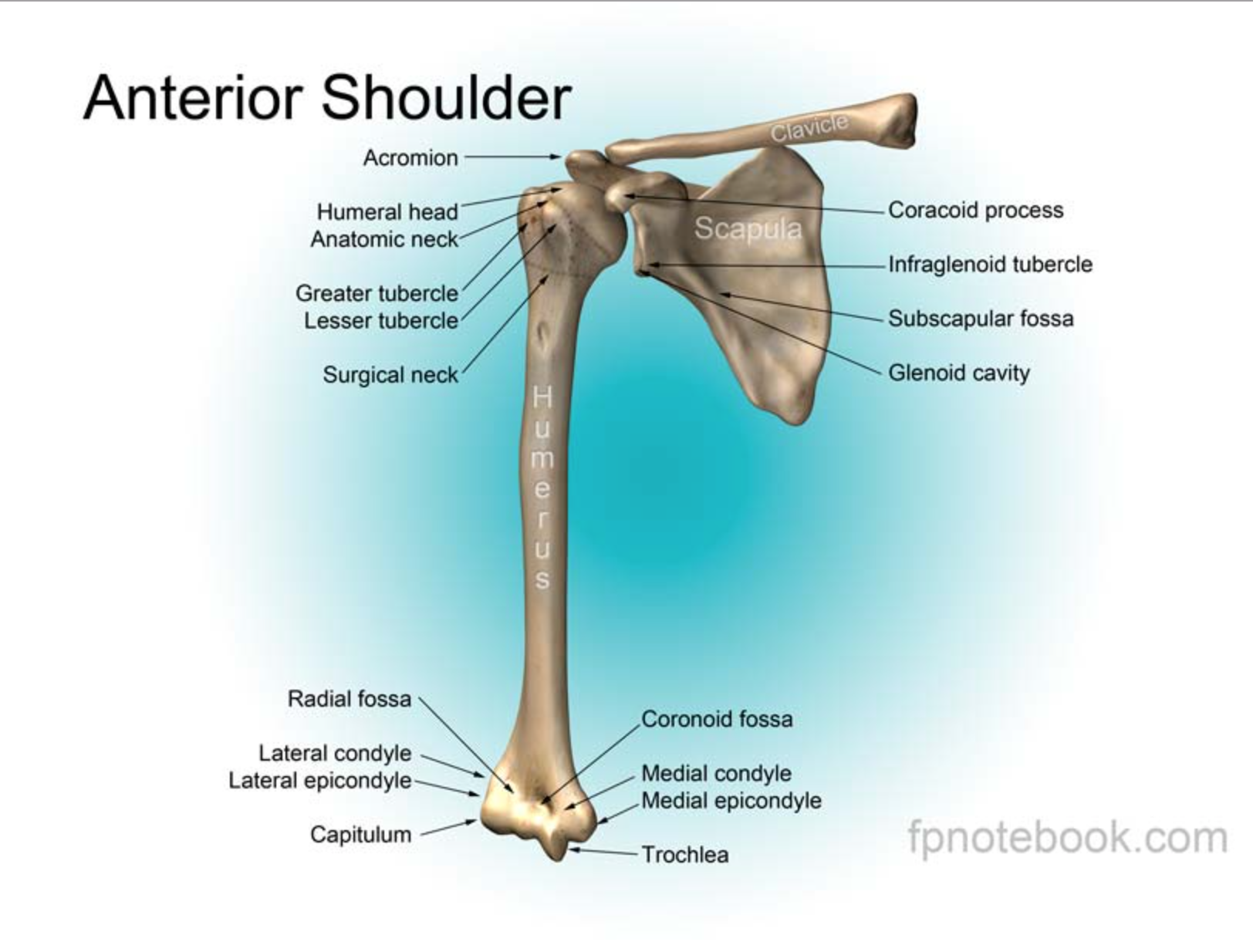
I will try to use the diagram provided in this post to describe the break. My description may not be exact because this happened 10 years ago and I am by no means a doctor. I believe that I broke some part of the humeral head with a vertical break. If you can imagine hitting a piece of firewood with an axe and splitting it from the top that would be essentially what it looks like. The piece of bone broke off and lowered by about an inch, but it stayed lodged against the humerus by the tendons connected to it.
Every time that I raised my arm high enough over my head, my shoulder would dislocate. I couldn't put my arm up and my elbow in line with my ear without my shoulder dislocating.
When I was 19, I went to the doctor, and he had me do a few movements. Immediately he said, "Your shoulder is broken." Then he had me do an x-ray, and sure enough, my humerus was broken.
I had orthoscopic surgery to reconstruct the shoulder joint. The doctor cut a piece of my coracoid process and used bolts to mount it to my humerus. After that, I worked really hard to build flexibility in my shoulder to get back most of the range of motion. The rehab was primarily focused on helping me get to the point where I could lift my arm above my head and lift a 10 pound weight horizontal to the floor. I did various stretches, but nothing like the stretches in the Thoracic Bridge series. I just worked through that stretch series yesterday, and I couldn't do several of the stretches at the end of the video.
If I don't exercise my shoulder and I get out of shape, my shoulder will sometimes ache because of the lack of support that my joint needs to function properly. There was a season in 2010 when I was running a lot, but I wasn't doing any upper-body training, and I extended my arm to close the car door, and I felt a tremendous amount of pain in my shoulder. Afterwards, I began doing a push-up and pull-up routine to strengthen the shoulder muscles, and I have never had that issue since.
I hope that helps give you an idea of my condition.
Nicholas,
Thank you very much for your encouragement! I appreciate your testimony. I will do my best to work towards it, and I can't wait to see what the GST series will do for my shoulder. I am really excited actually. I hope that I will gain much more flexibility and strength so I can be healthier.
Hi Bobby,
Sorry for my late reply. I'm sorry to hear about the trouble that you had with the shoulder. I am by no means a medical practitioner and cannot give you advice as to whether you will be able to gain full range of motion and strength in your shoulder. I guess the only way that you will ever find out is to give it a try. As I have said previously one of the great things about the GymnasticBodies system is that you will never be in a position where you are attempting skills that are outside your current physical capabilities. Coach Sommer has been meticulous in his planning of the progressions to ensure that you are fully prepared.
Another aspect that I have enjoyed since beginning my training with GymnasticBodies is the opportunity to prove people wrong. I didn't start body weight training until I was in my late 30's and was constantly told by people that I was starting too late. 4 years on I have achieved things that I thought I would never be able too. One of them being a planche. Stick with it be patient and consistent and you may be surprised at the results. I believe Arthur C Clarke said, "The limits of the possible can only be defined by going beyond them and into the impossible". I look forward to seeing how far you can go with your training.