This forum is archived information and is no longer active.

HS SE 14 Form check

Started by Francisco Garcia, June 26, 2017 · 12 Replies · 262 Views

Francisco Garcia

Ok, so I'm not really on SE14 since I fail all the shoulder mobility exercises.  I've demoted myself back down to PE4 and I've managed to hurt my left shoulder so I've got a ways to go.

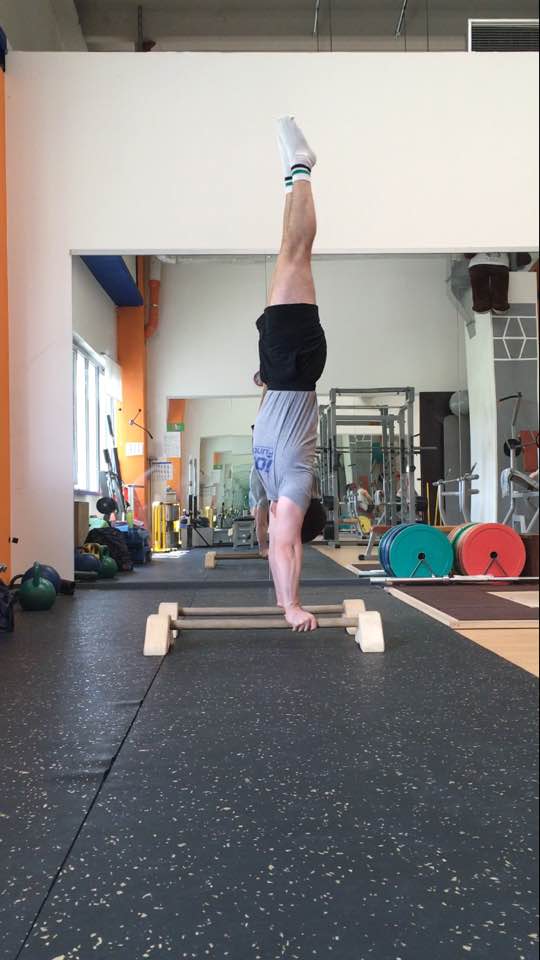
But I was hoping to get feedback on my handstand SE14.  My entry and exit are less than graceful, and I can't seem to stay up past a minute (50 seconds in this one, I think).  But otherwise, what do you think?  Any suggestions or pointers would be appreciated.
 

Alessandro Mainente

Hey FRancisco nice balance, well from my pov consider that the more you balance with the wrong alignment (due to shoulder lack of mobility) the more you tend to save in your brain a wrong pattern. consider that for learning something you need 24 thousands of reps and that for correct a wrong pattern your need to triple these reps. Spending too much time on learning something with a technical deficit it is not always the best idea. I know you can say that " i'm still learning" but it is like learning the wrong way to do math!

Affan Osman

I am no where close to this. So should I only do chest to wall handstands till I fix my shoulder deficits? Currently I do both chest to wall and back to wall handstands trying to hold for a few seconds to build balance.

Francisco Garcia
1 hour ago, Affan Osman said:

I am no where close to this. So should I only do chest to wall handstands till I fix my shoulder deficits? Currently I do both chest to wall and back to wall handstands trying to hold for a few seconds to build balance.

Hi Affan, the progressions in the HS course are the best I've seen and I would recommend sticking with them.  I disagree with @Alessandro Mainente in that I do think it is important to actually practice your handstands while you're working through the progressions.   If nothing else, it will show you how you are progressing.   I should put together a little collage video of my handstands over the past year to show how they have improved with the HS course exercises.  My alignment isn't perfect (you can see that my arms are not in the same line as the rest of my body, which I think is what Alessandro meant), but it is far better than it was even a couple of months ago.  As my shoulder mobility has improved, the arms are getting closer to being in line. 

To answer your question more specifically, though...  the exercise that has helped me the most is the fingertips-to-the-wall handstands (with the back on the wall).  It's important to keep the shoulders strongly elevated and keep a PPT.  I found that holding that improved both my endurance and my alignment.   

Stick with the course exercises, though!  Don't get frustrated.   I, unfortunately, did not follow that advice and managed to damage my left shoulder trying to go beyond my ability with the dislocates.

Good luck!!

Alessandro Mainente
14 hours ago, Affan Osman said:

I am no where close to this. So should I only do chest to wall handstands till I fix my shoulder deficits? Currently I do both chest to wall and back to wall handstands trying to hold for a few seconds to build balance.

my point of view about handstand development it is that only when proper mobility it is developed then you can begin free handstand, not before. coupling handstand and thoracic bridge course can be a godo solution.

I coached many kids and adults and with all of them I decided to stop free handstand in favor of mobility on the shoulder, then whey they were ready they got the handstand 2-3 times faster than before.

Francisco Garcia

@Alessandro Mainente you are undoubtedly right about people being able to achieve handstand faster once they have the required shoulder mobility.  The problem is that some of us with poor shoulder mobility will take years to develop it.  And so "faster" is a question of when you start the clock.

In my case, I am old.  My shoulder mobility is better than average, but no where near where it would need to be to pass PE5-iM if the requirement is to have the hands just beyond shoulder width.   It is possible that I will never be able to achieve that level of mobility.   

The GB coaches on the forum are very strict about approving mastery on the progressions.  Sometimes, so much so that I think even the demonstration videos wouldn't pass.  It's probably a good thing, so long as people don't get discouraged.  

An interesting counter example is my Tang Soo Do experience, which I have been taking learning with my son.   Sometimes, the masters allow me to advance to the next belt before truly mastering the techniques of the previous belt.  Interestingly enough, as I practice the techniques of the new belt, I find that the mastery of the previous belt techniques is there.  Was it a mistake to to advance me? 

The last thing to point out is if you look at the statistics of the form checks in the forums, they are heavily weighted toward the earlier progressions.  This would seem to indicate that people are getting stuck or quitting.  People need to feel they are making progress to stay engaged.

Alessandro Mainente

This is one of the biggest problems in the fitness world. when you talk about results people want that a diet works faster and also a schedule gives fast results. things do not work this way. do you want to know how much I spend on achieving my handstand like the photo below?

17457802_10212529710948597_2393881284188235018_n.jpg

something like 7 years ago and Coach Sommer can easily remember how my shoulders were so damned tight.

the consistency and the trust in the process and the course it is what you need, you have all the instruments and the courses to ensure a correct shoulder flexibility.

Accepting that the reward needs a long journey it is the first step. it is up to you accepting that the journey can be long, I accepted it. can you?

Francisco Garcia

Hi @Alessandro Mainente , that's a nice line!  It's good to hear that you started with tight shoulders and were able to get past it.  That gives me hope.  

I love GymnasticBodies and the coaching you guys provide.  As a matter of fact, I would really like to start a GB affiliate here in San Diego, at some point (I reached out and was told that the first step was to attend a seminar - unfortunately, the Denver one was sold out and I can't make the one in the UK next week).  

The progressions approach is what makes GB great.   Of course, I would like to get a solid handstand as quickly as possible (doesn't everyone?).   I don't want to cheat the process, though, which is why I've brought myself back down to PE4.  At my current rate of progress, it will be several years before I can get past PE5 (assuming constant progress of about 1/2 inch per month).  I am willing to put the time in.  

I do want to help GB be as good as it can it be, though, and to have it help as many people as possible.  Most people don't have the dedication (obsession?) that I do to improve on these skills.   How best to keep these people motivated (and purchasing your products!)? 

John Kiggundu
On June 27, 2017 at 10:23 AM, Francisco Garcia said:

@Alessandro Mainente you are undoubtedly right about people being able to achieve handstand faster once they have the required shoulder mobility.  The problem is that some of us with poor shoulder mobility will take years to develop it.  And so "faster" is a question of when you start the clock.

In my case, I am old.  My shoulder mobility is better than average, but no where near where it would need to be to pass PE5-iM if the requirement is to have the hands just beyond shoulder width.   It is possible that I will never be able to achieve that level of mobility.   

The GB coaches on the forum are very strict about approving mastery on the progressions.  Sometimes, so much so that I think even the demonstration videos wouldn't pass.  It's probably a good thing, so long as people don't get discouraged.  

An interesting counter example is my Tang Soo Do experience, which I have been taking learning with my son.   Sometimes, the masters allow me to advance to the next belt before truly mastering the techniques of the previous belt.  Interestingly enough, as I practice the techniques of the new belt, I find that the mastery of the previous belt techniques is there.  Was it a mistake to to advance me? 

The last thing to point out is if you look at the statistics of the form checks in the forums, they are heavily weighted toward the earlier progressions.  This would seem to indicate that people are getting stuck or quitting.  People need to feel they are making progress to stay engaged.

@Francisco Garcia if your goal is to only be able to achieve a freestanding handstand, then you are absolutely correct. If, however, your goal is to not only achieve a freestanding handstand but also take a stab at more advanced GST skills (I'm thinking about rings training, for instance) then you are absolutely wrong and @Alessandro Mainente is absolutely correct.

I originally thought that the main purpose of Pe5>iM (shoulder dislocates) was to improve the mobility in our shoulders, to open them so to speak, so that we could have a properly aligned freestanding handstand. It was, so I originally thought, simply to help with aesthetics. I then had the opportunity to see gymnasts performing dislocates on rings and then the light bulb lit and I realized that our humble Pe5>iM is actually intended to prepare our shoulders for future ring dislocates and not merely to help us achieve a properly aligned freestanding handstand. That is why the coaches keep insisting that we try to narrow the width of the dislocates as much as possible, and to then start doing them with added weights once we have narrowed the width.

Ask yourself, how in the world could we attempt dislocates on rings when we couldn't even do a basic standing dislocate? Or, if we could injure ourselves when doing a standing dislocate, then what would happen when we attempted dislocates on rings? The hospital emergency room?

It's taken me way longer than I care to admit to progress from Pe10 (5x60 wall runs) to Pe11. So many times I've tried to talk myself into forging ahead to the next PE while I continue trying to master Pe10 on off days. But it was only after I re-read Coach's original post on handstand wall runs that I realized that the 5x60 threshold is not only beneficial in helping us master a handstand, but is most likely intended to strengthen our shoulder girdle to prepare us for press handstands, one-arm handstands, etc.

Coach has repeatedly said that poor form is often the consequence of weakness or poor mobility or a combination of the two. If the coaches were not keeping us in check and allowing us to progress with this poor form, then we would eventually injure ourselves due to these unaddressed weaknesses or mobility deficits.

Just my humble two cents.

Francisco Garcia

@John Kiggundu, I think you misunderstood the intent of my post.  It was not to imply that shoulder mobility is not required to do a proper handstand.  I completely agree it is and that is why I am working hard to improve my shoulder mobility and am practicing my dislocates daily.  

The point of my post was simply to ask if it might make sense to allow people to try more advanced exercises (while still working on improving shoulder mobility!), especially those that don't require great shoulder mobility.  I am curious to see how the GB affiliates teach handstands.  Will they not even let you attempt a handstand against the wall unless you have achieved shoulder-width dislocates?  I doubt those classes would be very popular.

Suzanna McGee
On 8/6/2017 at 7:26 PM, John Kiggundu said:

It's taken me way longer than I care to admit to progress from Pe10 (5x60 wall runs) to Pe11

John, out of curiosity.. how long did it take? I have been for really long on PE8 (5x30r wall runs). At this point, I have surrendered and enjoying the process, because each training sessions makes me stronger. So I am not in a hurry (anymore). But still curious how long was it for you  :-) 

John Kiggundu
18 hours ago, Suzanna McGee said:

John, out of curiosity.. how long did it take? I have been for really long on PE8 (5x30r wall runs). At this point, I have surrendered and enjoying the process, because each training sessions makes me stronger. So I am not in a hurry (anymore). But still curious how long was it for you  :-) 

@Suzanna McGee, I'm still working on it. I was lazy and erratic in my training (nowhere close to being as disciplined as you) and that's why it has taken me this long. Consistency makes a huge difference, particularly with wall runs, because the multitude of tiny muscles that we have in the shoulder girdle, as well as the traps, adapt well to consistent training.

The most important cue here is to make sure that you press the floor during every rep which will elevate the shoulder on the arm under tension. Although this may seem like extra work, it actually makes it less straining to lift the opposite arm and consequently the wall runs become a little bit easier. This one is a classic example of proper form paying good dividends.

Suzanna McGee

@John Kiggundu thank you. Yes, I have not missed a workout, and I do love the Wall Runs. I don't feel stuck on them, I feel I am finding something new each practice session and little by little getting stronger and with a good control. Pushing the ground away is definitely my main cue when I perform these.