This forum is archived information and is no longer active.

Rest and recovey

Started by Étienne Lajeunesse, April 26, 2017 · 124 Replies · 2,635 Views

Everett Carroll
5 hours ago, Joshua Hibbert said:

I read a blog post by GST about alternating between hot and cold exposure just before bed which I have done the past couple of nights and I have had a much improved sleep.


What is the theory behind this?


Hey Joshua! Glad to hear it's helped! I got that info from Ray Cronise. Here is a podcast where he discusses the protocol: 

They discuss it in depth around the 1 hr 15-20 minute mark. It has never failed me!

Joshua Hibbert
17 hours ago, Everett Carroll said:

Hey Joshua! Glad to hear it's helped! I got that info from Ray Cronise. Here is a podcast where he discusses the protocol: 

They discuss it in depth around the 1 hr 15-20 minute mark. It has never failed me!
Thanks for sharing Everett,  some very interesting topics covered.  There is also lost of other information I can listen to.

Ryan Segervall
On 5/15/2017 at 8:47 AM, Everett Carroll said:

I'm noticing that for sure! When I land a 9.0-9.3 (baseline=9.2), I am AMPED! The only outlier is a 10.1 I got out of the blue; I was pretty fatigued that day and had to take it lighter than expected despite having a high recovery value.

Thanks again for sharing this Ryan! I'm having a blast with this app. 

The day you took it lighter, did you just cut down volume? if so by what percentage roughly? 

Did you notice you being able to recover better for your next training session later in the week?

Ryan Segervall
On 5/17/2017 at 9:11 AM, Suzanna McGee said:

Similar two days for me, @Katherine Zodiaco…  I only had a (deloaded) Handstands yesterday, but a really full day with work/clients. And I did some little extra pole training, which seems very taxing to me (I am so not strong for the pole, grrrr). Anyway, my score was 9.0 yesterday and today it fell down to 7.5 (baseline 8.4)! Wow, what a drop… what to take from all these numbers? I still don't really know, I bet @Ryan Segervall will have more experience to share, but I think it is just observing how we feel, and perform, and correlate it to our lifestyle and what the app tries to suggest to us. We want to see the different links and correlations to different training stimuli. And eventually just be more careful when the numbers are getting low (for too long) and maybe take an extra nap, an extra light day, or something to help us to recover faster to get the numbers up… Personally, I am noticing that each time I add some extra pole practice, even though it is only 30 minutes, it really wears me down. (I still so struggle with that pole thing…) My HRV numbers go down immediately.  Maybe I need to go to bed earlier on those days to get more sleep to recover better, or do more myofascial rolling/massage to feel more relaxed, or take a hot bath… I will play with these things in the future and see how my body will respond. 

- Yea sounds like the extra pole work is wearing you out. try playing around with different recovery tactics on those days and see how you recover. Extra nap, a sauna or hot bath, meditation, fish oil supplements (upwards of 30g), foam rolling, ect. 

Also could try placing your pole work onto different days of the week and see how you tolerate that. 

This is the fun part where you can start to use the data to optimize your routine to insure best possible results :) 

Ryan Segervall
On 5/18/2017 at 4:25 AM, Ferdinand Berr said:

I'm actually impressed by the app's "accuracy". My results this week have been: 7,7 / 6,1 / 8,2 / 7,2 / 8,2 / 6,6 / 6,2. I've actually been rather exhausted and stressed most of the time. The 6,1 was recorded waking up the morning after my move-in party and extensive drinking, which I normally don't do. The 6,6 yesterday really surprised me (trained the day before, but sleep and nutrition had been nice), but I actually seem to have caught a little cold and feel a little sick today also. I'm interested in how the values develop when hopefully getting back to healthy and a normal rhythm during the next weeks.

Do you do your measurements directly after waking up while lying in bed or do you wait like 10 minutes or something?

- Its best to measure right when you wake up and before you start walking around and doing things, and always make sure your getting an optimal reading. 

but it is surprising how the score you get in the morning dictates how the rest of your day is going to go. 

Ryan Segervall
On 5/18/2017 at 11:23 AM, Everett Carroll said:

Hey Joshua! Glad to hear it's helped! I got that info from Ray Cronise. Here is a podcast where he discusses the protocol: 

They discuss it in depth around the 1 hr 15-20 minute mark. It has never failed me!
Super interesting! For the contrast shower how long do you usually go 10s hot 20s cold. I thought they said 2 minutes but was wondering what you were doing/what your experiences were with it. Also when during the day do you do it? Closer to bed time around 6pm or in the morning? @Joshua Hibbert

Everett Carroll

Hey Ryan,

I do it just before bed. 10s hot, 10 cold, repeat 10 times, end on cold. 

Ryan Segervall
8 hours ago, Everett Carroll said:

Hey Ryan,

I do it just before bed. 10s hot, 10 cold, repeat 10 times, end on cold. 

Awesomeness,

im a give her a go. In the past ive do e contrast showers with minute intervals. This seems a bit more time effective and possibly more enjoyable haha

Joshua Hibbert
On 20/05/2017 at 4:33 AM, Ryan Segervall said:

Super interesting! For the contrast shower how long do you usually go 10s hot 20s cold. I thought they said 2 minutes but was wondering what you were doing/what your experiences were with it. Also when during the day do you do it? Closer to bed time around 6pm or in the morning? @Joshua Hibbert

Hi Ryan,

I have been doing it about half an hour before I go to sleep. I tried the 10 seconds hot, 10 seconds cold for 10 times.  I also tried the 10 hot, 20 cold.  Didn't seem to have any added benefit so will stick to the shorter time.  Need to do it a bit longer to see the full effects but it has generally meant I have slept through out the night a lot better.

Everett Carroll
On 5/19/2017 at 8:50 PM, Ryan Segervall said:

The day you took it lighter, did you just cut down volume? if so by what percentage roughly? 

Did you notice you being able to recover better for your next training session later in the week?

It was a climbing day so I just climbed easier routes. Unfortunately, it was not as quantifiable as a Foundations workout. I cut the difficulty by about one full number grade i.e from 5.12 to 5.11. 

Ryan Segervall

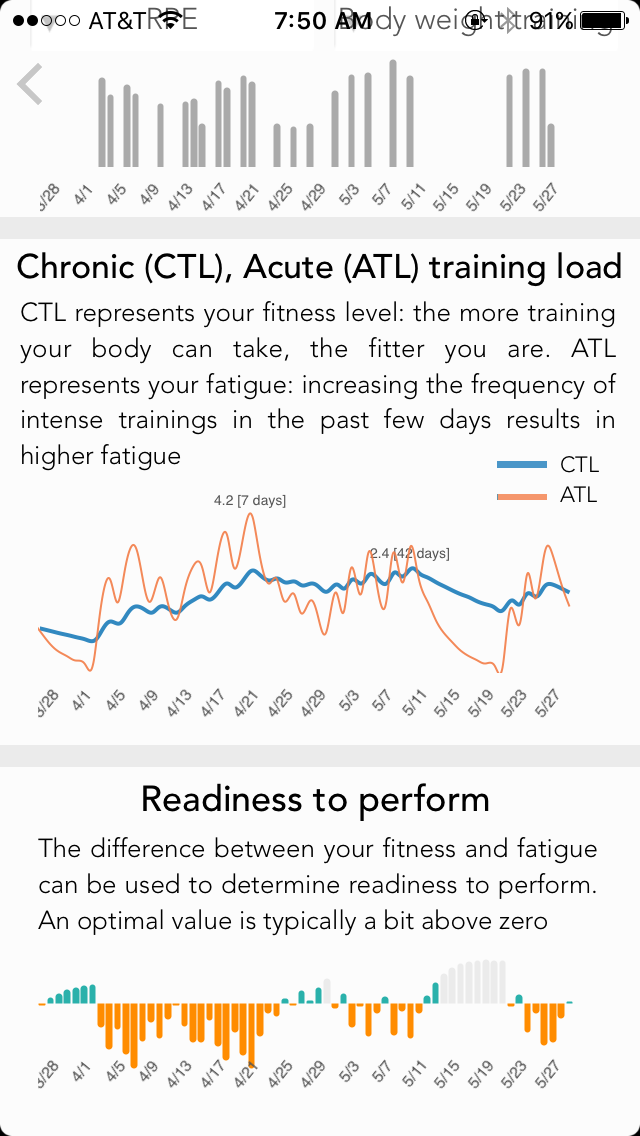
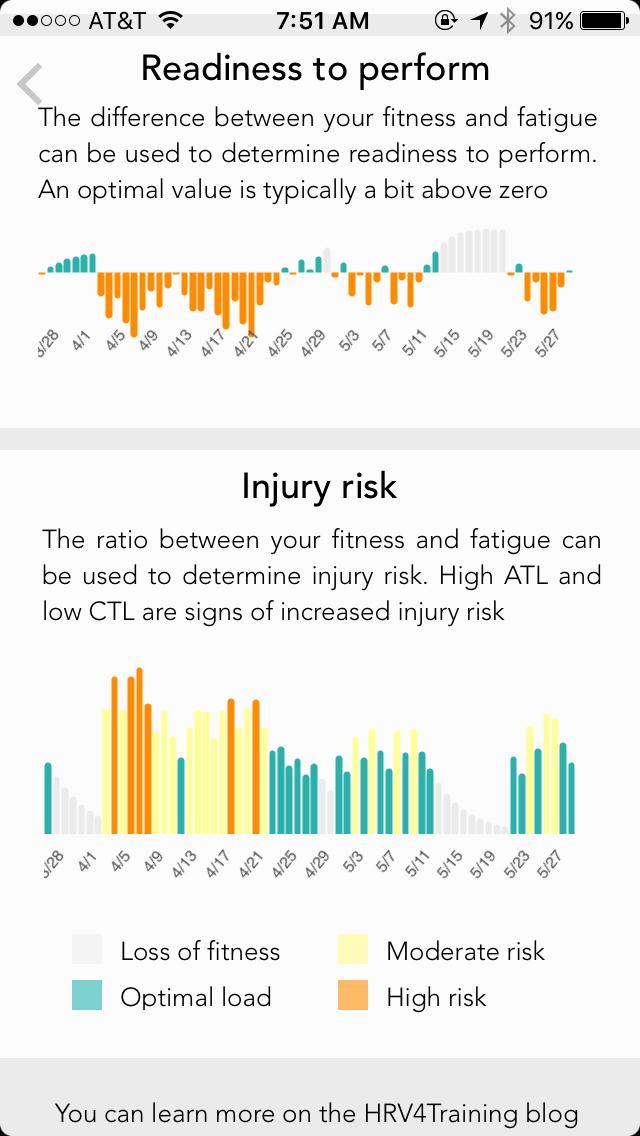
So after a 10 day lay off from training (due to graduation crazyness, and a road trip with my college buddies) I am finally back. Last week I came in strong and set a bunch of PR's on my lifts, but it was a very taxing week as I added in H1 to my training and also had a 2 hour squat clinic on one of my rest days. 

Woke up today and strangely my HRV was in the shitter. Making some adjustments to this weeks volume as last week was very intense. Switching from a MWF strength split to a Tue Fri split to allow for better recovery.

Looking at the trends I saw I was right on the border of what I could recover from (you see my fatigue begins to stay above my fitness by the time my next training day comes). Decreasing training days from 3 to 2 times per week to give my a body a chance to catch up. Next week I will see where I am at but may stick with a 2 day split for a while as my last 4 week cycle of a three day split started to catch up to me and started to not be able to recover fast enough as you can see right before I took by 10 day break. 

IMG_1200.PNG

IMG_1201.PNG

Katherine Zodiaco

@Ryan Segervall, Super helpful post!  I am almost to the point where some of those measurements become available. Right now my readiness to perform only shows orange below the line. Hopefully in the next few weeks I'll be able to get some green above the line. 

Congratulations on graduation! And I hope you had a great road trip.

Ryan Segervall

@Katherine Zodiaco 

Glad I was helpful! The training load portion of the app is by far the most useful in my opinion just takes a bit to get enough measurements to have that portion unlocked. 

And thank you! we had a blast playing out in Utah :) 

Ryan Segervall

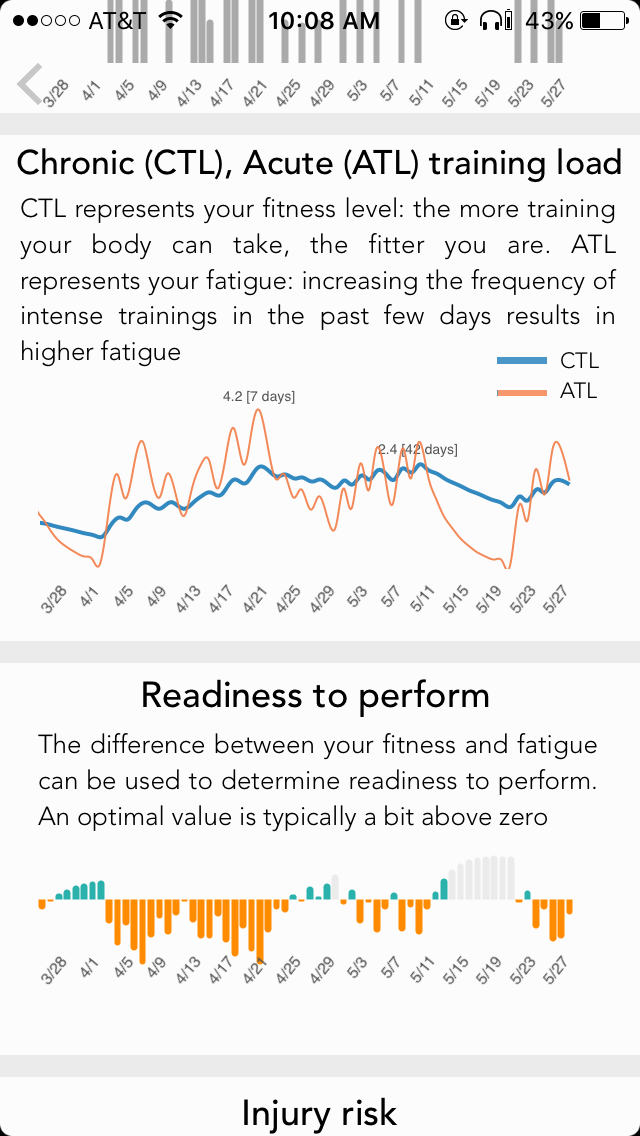
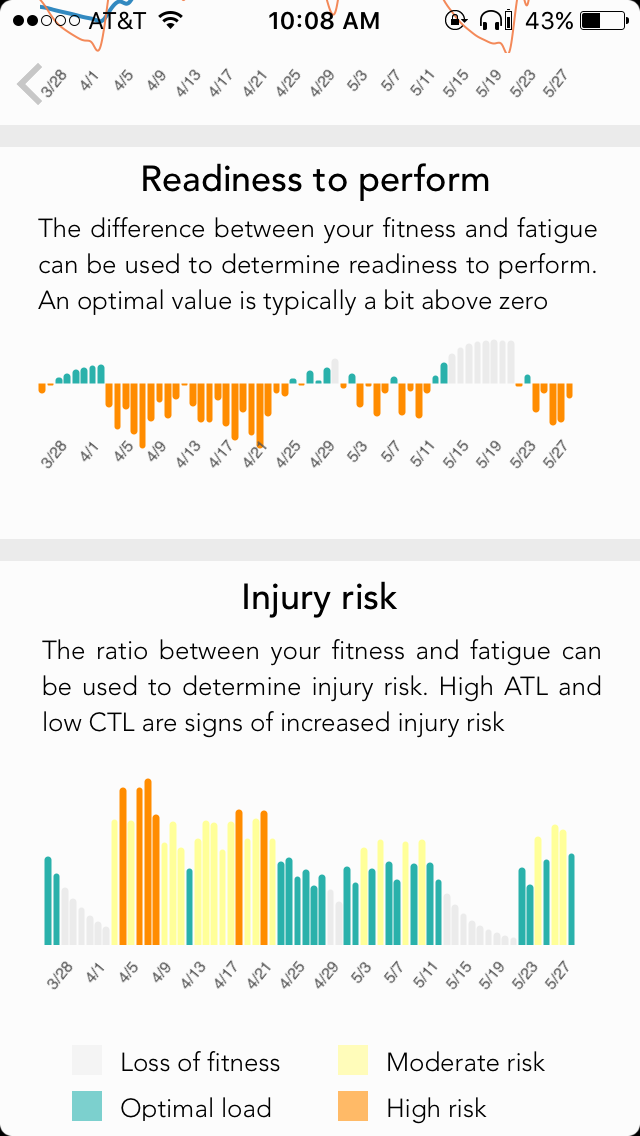
- The data is giving me a green light today. Gonna go get after it, which me luck :) 

IMG_1222.PNG

IMG_1223.PNG

Ryan Segervall

Just checking back in. The adjustment made proved to be a very wise decision. All exercises progressed and Mastery was reached on one of my exercises. Very excited and come into each training session feeling very fresh and able to give it 110%


- Hopefully this example helps show how you can use this data to optimize training and help eliminate some of the guess work when finding the optimal training frequency 


Joshua Hibbert
9 hours ago, Ryan Segervall said:

Just checking back in. The adjustment made proved to be a very wise decision. All exercises progressed and Mastery was reached on one of my exercises. Very excited and come into each training session feeling very fresh and able to give it 110%


- Hopefully this example helps show how you can use this data to optimize training and help eliminate some of the guess work when finding the optimal training frequency 


Glad it's working out for you Ryan,  I am going to give the app a go as my recovery time at the minute feels a lot more laboured recently.   Just a couple of questions, can you tell feelings wise the difference between green light  and red light? (when fatigue levels are high)  At what point do you adjust your training because of the fatigue factor?


Climbing is having the biggest impact at the moment,  I still get DOMS especially in the forearms that can last for 4 or 5 days (not everytime) which is obviously impacting my GB training.  GB is my main focus  but I still want to improve my climbing. @Everett Carroll what do you recommend?  My climbing sessions last around 1 and a half hours to 2 hours usually pushing to my limits.  Should I reduce the intensity of my climbing sessions?

I used to do F7 twice a week but have reduced that to just core on Tuesday as I wasn't recovering in time.


My schedule is currently

Tues: Core

Weds: Front Split

Thurs: Middle split

Fri: F7

Sat and Sunday: Fit in squash and a climbing session around 1-2 rounds of golf.

I have been sticking to this schedule irrelevant of feeling fatigued to keep my training consistent.  At what point do people judge that missing a training session would be more productive than doing it?  I played a charity football match on Sunday, the first game in about 3 years which has left me a little drained which has got me thinking about this.


Ryan Segervall

@Joshua Hibbert


Training capacity and recovery rate is going to vary from person to person, but I can give some general guidelines that might help. 


In my experiences with GST which has been about 5months now I have made the most progress with more of a minimalist approach. I have tried strength training 4 and 3 days a week but usually wind up feeling overly fatigued. Some clear signs are having to drag yourself into the gym. Barely making it through the weeks training volume and having that mind set of once its the weekend I can finally rest up and recover. I Have found strength training twice a week, for me, to work much better. I go to the gym full of energy and am able to really give it my best effort and attention as opposed to having to drink a coffee to energize myself in order to get through the workout. I have found progress to come much faster and plateaus to dissipate.  

Current Split

Sun: Rest/ middle split & H1

Mon: F3 (SLS, MN, SL) 

Tue: Front split 

Wed: H1

Thur: F4 (RC, HBP, SPl, FL) 

Fri:Rest

Sat: Rest/ Middle Split & H1


(Sat or Sun are either middle split H1 or a rest day depending on how my weekend unfolds.)


As for you you could try a similar split that I am on but through climbing in on the weekends. This would give your upper body upwards of 5 days rest before hitting it again on thursday. 


Also will note that the F3 F4 allows you to train with greater intensity and your performance tends to remain high throughout the workout as opposed to F7 where you can become quite fatigued by the end of the session and you may have trouble progressing exercises that are programmed at the tail in of your workout. 


@Everett Carroll feel free the chime in on your experiences as you have been training far longer than I have. This is what I have found over the months

Ryan Segervall

@Joshua Hibbert Just wanted to add that I am in a beginner stage of GB journey so the amount of work I can take is less than someone who has been training GB for several years. 

Using HRV can help find that sweet spot that allows you optimal recover/performance on each training session as I showed in my example above. 


Hope this helps, 

Ryan 

Everett Carroll
On 6/6/2017 at 7:45 AM, Joshua Hibbert said:

I still get DOMS especially in the forearms that can last for 4 or 5 days (not everytime) which is obviously impacting my GB training.  GB is my main focus  but I still want to improve my climbing. @Everett Carroll what do you recommend?  My climbing sessions last around 1 and a half hours to 2 hours usually pushing to my limits.  Should I reduce the intensity of my climbing sessions?

Yes, reduce the intensity of your climbing sessions. Routinely pushing your limits on the wall is going to have a massive impact on your recovery. I suggest reducing either your frequency, intensity, or duration. You want to make recovery a priority so back off as much as needed. Managing your fatigue so that you are consistently improving is the key. 


Joshua Hibbert
On 2017-6-7 at 8:00 PM, Everett Carroll said:

Yes, reduce the intensity of your climbing sessions. Routinely pushing your limits on the wall is going to have a massive impact on your recovery. I suggest reducing either your frequency, intensity, or duration. You want to make recovery a priority so back off as much as needed. Managing your fatigue so that you are consistently improving is the key. 


Thanks Everett, I will take your advice and try not to push too hard on the wall.  I think I will make a note of how many attempts I make etc to give me a better idea of the intensity of each work out.  It can be hard stopping when you know you're tired, it's always just one more!


@Ryan Segervall I basically took last week off, just some limbering and a bit of cardio.  I have had a bit of cold this week so wanted to give my body a chance to recover and start fresh this week.  I have started taking the HRV measurements so when I get back into it this week it will be interesting to see how it's effected.  The main plan is to do F7 once week, I like the idea of building work capacity, and then depending on how I feel try and get another in.

I have been looking at my data, I have a HRV of 144.00ms which is unexpectedly high.  I think I understand that HRV is the variation between heart beats and generally speaking the higher the better.  The purpose of HRV is to focus on your trends but what actually causes a high HRV and what does that mean?

Petra Kmecová

@Ryan Segervall ... thank you so much for introducing this app in this topic and all your helpfull post regarding using it ... I've been using it for three week now and it already confirmed what I've been suspisious of.

Since new year, I've been in a bad circle of overtraining myself far beyond my ability to recover, not progressing or progressing very very slow, pushing it harder and thus making it even worse ... and since I'm guilty of being the intensity person (love the adrenalin rush, lying in a pile of sweat, etc... :-)) I have hard time backing off ... As you mentiined in one of your posts ... I love to train, love to train hard, hate rest days, but I also hate no progress and constant fatigue... your posts on how reducing volume helped you to progress and also seeing your progress and ppatience in formcheck section really inspired me to restart my gst training ... this time - the right way. So, thanks once again... :-)

Ryan Segervall
On 7/10/2017 at 10:12 AM, Petra Kmecová said:

@Ryan Segervall ... thank you so much for introducing this app in this topic and all your helpfull post regarding using it ... I've been using it for three week now and it already confirmed what I've been suspisious of.

Since new year, I've been in a bad circle of overtraining myself far beyond my ability to recover, not progressing or progressing very very slow, pushing it harder and thus making it even worse ... and since I'm guilty of being the intensity person (love the adrenalin rush, lying in a pile of sweat, etc... :-)) I have hard time backing off ... As you mentiined in one of your posts ... I love to train, love to train hard, hate rest days, but I also hate no progress and constant fatigue... your posts on how reducing volume helped you to progress and also seeing your progress and ppatience in formcheck section really inspired me to restart my gst training ... this time - the right way. So, thanks once again... :-)

Thank you for your thought out message. So happy I could be of help! And although we may not like the answer less is often more when it comes to GST. Or at least this is what I am finding to be true :) 


Andy Vitus

For those of you who can't get enough of quantifying yourself: take a look at an app called 'Sleep Cycle'. I've been using it to track my sleep quality for 6 months and it seems quite accurate. Would be great if it integrated with HRV4 because I base my sleep quality assessment in HRV4 on the output of Sleep Cycle each morning.

Suzanna McGee
On 8/8/2017 at 9:41 AM, Andy Vitus said:

For those of you who can't get enough of quantifying yourself: take a look at an app called 'Sleep Cycle'. I've been using it to track my sleep quality for 6 months and it seems quite accurate. Would be great if it integrated with HRV4 because I base my sleep quality assessment in HRV4 on the output of Sleep Cycle each morning.

I do the same :) (data analyzing nerd). I use my FitBit that shows my sleep phases (light, REM, deep, restless) and it is really cool to see how it also reflects in HRV4Training…  it is quite precise. If my HRV data goes down, I make sure to add a few naps in.