This forum is archived information and is no longer active.

Any thoughts on using a heart rate monitor?

Started by PAUL DALY, March 21, 2017 · 11 Replies · 187 Views

PAUL DALY

I've been thinking that a heart rate monitor could give you an objective way of determining whether an exercise is easy, fine, too hard, etc. 

Anyone ever try that or think about it. 

Let's just say I try it -- what kind of numbers should I be looking for? 
Ryan Bailey

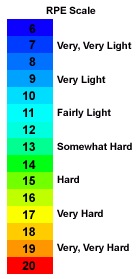
I think heart rate monitor gets a little tricky when trying to relate it to the smiley system because it leaves out form, control, mastery ect.  But if you are into the heart rate monitor thing, it may be interesting looking at this scale Ias it relates to your exercise and your heart rate.  

58d08cebf2659_BorgRPE.gif.a8516b5580779750de7b292f539057bb.gif

The Borg Rate of Perceived Exertion (RPE) 6-20 scale was studied to correlate somewhat to heart rate, hence the subjective intensity.  Example, take a cardiac patient walking on a treadmill at 3.0 incline at 3.5 MPH.  If that person subjectively rates the exercise as hard "15/20"  then the heart rate on the monitor would loosely correlate to 150 beats per minute.  So looking at the scale, we would add a 0 after the number to have a general correlation between the heart rate vs. the subjective.  Again, I do not think this would relate to the GB exercise and mastery, but you might try for a workout asking yourself your perceived exertion and then checking the number on this scale.

Suzanna McGee

Personally, I don't think it will work… (or at least it doesn't for me). My heart rate is MUCH higher when I walk my dog for an hour early in the morning (and it is not tiring at all). While some GST exercises may be quite hard sometimes, (like my MN/PE6, grrrrr) but my heart rate doesn't go that much up. Maybe try it and experiment with it. And let us know :) (I just log in everything for my personal entertainment and analysis, and this was my little conclusion) 
Wayne Smith

I can't see the need to complicate life, myself. Making sure I get the time to show up and get my workout done is complication enough for me. If I can't maintain good form throughout or can't finish my sets then it's too hard. If I finish my sets thinking it was way easier than it used to be, and I can do more than just a couple of extra reps, then it's smiley face time. If I'm grinding 'em out, maintaining form and wishing it was over already then I call that 'fine'.

I do use an HRM for some occasional cardio work, following the MAF protocol (target HR = 180 - age). That's because I am specifically trying to target an improvement in VOx  for beep test performance. Too early to tell if that's working for me or not.

My limited understanding is that an HRM is good for indicating the performance of the aerobic energy pathway, and GST recruits more of the anaerobic energy pathway.

Darin Phoenix

I like the fact that you are thinking outside the box, however, you would be far better off focusing your energies on the qualitative aspects of your training. Focus on whether you have the adequate strength and mobility to execute each movement correctly, these indicators will help you determine the appropriate rating to give your workout. 

Janno Rillo

I have been using HRM for over a decade for my endurance training and have tested is also for different other sports types (weight lifting, bodypump, bodyweight circuits, even ashtanga yoga). HRM has basically only 1 goal- to ensure that you are not overdoing your cardiovascular training (not running your long runs with too high intensity, not pushing your intervals with more effort than reasonable). It's also meant for sessions with relatively stable exertion, rather than frequently changing activities like GB sessions or short bursts. While it's helpful for endurance sports (especially for beginners), it's not a precision tool even there. But for strenght training I think it's completely worthless. As Suzanna mentioned, her HR is lower during strength training than walking her dog. She probably has good base endurance, in my case my HR can rise pretty high during GB session, but the point is still there- your effort and HR are not in sync and that's why it doesn't add value to your training. You might be already in the middle or end of the set when HR is still increasing, and you might be already finished with your mobility set while HRM still shows you high gears. By the end of the training the heart rate graph resembles to saw teeth, the average HR will be lower than usually recommended for the entry level aerobic training and it's difficult to draw any conclusions from that:)

PAUL DALY

I might be doing something wrong. . . I used my HRM for my GB work out the other day. By the time I finished my warm up, it was in the 150's, and stayed in the 150-160's throughout, i.e. for about an hour. Occasionally got into the 170s. No real saw teeth graph -- it never got down into the 140s. 

That seems a fairly high rate to keep up for that period of time. Or maybe not. I don't really know. 

Maybe I should scale back to the point where I can get some dips in the Heart Rate as I go from one exercise to the next? 

Maybe this relates to my other post. . . avoiding soreness? 


PAUL DALY
On March 20, 2017 at 11:14 PM, Suzanna McGee said:

Personally, I don't think it will work… (or at least it doesn't for me). My heart rate is MUCH higher when I walk my dog for an hour early in the morning (and it is not tiring at all). While some GST exercises may be quite hard sometimes, (like my MN/PE6, grrrrr) but my heart rate doesn't go that much up. Maybe try it and experiment with it. And let us know :) (I just log in everything for my personal entertainment and analysis, and this was my little conclusion) 
so have you tried a heart rate monitor during your GB work out? can you give me an idea of your hr while walking your dog as opposed to during GB. My experience is very different. 


Suzanna McGee

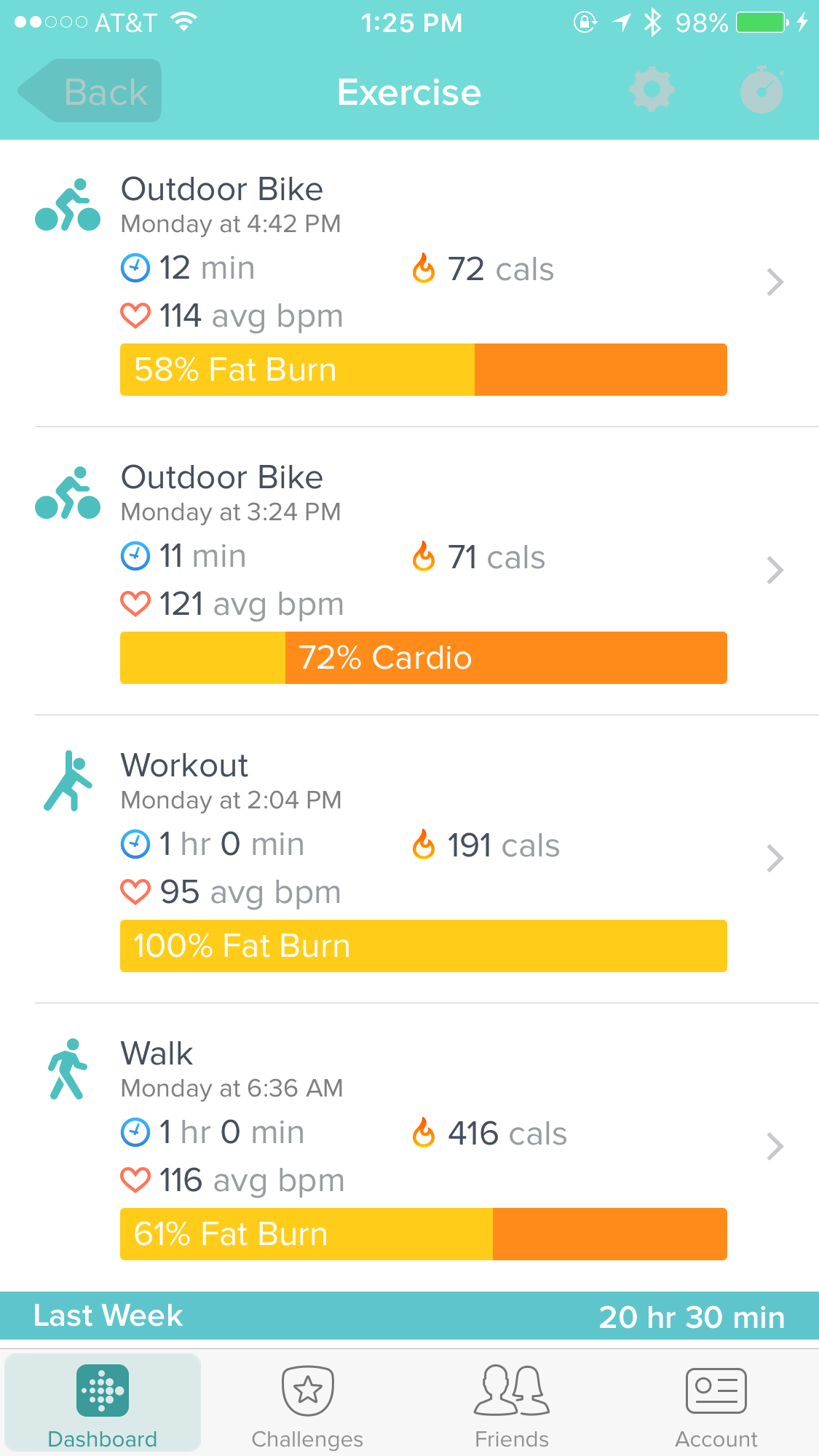
@PAUL DALY, here is attached a picture of my heart rate readings… on Monday I did my deload F7 for one hour. I didn't even take breaks between the exercises, so the heart rate was not going down too much between. The dog on my morning walks stops to peepee/poopoo, so I have some breaks :) my two short bicycle activities are not for exercise, but as transportation to/from client…  (if it helps, my resting morning heart rate is around 45, I am 52 years, and I have been training something pretty much all my life. I tend to overdo things, so I am used to a lot of volume). 


Fitbit heartrate Monday 3-20-2017.PNG

Alessandro Mainente

MOnitoring the hearth rate it is a good way to check the amount of overtraining.

Janno Rillo
13 hours ago, PAUL DALY said:

I might be doing something wrong. . . I used my HRM for my GB work out the other day. By the time I finished my warm up, it was in the 150's, and stayed in the 150-160's throughout, i.e. for about an hour. Occasionally got into the 170s. No real saw teeth graph -- it never got down into the 140s. 

That seems a fairly high rate to keep up for that period of time. Or maybe not. I don't really know.


13 hours ago, PAUL DALY said:

so have you tried a heart rate monitor during your GB work out? can you give me an idea of your hr while walking your dog as opposed to during GB. My experience is very different. 


Hi again,

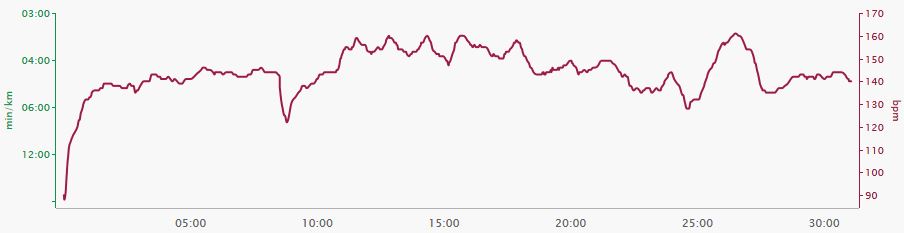
I can give a little illustration of the differences between the heart rate during running and strenght training based on my example:

1)  This is an example of a short 30 minute run from couple of years ago, which consists of 10 minutes of easier jogging for warm-up, 15 minutes of several shorter sprints + one longer interval at the end, and cool down. The intensity was around 80% of my maximum so that nothing special. As most of the endurance training HR graphs look like the first 10 minutes on the below graph (quite stable), therefore I specifically chose this graph in order to illustrate how endurance interval training looks from HR perspective (the middle section of the graph). You see clear saw teeth there, but they are not sharp because despite the recovery time between sprinting sets, heart keeps bumping on higher gears and the effort level during recovery periods is not really visible here. HRM as a tool comes especially handy in such situations- you ensure that you recover enough before the next working session (heart rate comes down enough). Training totals were: average HR 144 (my aerobic zone is 130-145) and max HR 161 (my max is around 190, anaerobic level is 178).RUN.JPG.7a39a40d28da71f1fdaf0932f7a4efc2.JPG


2) Another example is from strength circuit from couple of years ago, which consisted 3 rounds of pull-ups, lunges, push-ups, kettlebell swings (short recovery periods between sets, longer recoveries btw circuits). That was a heavy training for me, which was done right after a 45 minute run (meaning that I was already in a prefatigued state before starting the circuit). Training totals were: average HR 129 (below my aerobic training zone) and max HR 159 (littlebit lower than the running example).

58d395e740718_JUD.thumb.JPG.d43372478e5ab5cf288f8908a665b24c.JPG'

I think that running the sprints and circuit training both have some similarities to typical GB session - you are alternating efforts with short recovery periods. Now, if you compare these 2 graphs, based on HR numbers you might think that the first training was more difficult (higher max, higher average, the HR was higher throughout the whole training). In reality it was the circuit training that was much-much more difficult (especially taking into account that I had 45minutes running completed beforehand).

The main goal of HRM is to keep you from overtraining. People are different and someone else's graphs might look somewhat different as well, but I believe that due to the nature of strength training the HR measurements don't give you any insights into real effort level or cardiovascular stress, meaning that you cannot use HRM to track if you are doing too much

PAUL DALY
3 hours ago, Janno Rillo said:


Hi again,

I can give a little illustration of the differences between the heart rate during running and strenght training based on my example:

1)  This is an example of a short 30 minute run from couple of years ago, which consists of 10 minutes of easier jogging for warm-up, 15 minutes of several shorter sprints + one longer interval at the end, and cool down. The intensity was around 80% of my maximum so that nothing special. As most of the endurance training HR graphs look like the first 10 minutes on the below graph (quite stable), therefore I specifically chose this graph in order to illustrate how endurance interval training looks from HR perspective (the middle section of the graph). You see clear saw teeth there, but they are not sharp because despite the recovery time between sprinting sets, heart keeps bumping on higher gears and the effort level during recovery periods is not really visible here. HRM as a tool comes especially handy in such situations- you ensure that you recover enough before the next working session (heart rate comes down enough). Training totals were: average HR 144 (my aerobic zone is 130-145) and max HR 161 (my max is around 190, anaerobic level is 178).RUN.JPG.7a39a40d28da71f1fdaf0932f7a4efc2.JPG


2) Another example is from strength circuit from couple of years ago, which consisted 3 rounds of pull-ups, lunges, push-ups, kettlebell swings (short recovery periods between sets, longer recoveries btw circuits). That was a heavy training for me, which was done right after a 45 minute run (meaning that I was already in a prefatigued state before starting the circuit). Training totals were: average HR 129 (below my aerobic training zone) and max HR 159 (littlebit lower than the running example).

58d395e740718_JUD.thumb.JPG.d43372478e5ab5cf288f8908a665b24c.JPG'

I think that running the sprints and circuit training both have some similarities to typical GB session - you are alternating efforts with short recovery periods. Now, if you compare these 2 graphs, based on HR numbers you might think that the first training was more difficult (higher max, higher average, the HR was higher throughout the whole training). In reality it was the circuit training that was much-much more difficult (especially taking into account that I had 45minutes running completed beforehand).

The main goal of HRM is to keep you from overtraining. People are different and someone else's graphs might look somewhat different as well, but I believe that due to the nature of strength training the HR measurements don't give you any insights into real effort level or cardiovascular stress, meaning that you cannot use HRM to track if you are doing too much

your chart looks like one would expect -- saw teeth for the strength training. 

My GB work out looks like your running workout. That is why I am concerned. Perhaps I am overtraining.
