This forum is archived information and is no longer active.

handstand one: mobility progressionswith shoulder hypermobility

Started by John Howard, December 23, 2016 · 23 Replies · 428 Views

John Howard

Hi

Over the past few years I would occasionally get a little pain in the front of my right shoulder. After recently getting an assessment from a physio therapist he said it was bicep tendinitus which is the result of hypermobility in my shoulder. I think the explanation he gave me was ( I could have butchered this a little) that the ligaments that run across the anterior part of the shoulder are a little looser and therefore this puts more strain on the bicep tendon which also plays a part in stabilizing the shoulder. 


I would only really feel the pain when my right arm is in full flexion and the pain would be greater the closer my arm is adducted towards the body. He pointed out then when my arm is in my 'full flexion' the humeral head is coming out the socket and that I actually go beyond full flexion. So amongst a rehab program one of the things he said was that I shouldn't perform exercises in what I consider full flexion. Instead I need to re-teach where that end range is for me. For example if I was doing a shoulder press this should be executed just short of my end range, where the shoulder and presumably the humeral head is in a more stable position.

So this leaves me a little confused with how to tackle some of the mobility progressions in handstand one where you are working in end range flexion and trying to increase flexibility and strength.

So for now how I guess how would you adapt HS/PE1>iM  for somebody with hypermobile shoulders? or its fine as it is. 

Any other information on the topic would be much appreciated also 

Thanks 

John
 

Alessandro Mainente

Hi John, I understand your point, did ever tried to perform a wall handstand? how do you feel it?

John Howard

Hi,

Thanks for the quick response, yes I have tried to perform a wall handstand. It doesn't feel so bad...anything particular your interested to know? 

I did notice when I do it like in HS/PE7 I used to feel like quite a lot of the workload was in my anterior delt on the right shoulder. By 'workload' I just mean a normal muscular burn the same as if doing just weights. On the left shoulder the weight would feel more distributed through the whole shoulder girdle. I feel focusing on some elements I have improved this feeling a little. 

Thinking back sometimes I think a wall handstand would lead to the small niggling pain in my right from shoulder but other times I think not.

Let me know if you want me to go into more detail on specific aspects... 

Thanks
 

Alessandro Mainente

I would like see a wall handstand by you from both side and front view. in order to see if your hypermobility it is enough to procede. there is no reason to push against hypermobility.

John Howard

not pretty haha, but hopefully you'll get something from it... 


John Howard


Rayne-William Fitzgerald

You need to strengthen your shoulder rotator cuff muscles equally.

With your arms relaxed... If they tend to fall at your side internally rotated, your externally rotator cuff muscles are weaker.  Most males swimmers and body builders have the problem also.

I used to deal with the issue personally, until I started focusing on strengthening my shoulder rotator cuff muscles equally.

Alessandro Mainente

wall handstand means handstand with hands at shoulders width and hands approximately 10-12 cm

John Howard

Hi, Sorry I probably wasn't very clear, I haven't progressed that far yet and I am not able to do a proper wall handstand. I could probably repeat this with slightly narrower hands and also I could probably walk half a foot closer in. Would that be of any help to you? If not is there any other movements you would like me to perform that will give you some answers?

Yes the physio therapist said that my external rotators were a little weak and I currently have some exercise in my plan which are working on that. Also in addition my scapular movement wasn't great. eg poor upward rotation during shoulder flexion. So I'm currently doing some exercises/drills for that too. However I was more concerned about the hypermobility aspect though? and how if at all I should adapt the mobility progressions because of this.

Thanks again for you help 

Alessandro Mainente

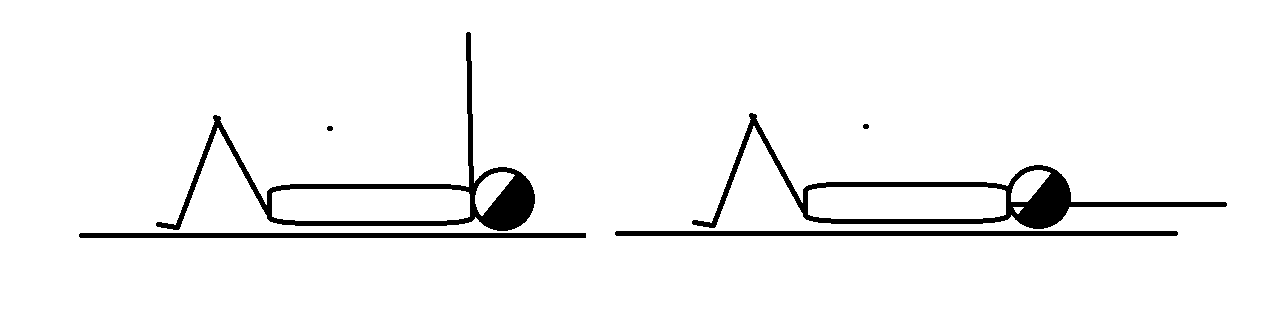
Well john your situation it is strange, basically who has shoulders hypermobility can shows a perfect open shoulder without any type of problem since he normally has more range of motion. if you want to check your situation I suggest you to shoot a video on this test and I can easily tell you if you still have tight shoulders: 

simply lay on the floor, your lower back must always touch the floor. let your arms straight and at shoulders width to fall inot the floor. i'm curious to see what's happen.

shoulder test.png

John Howard

Hi, 

So I performed the movement as in the diagram. 


Your comments got me thinking about why I couldn't do a wall handstand with a narrow grip if I had the flexibility so I tried a couple more and whilst I could get my hands about shoulder width my right shoulder (the 1 with bicep tendinitus) felt much weaker in this position and feels stronger with a wider grip. Actually the left shoulder felt relatively strong and stable still. So I think its strength and not a flexibility issue. I can also feel in the left shoulder the weight feels like it distributed almost right down the back of the shoulder and into the mid/lower trap and in the right shoulder the weight feels more in the deltoid itself and maybe even a little in the anterior delt. Anyway I probably drifted off topic a little. 

Let me know if you need anything else...

Thanks, John


Leo Trinidad

Hi @John Howard,

Strength is definitely an issue or strength in that position. ;)

John Howard

Hi, 

Hope everyone had a good Xmas and new year. Now back to the gymnastics... :)

So should I continue with mobility and strength progressions exactly as outlined in the handstand one course? 

Thanks
 

Alessandro Mainente

Well john if you can do that also with legs extended completely without space under the lower back and arms at shoulder distance you should not have mobility deficits.

John Howard

Hi, 

Yes I can do that.  If you remember my concern wasn't that I have a mobility deficit, a physio recently told me I was hypermobile he said this also showed in other joints as well as my shoulders. As a result I have more range of motion than people normally should and that I should avoid performing exercises in 'my end range'. I am now concerned if I should perform the exercises in the course different in any way? In particular I see a lot of them are working in those end ranges of shoulder flexion which he said I should avoid. 

eg.  HS/PE1>iM  should I perform this exactly as described in the video forcefully flexing my shoulders as far as they will go?

Thanks 

Pauline Taube

Hi John,

Even if you've got sufficient shoulder mobility I would recommend to strengthening the ROM.

Alessandro Mainente

Exactly, what is your point on the hollowbakcpress development?

John Howard

@Pauline Taube Ok, thanks for your reply. 

Coach Sommer

Hello John,

Given the specifics of your situation, I suspect a strength imbalance.  I would focus on building your pressing strength up to match your mobility.

Yours in Fitness,

Coach Sommer

Tobias Åkeblom
On 1/6/2017 at 7:11 PM, Coach Sommer said:

Hello John,

Given the specifics of your situation, I suspect a strength imbalance.  I would focus on building your pressing strength up to match your mobility.

Yours in Fitness,

Coach Sommer

Hi coach. Would you, in his case, prescribe focus on the hollow back press progression? Or even adding dumbell/barbell pressing?

John Howard

@Coach Sommer Thanks for taking the time to reply. Are you referring to increasing strength in over head pressing? or you would work on multiple angles between perpendicular to the body and overhead pressing maybe trying to identify any particular weak angles? 

Coach Sommer

You're welcome, John.

I am implying that your pressing strength overall is probably lacking in relation to your degree of mobility and will need to be systematically addressed by first mastering pushups, then dips, then headstand pushups, then handstand pushups.  

Jumping directly into focused bodyweight overhead pressing is almost certainly going to be more than you can effectively handle at this time.

Yours in Fitness,

Coach Sommer

Coach Sommer
On 1/7/2017 at 0:32 PM, Tobias Åkeblom said:

Hi coach. Would you, in his case, prescribe focus on the hollow back press progression? Or even adding dumbell/barbell pressing?

Hello Tobias,

The hollowback press progression.

Yours in Fitness,

Coach Sommer

Eva Pelegrin

As Coach Sommer mentioned, your shoulder strength is probably lacking relative to your available ROM. 

On 12/23/2016 at 1:55 AM, John Howard said:

So this leaves me a little confused with how to tackle some of the mobility progressions in handstand one where you are working in end range flexion and trying to increase flexibility and strength.

Nice to met you John. It sounds like your first priority will be to strengthen the end-range of motion you already have, which the HS mobility progressions will show you. Unlike most people starting GST who have to work really hard to open up their shoulders and gradually strengthen the new ROM they’re gaining, you already have the passive shoulder range for HS, whoohoo.

On 12/23/2016 at 1:55 AM, John Howard said:

For example if I was doing a shoulder press this should be executed just short of my end range, where the shoulder and presumably the humeral head is in a more stable position.

Don’t be confused by general explanations that may or may not apply to the skills you’re after. What’s “normal” or “average” shoulder flexion for the “regular person" may not be enough for GST standards (and many other sports). Don't let labels classify you. "Hypermobile" (for what?) Your shoulder is beautiful.

Whatever end-rage of motion you have now, your body will naturally access it and be able to use it simply because it's there. It is not like you can tell your shoulder don’t go so far when you’re throwing a ball or doing a push-up. Maybe sometimes, but your body typically follows the path of least resistance–sometimes stressing the structures that need it the least! like your bicep tendon. :) While learning to control a movement is a conscious process, once we understand it, we bring it to our unconsciousness and then can perfect and speed up its execution. We're not constantly thinking every micro step of each movement we do. 

Control is where it's at. The question becomes do you have control in your end-ranges? Do you have the end-range strength to stabilize a load? move a load? what kind of load? or redirect a force/s from there, etc… Because if you don’t, you’ll be likely more prone to injuries and compensatory patterns like the one you described. The solution is not “don’t go there” because your body will, but to strengthen the ROM you have in a 3-dimensional, balanced way like GST follows. It is for these reasons that those of us who have more than “normal” (whatever that means) ROM at one or more joints, we typically need to focus on first strengthening the ROM we already have, before being overzealous to get some more. That said, nothing wrong with having more range, as long as we can control it. Look at gymnasts. They certainly have more and they certainly can control it. Cheers.