This forum is archived information and is no longer active.

Lower back pain doing Jefferson curls, APT and PPT

Started by Ludvik Solnør, September 3, 2016 · 7 Replies · 200 Views

Ludvik Solnør

Hi,

Recently I started getting pain in my lower while walking or standing for a long time. I fear that I'm less flexible/mobile than most and I think that my problem might be tight psoas and excessive APT. It feels better when I focus on PPT while standing and walking so I'm guessing that a neutral spine is what I should be aiming for. It's also painful in my lower back area when going from spinal flexion to extension and vice versa when placing load on the movement (bodyweight), but usually pain free if I do it lying on the floor. Jefferson curls are painful when bending the vertebras in the thoracic and lumbar junction (both on the way down and up). The only way not to get pain is if I twist my spine while coming down and up (like standing on one leg instead of two while going up and down). When doing FL/PE1 and MN/PE1 it also gets painful.

Any thoughts about what this could be and what I should do to correct it?

Thanks a bunch! 
Everett Carroll

Hi Ludvik,

Your best bet is to get a diagnosis from a physio. We have two coaches on forums who are physios and they may have some advice for you but for an issue like this, you are really going to want to see someone face to face. Avoid any movements that cause ANY pain until you know what the issue is. 

Ludvik Solnør

Thanks Everett. Will make an appointment with a physio.

Ryan Bailey

Hi Ludvik,

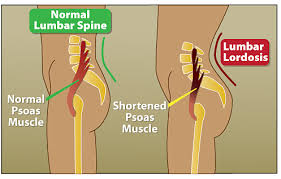
With tight Psoas and excessive Anterior Pelvic Tilt, there is a compressive and a shear force through the painful lower back region you described. 

Psoas.jpg

If this is the cause of the problem, some of the movements you described will not feel right.  I would address the problem first:

1) PPT work with the pain free, early GB progressions that focus on this, (Try feet on the ground for FL PE1 if the PE1 already causes pain. )

2) Front Split stretch series (Modified ranges without pain),

3) Form checks of the movement you have difficulty with so the coaches can assess the technique.

Regarding Jefferson Curl and pain with APT: the other coaches can correct me if the form detail is off,

If you have APT, and unable to PPT, the spine is being compressed, or sheered forward as you get half way into the movement. (Hard to explain in words, I lightly tried doing this incorrectly on my own as I was writing this, to demonstrate what I was trying to tell you and this did not feel good with bad form.  Please do not do the Jefferson Curl with pain or bad technique.)

The psoas attachments create an anterior pressure through the spine, if over active or tight, as shown in the diagram above.

Best of Luck,

Ryan

Alexander Egebak

In addition to Ryan's excellent comment you should also look at injury history. If you have had any injuries in the hips and back region your anatomical structures might send a faulty signal to your brain which then inteprets it and sends out a pain signal due to the nature of the signal received. Fixing this on its own (assuming that the problem is neurological) requires you to fix faulty movement patterns and reacquire correct movement patterns through mobility work, manipulation (and other manual therapy) and breathing exercises (since pain in the lower back usually results in superficial breathing).

This is all assuming that the problem is not (only) due to tight muscles causing compression of the spine.

Ludvik Solnør
35 minutes ago, Ryan Bailey said:

Regarding Jefferson Curl and pain with APT: the other coaches can correct me if the form detail is off,

If you have APT, and unable to PPT, the spine is being compressed, or sheered forward as you get half way into the movement. (Hard to explain in words, I lightly tried doing this incorrectly on my own as I was writing this, to demonstrate what I was trying to tell you and this did not feel good with bad form.  Please do not do the Jefferson Curl with pain or bad technique.)

The psoas attachments create an anterior pressure through the spine, if over active or tight, as shown in the diagram above.

Best of Luck,

Ryan

Thanks for the advice! I won't do JC when painful, but just to clearify should you have a neutral spine or as much PPT as possible doing this exercise?

Ludvik Solnør
21 minutes ago, Alexander Egebak said:

In addition to Ryan's excellent comment you should also look at injury history. If you have had any injuries in the hips and back region your anatomical structures might send a faulty signal to your brain which then inteprets it and sends out a pain signal due to the nature of the signal received. Fixing this on its own (assuming that the problem is neurological) requires you to fix faulty movement patterns and reacquire correct movement patterns through mobility work, manipulation (and other manual therapy) and breathing exercises (since pain in the lower back usually results in superficial breathing).

This is all assuming that the problem is not (only) due to tight muscles causing compression of the spine.

Takk Alexander! Fellow Scandinavian I see. I've tracked my pain back to when doing squats where I couldn't maintain APT when going down to parallel thighs so then my pelvis folded under my spine and into PPT. It was painful and uncontrolled with heavy weights. Since then it's been painful going from APT to PPT even with just my own bodyweight. I don't know whether it's a neuromuscular fault where I "fear" the movement/pain or if it's structural damage, but I reckon with sufficient time and almost no weight I can train my spine and hip again to be painfree. Any thoughts?

Everett Carroll

You want to keep the hips tucked under (PPT). The pain you are experiencing doesn't sound good. Again, avoid it and get a diagnosis.