This forum is archived information and is no longer active.

Greek yogurt: do the carbs count?

Started by Julien Le Nestour, February 26, 2016 · 24 Replies · 577 Views

Julien Le Nestour

Hi Jeff,

Not sure where to post this, as it's technically related to the Breakfast Construction essay posted on Lesson 6, feel free to move this!

Since breakfast is protein+fat and greek yoghurt was recommended multiple times, I checked the nutrition on the one I buy when in the US (this one: http://wallabyyogurt.com/our-products/whole-milk-greek-yogurt/item/whole-milk-greek-plain-32oz ) and I saw that for 1 cup there are:

  • 19g proteins
  • 10g fat
  • 10g carbs

Since I function perfectly with a breakfast consisting only of 5 eggs (and vinegar on them ;-) which have minimal carbs, I was wondering if the carbs in the yoghurt would have a negative impact or not?

Any guidance here for someone doing very well without any carbs until lunch would be greatly appreciated :-)

Just trying to find breakfast alternatives to avoid eating 5 eggs every day, but having not a whole lot of luck with finding stuff with the same very low amount of carb as is in the eggs. It's mostly for the sake of not having the same breakfast every day but I just love eggs, so I am happy to eat them everyday, it's just like candy for me :-)

Julien

Briac Roquet

I think I remember Jeff saying that the fermentation process continues between the moment they analyse/label the nutritional content and the moment you buy it, so it's actually lower on carbs. I don't know if the 10g would reduce to zero or if you'd still have more, but you wouldn't have much. 

I'm with you on eggs being so good!

Travis Widmann

Jeff has pointed out in a couple of these threads how the active cultures in the yogurt will actually consume some of the sugars, so that in reality you'll get maybe half the number on the label I believe. If I got that right than one serving of your brand has only 5 estimated grams of carb. That's hardly anything so probably not worth worrying about right now.

Jeff Serven

Hi Julien, 

Brian and Travis are right. There is about half the carbs due to the process they outlined above.

Julien Le Nestour

Many thanks everyone, it does answer my question!

Now, my next task is to find organic grass-fed greek yoghurt in Sydney ;-) Haven't had much luck so far and the Chobani stuff is not inspiring at all...

James Hall
12 hours ago, Julien Le Nestour said:

Many thanks everyone, it does answer my question!

Now, my next task is to find organic grass-fed greek yoghurt in Sydney ;-) Haven't had much luck so far and the Chobani stuff is not inspiring at all...

I'm trying out the Jalna pot-set Full fat greek yoghurt at the moment.  I've seen it pretty much everywhere and seems ok.  It even comes in 2L tubs.

Julien Le Nestour

Ah yes, I've seen it too and does look good, but for me (household choices!), I'll only consider grass-fed (or at least organic) dairy :-( Plenty of good sources in Australia, but none that I know of that produce greek yoghurt :-(

Many thanks for offering this suggestion though :-) They seem to have a typo on their nutrition info on their website as 3.8g of proteins per 100g seems really low (http://www.jalna.com.au/products/greek-yoghurt.html).


Screen Shot 2016-02-28 at 10.52.30 PM.png

James Hall

@Julien Le Nestour The tub also says 3.8g protein- so no typo amigo.

Julien Le Nestour

@James Hall Honestly, there seems to be something wrong somewhere. Greek yogurt is supposed to have more protein (and fat) than regular yogurt and here if you take their normal organic yogurt (http://www.jalna.com.au/products/biodynamic-organic-yoghurt.html) it has more protein than the greek one (4.3g vs 3.8g for greek). No idea what's going on with them :-(

Fabio Pinna

Hello @Julien Le Nestour. Years ago I lived in a small town which had many farms around it, and I got used to buy milk from free range, grass eating cows. It was delicious. Sadly, nobody in town made greek yogurt. So I decided to make my own. It is quite easy, and the taste blows away anything commercial that you might find anywhere. The only downside is that, unless you're willing to pay for nutrient analysys, you can't know the macronutrients inside your product. Back then I was big into counting calories, but I decided that the pros far, far outweighed the cons. Sadly, I can't eat dairy anymore, so since I am in a writing mood, here is my process for making greek yogurt, hoping that somebody can find an use for it.

Please note: greek yogurt is basically normal yogurt that went through a process of straining. More on this later.

Things needed:

- milk of your choice. Obviously full fat. Raw milk is fine if you're able to find it in your country.
- a tub of any commercial yogurt of your choice - OR - a probiotic supplement containing _at least_ Lactobacillus bulgaricus and Streptococcus thermophilus in good quantities. Be sure it's sold as a "live bacteria" supplement. L. delbrueckii is the same thing as L. bulgaricus (new name, old cow). Other bacteria are a bonus and might be good for you/your yogurt but are ultimately not needed (and most of them will die anyway unless you're very good at making and storing the yogurt). If you do things right, you can use one batch of greek yogurt to produce the next, and this will not be needed anymore.

- kitchen and a pot where to heat the milk and let it rest overnight
- another container for the straining process (this one won't need to get hot)
- a cheesecloth, or any rag. Kitchen towels are good. A rag too thick/woven too tight will make straining longer, but anything will do as long as liquid can pass through it. I like to use stuff made of cotton.
- an oven - OR - a box large enough to accommodate the pot and a 60w lightbulb. There must be airflow into the box. I used an old wooden fruit crate.
- kitchen thermometer optional but strongly recommended.

The cheesecloth/rag must be very clean. Either wash it in a washing machine at 90° (no softener/conditioner) or hand wash with soap and vinegar, rinse, then boil in water for at least 5 minutes and air dry.

Process:

1) Put the milk in a pot, heat it up to 90°/180F and leave it there for 1-2 minutes. It should not boil. Heating the milk to this temperature (also know as "scalding") will kill most enzymes/bacteria already present in the milk, so that there's room for our yogurt-making bacterias. It will also denature the proteins and make sure they stick together instead of forming curd.
2) let the milk cool naturally until it's between 40°/110F and 50°/120F. This is the temperature at which L. bulgaricus can Thrive (ha ha I made a pun!). Higher, and it dies, lower, and it's going to be too slow or completely inactive.
3) add a big scoop of the commercial yogurt, or a good amount of the probiotic supplement. Mix it well. With yogurt, used to add one fourth of the volume. So if I had two liters of milk to work with, I'd add 500ml of yogurt. Some recipes will have you add much less but I liked to use a lot to make sure the incubation went smooth.
4) cover the pot with a cloth (it needs to breathe a bit), and put it in the oven set at 40-50°/110-120F. OR do as I did and put the covered pot together with a 60w lightbulb in a wooden fruit crate (or any other box), then turn on the lightbulb and cover the box. Leave it to rest overnight. Usually 8 hours are enough but sometimes it needs up to 12.
5) check the pot. You should now have a yellow-ish, thick, runny, gelatinous yogurt-like substance. Congratulations! It's-a me, Maryogurt! It will be much more liquid than commercial yogurt. This is okay, we're not going to eat it in this state anyway.

If nothing happened after a night at the correct temperature, something went wrong. Throw everything away and begin the process again, this time making sure you follow every step correctly.

6) take your second container, and put the cheesecloth/rag on top of it. If it's a real cheesecloth, it's better to have two or three layers. Kitchen rags are usually fine with only one layer. You want liquids to pass but not anything else. Use any way you like to hold the cloth on top of the container so that it sinks a bit into the container, but not too much. It should not touch the bottom.
7) put the yogurt made in step 5 on top of the cloth. Cover with another rag, put this other container into the fridge - top shelf if possible. Leave it for a few hours.
8) after a few hours, the container will be full of a watery, yellowish liquid. Congratulations! What's left in the cloth is your very first batch of greek yogurt. Scrape it off with a spoon and enjoy its deliciousness. You will end up with an amount 30-50% of the original weight, depending on a number of factors.

The greek yogurt is safely stored in the fridge for around a week before going bad. The yellow liquid is whey serum, with some lactose and lactic acid in it. You can use this for a number of culinary adventures, or just throw it away. You can essiccate it and make diy whey protein powder - I did this once and it is really, really, really not worth the hassle. You can use it as brine for chicken. You can incorporate into homemade bread to make it slightly higher in protein and facilitate leavening. Some people use it in smoothies. Me, I hated the taste, so I just threw it out.

Obviously doing this every day is not always possible, so what I used to do was to buy 4lt of milk at a time, and make it every four days. The day when I was left with only 1lt of greek yogurt, I would scald the milk and use 500ml of the old batch to start the new one. The following day I'd finish the old batch and strain the new one. Third day I'd begin eating the new batch.

Speed hack: if you find a yogurt made from free-range cows that you like, simply strain it and turn it into greek yogurt. It's not as delicious tho!

All of this requires a bit of playing around to get things to your tastes - how long to leave the milk to rest overnight, how long to strain, how much to make in one sitting, etc. I believe the results are very worth it, tho. Enjoy.

F

James Hall

@Fabio Pinna Do you keep the whey/cultures for making subsequent batches?  My father uses whey from the last batch, with no need to add commercial yoghurt- Tastes fantastic

Fabio Pinna

@James Hall by all means, it is an option. As I stated in my post, the commercial yogurt (or probiotic supplement, remember!) is only needed the first time you do the entire process, because you need a source of lactic acid bacteria. On successive batches I'd reuse part of my own yogurt.

I didn't like to use the whey because I found that the it didn't store as well as the actual yogurt did, and went bad much sooner. But yes of course if you prepare the yogurt often enough you can conserve some of the whey and use it to incubate the new batch! You could add pure lactose/powdered milk to the whey to make sure the culture stays alive longer. It's another option. But I didn't like to do it because I wanted to keep things with just one ingredient: delicious farm milk.

My first batch was started with the following probiotic supplement:

Fermenti lattici vivi liofilizzati 1,0 g con la seguente composizione:

    S. salivarius subsp. thermophilus minimo 204 miliardi UFC
    Bifidobacteria (B. breve, B. infantis, B. longum) minimo 93 miliardi UFC
    L. acidophilus minimo 2 miliardi UFC
    L. plantarum minimo 220 milioni UFC
    L. casei minimo 220 milioni UFC
    L. delbrueckii subsp. bulgaricus minimo 300 milioni UFC
    S. faecium minimo 30 milioni UFC

Eccipiente: lattosio.

It's in italian but I believe it's easily understood anyway. I used 4lt of milk straight from the farm and a packet of this to begin the process. Every few weeks I'd add another packet (it was a powder) to the new batch, together with yogurt from the old batch, to refresh the culture. Incidentally, I've been told that this culture could also be able to make kefir, but I've never been able to do it.

Briac Roquet

Very good info on making yoghurt! I might have to start making my own too!

Ryan Bailey

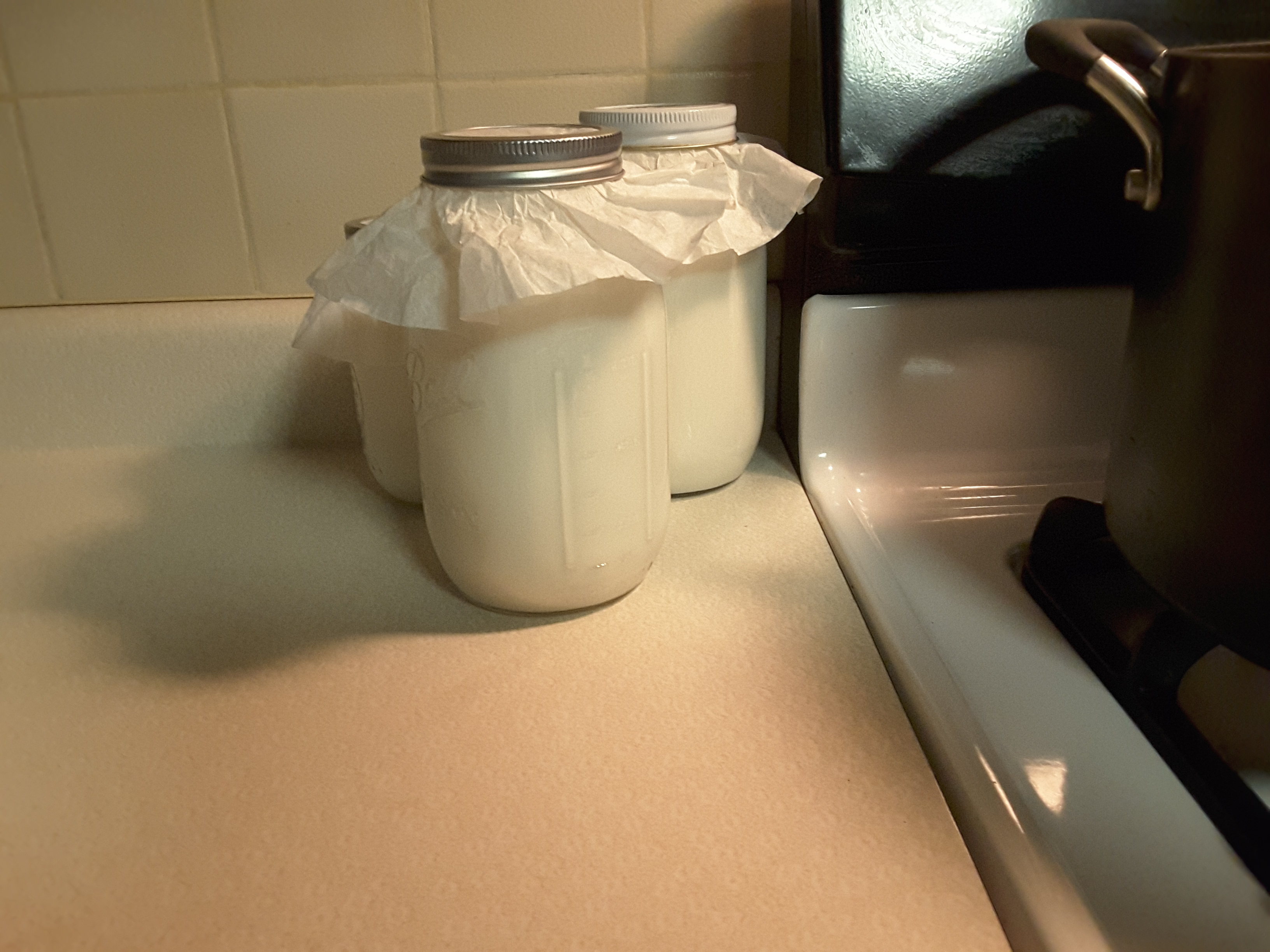
I agree with Briac, good thread and info on yogurt. There are many types of yogurt as everyone knows. My wife makes a "Viili" yogurt in our house. Here's our counter right now:

20160409_202630.jpg

She uses a Viili culture from Finland.

1) takes 2 spoonfuls of previous yogurt and swirls in an empty quart jar,

2) Fills the jar with fresh, raw milk, left to ferment on counter for 2 days.

This is our yogurt.

Texture is different from the store, not as creamy as Greek or other yogurts. I have no idea about the protein content or other constituants. The milk usually has a 3-5 cm head of cream on the top of the half gallon; but I like to steal this on occasions for the coffee.

Coach Sommer

Jeff, 

I am thinking a 'road trip' to Ryan's house might be in order. ;)

Yours in Fitness,

Coach Sommer

Ryan Bailey

Always welcome. You would get eggs from our chickens, catch our fish, then tackle the garden. 

Jeff Serven

Yes, I'm thinking the same thing. Looks great! 

Kelby O'Shea

@Julien Le Nestour I'm in Brisbane and I've been looking for a manufactured grass fed milk product for ages. Unfortunately there aren't any from what I can tell. All organic milk cows in Australia seem to get fed a lot of supplementary organic grain to increase milk yield.

that said, if you find someone producing grass fed yoghurt/ cream let me know!

Jared Birbeck
8 hours ago, Kelby O'Shea said:

@Julien Le Nestour I'm in Brisbane and I've been looking for a manufactured grass fed milk product for ages. Unfortunately there aren't any from what I can tell. All organic milk cows in Australia seem to get fed a lot of supplementary organic grain to increase milk yield.

that said, if you find someone producing grass fed yoghurt/ cream let me know!

just about all milk products in Australia are pasture fed. They are usually supplemented with grain as you say to increase yield, but more to account for the drier seasons where there is no grass or when it is really wet and the paddocks turn to mud.  something like less than 2% of the total is solely grain. It costs too much, at a time when there is an issue around costs and profits I expect there would be more pasture fed than not...but that is speculation. The feedlot systems that are more common in other parts of the world are far less common here albeit more common in SA and QLD.

choose the smaller producers from 'greener' areas. they are more likely to have greater pasture fed ratio. BD Paris Creek is available across the major supermarkets and while expensive worth it. check here for some qld suppliers...don't sweat the small stuff on the dairy. we don't live in an area where there is consistent access to pasture.

Kelby O'Shea

Thanks for the advice and comments @Jared Birbeck. I am nothing if not a pragmatist so I'm with you on the not getting too caught up in the perfect - but I am always on the look out for products that identify as pasture fed or attempt to indicate how much pasture they're getting. I had a look at your list and I do already buy Barambah organic dairy products which seems to be the easiest for me to find in my neck of the woods. Only problem is their yoghurts all use low fat milk solids, so not as appropriate for Thrive. Delicious though.

Jared Birbeck
4 hours ago, Kelby O'Shea said:

Thanks for the advice and comments @Jared Birbeck. I am nothing if not a pragmatist so I'm with you on the not getting too caught up in the perfect - but I am always on the look out for products that identify as pasture fed or attempt to indicate how much pasture they're getting. I had a look at your list and I do already buy Barambah organic dairy products which seems to be the easiest for me to find in my neck of the woods. Only problem is their yoghurts all use low fat milk solids, so not as appropriate for Thrive. Delicious though.

Tassie has the highest proportion of pasture only dairy cows. could look out for stuff from there. or alternatively go the yoghurt and then grab their cream and mix it in to up the fat content.

I often make my own yoghurt, just get whatever your favourite milk is, and fav yoghurt and some cream. mix the milk and yoghurt, heat, cool to the mid 30 degrees C, stir in 3-4 tablespoons of the yoghurt and then keep warm for 8 hours or so. I usually keep it in a cooler bag with a wheat bag I heat every couple of hours. until I go to bed, then let it sit overnight. adding some milk powder can help thicken the yoghurt a bit but it can depend on the yoghurt you start with.

Kelby O'Shea

Thanks @Jared Birbeck I'll keep that in mind. I'm not surprised Tassie has such a high proportion of pasture. When I was there in June for Dark Mofo it was so green. I can't see myself making yoghurt on the regular though, but maybe I'll give it a crack some time soon.

Julien Le Nestour

@Kelby O'Shea late to this one but here is what I can add:

  • I second the BD Paris Creek recommendation, great stuff :-)
  • I also avoid Barambah because I have been advised to avoid all products with milk solids in them (pb seems to be they can be highly processed and denatured, you can't know). I have been advised by our naturopath to specifically avoid Barambah though, so theirs may be bad.
  • We are also big fan of the Meredith Sheep yoghurts, though they are expensive.
  • Another way to get greek yoghurt is to strain normal yoghurt in the fridge through a cheesecloth, if you can find great regular products and want the greek stuff.
  • On yoghurt: for a long time I didn't want to hear about making my own yoghurt as our lives are already so busy, I didn't want to bother myself and have to wait X hours for 8 pots of yoghurts, etc. But I recently came across a yoghurt recipe using only a slow cooker with no prep: http://inhabitat.com/diy-make-your-own-yogurt-in-a-crock-pot/ I've now done the recipe multiple times, always get great yoghurt (and I haven't been very exact with the times, quite approximate) and I can use top-quality raw grass-fed jersey milk so the end result is miles better than the pasteurised stuff sold otherwise. I also do either a 2L bottle or 2 2L bottles, which results in a great pot of yoghurt that lasts quite a few days in our high-consumption household. The milk producer is in Queensland, so I am sure it's available in Brisbane (though raw milk being illegal to sell for human consumption, it may not be well advertised in stores). The milk we are using is Cleopatra's raw milk. More info here: http://www.angelfire.com/folk/rawmilk/ We find it quite easily in Sydney, but you may have to ask in store as some keep it in the back to avoid issues.

Let me know if you have any questions on this :-)

Kelby O'Shea

@Julien Le NestourThanks for the tips. I'll keep that in mind and perhaps take the plunge into home made yoghurt some time soon. I'm a little dubious on the raw milk though. Not because I'm worried about it in principle, just that I would need to know it is in fact fresh enough to be drinking. Hard to varify and I really hate getting food poisoning! 

Julien Le Nestour

@Kelby O'Shea it's a trust thing mainly, so I can't offer you definitive answer on raw milk. For the Cleopatra one, what I can tell you is that all the retailers/practitioners we use/trust here in Sydney recommend it, and more than one of them investigated before consuming it.

For our personal history (which is 1 data point, so it's only that), we've been drinking the milk since we arrived in 2010 in Sydney (kind of first thing we did is to find a raw milk source) and in the meantime we had 3 kids, who all drank it exclusively when they transitioned from breast-feeding around the 1 year old mark (no other milk before), and my wife drank it through all pregnancies. So no definite proof for sure, but quite heavy consumption by traditionally viewed "vulnerable" people and never had an issue. There may be other confounding factors though, so just impossible to tell for sure (though we do know our retailer is keeping up to date on any potential issue with the milk as they are being watched closely by the ragulators here in Sydney that made a few stores stop selling it by intimidation).