This forum is archived information and is no longer active.

Table Mechanics Shoulder Extension

Started by Ryan Bailey, January 15, 2016 · 15 Replies · 3,472 Views

Ryan Bailey

Quick question regarding table mechanics.

There seems to be 2 different ways to do these; subtle but pretty important I think.

1) lift into the table using primarily legs; the arms passively go along for the ride.,

2) Lift into the table using mid back, scaps, very active shoulder extension (more chest stretch this way I feel as well) and I can see how this would help HS iM2.

I would think this 2nd technique is correct.

Am I missing anything here? I used these a lot today limbering shoulders.

Here is an example:

The first 2 reps are using leg extension only. The last 2 reps are using shoulder and scaps primarily.

https://m.youtube.com/watch?feature=youtu.be&v=P_xEiZXmhGo

Thanks for feedback.

Ryan
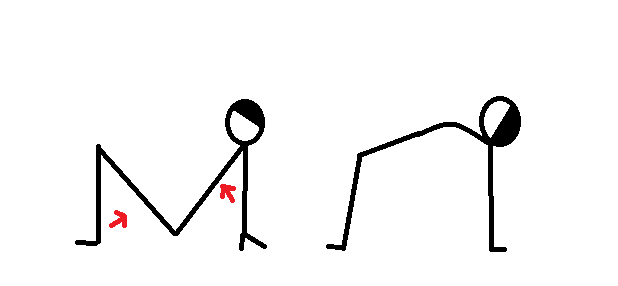
Alessandro Mainente

technique follows the development of the bridge.

-you need to open up your chest for future thoracic spine work, so retract, depress and push your chest up

-you need to develop hamstring and glutes strenght to avoid excessive stretch on lower back and to ensure full hips extension, so push strongly with heels on floor and push the hips upward by squeezing the butt. try to avoid bad habits like squeeze the lower back.


So basically the truth is in the middle.

I would say that the final result when you focus to bend in the thoracic spine is a table with T spine extension.


post-1151-0-78813200-1452895024_thumb.pn

Ryan Bailey
Alessandro Mainente said:

technique follows the development of the bridge.

-you need to open up your chest for future thoracic spine work, so retract, depress and push your chest up

-you need to develop hamstring and glutes strenght to avoid excessive stretch on lower back and to ensure full hips extension, so push strongly with heels on floor and push the hips upward by squeezing the butt. try to avoid bad habits like squeeze the lower back.


So basically the truth is in the middle.

I would say that the final result when you focus to bend in the thoracic spine is a table with T spine extension.


attachicon.giftable.png

This is really excellent.

Coach Sommer

Excellent question and an excellent answer.


Well done, gentlemen.


Yours in Fitness,

Coach Sommer

BobH

I'd like to add one more consideration here, which is especially important for those who are hypermobile (congenital laxity) or prone to tendonitis.  


Although this movement looks pretty tame, it can really mess up your shoulders if not done properly.  The front (anterior) of the shoulder capsule is very crowded spot (a zone of convergence).  When the humeral head is allowed to glide forward in the socket, the space in front closes down and the tendons don't have as much space to slide.  If you do this long enough, the tendons become inflamed and eventually start to thin and tear.  If you are already managing chronic tendonitis, this one will light you up like a candle. Yes, I'm speaking from experience here.


So engage the traps, keep the scapula depressed and retracted.  Keep the shoulders back: don't allow the femoral head to glide forward and keep the chest open.

Mark Collins

I like to be active in the shoulders and retract the scapula. I take every opportunity to undo my years of bench pressing.

Wesley Tan

One other thing I would mention is neck and head position.

Obviously the focus is on opening the shoulders but it's good practice to keep an eye on head and neck position. 

Restrictions in the anterior shoulder girdle will result in compensations in the neck. The head will tend to lift up, the chin moves towards the chest in a compensation movement which actually takes the stretch off the anterior shoulder girdle slightly. trying to keep the head and neck in line with the thorax will result in a better stretch across the chest and shoulders :)

Kevin Easton

I have been experimenting with table rocks recently as a means to add some mobility to my shoulders.  My shoulder extension is so bad that I can't do even the most basic TB series stretches.

While doing table rocks my elbows feel like they are going to explode!  Is this in indication of not just poor shoulder extension, but also extremely tight biceps and brachialis?

Everett Carroll

Great question! 

This is very common, Kevin, as most adults have very little experience with shoulder extension work. You more than likely have incredibily tight biceps and certainly have limited thoracic extension.  What you want to avoid at all costs is that feeling of pending explosion in your elbows!

Cut the intensity in half when experimenting with the table position from now on. Over time, your tissue will get healthier and you will be able to extend more and press higher COMFORTABLY. It is important that this is a slow improvement process. My best advice is to lower the intensity of your mobility work and regularly submit form checks. You can submit F1 videos here and your stretch exercise form in the TB subforum. 

If you have any more questions about this stuff, please let us know. Otherwise, I'm looking forward to those form checks!

Kevin Easton

After the holidays I will put up a form check video.  I thought my lower body mobility was poor, however I am able to do the FS and MS series.  The TB series I can't do most of the stretches because my mobility in my back, shoulders, bi, etc are so poor.    I almost need a pre-TB stretch series to work up to, LOL.

Tristan De Montebello

If I'm understanding well, one shouldn't get tired in the low back after a minute or two of table rocks, right?

That would indicate poor glute activation?

Pauline Taube

That's right Tristan, squize your glutes hard :) 

Geoff Coppola

How exactly do you decrease intensity while in table?  Is it acceptable to turn the fingers so they point towards your heels? 

Alessandro Mainente

actually not, the vast majority of the people do not have the necessary forearm mobility in order to hold the external rotation of the upper arm while changing the nature of the grip on the floor. instead of change the fingers direction consider to put the hands on an elevated surace of 15-20 cm.

Nolan Phillips
On 4/25/2016 at 11:37 AM, Wesley Tan said:

One other thing I would mention is neck and head position.

Obviously the focus is on opening the shoulders but it's good practice to keep an eye on head and neck position. 

Restrictions in the anterior shoulder girdle will result in compensations in the neck. The head will tend to lift up, the chin moves towards the chest in a compensation movement which actually takes the stretch off the anterior shoulder girdle slightly. trying to keep the head and neck in line with the thorax will result in a better stretch across the chest and shoulders :)

This is something I was wondering about. I just started this exercise FL/PE2 and the limiting factor is my neck. I have no problem getting into position, and the muscles holding me up don't mind, but my neck is weak and tight and to make it through the 30 seconds I either have to let my head drop or raise it towards my chest for part of the time. 

Does this count as failed mobility?

Everett Carroll
3 hours ago, Nolan Phillips said:

Does this count as failed mobility?

Yes, keep working at this progression until the neck position Wes describes becomes comfortable. Don't rush. Gradually ease into this adjustment and anytime you'd like, please post a form check video so we can provide more detailed feedback.