This forum is archived information and is no longer active.

Is the Spine meant to move or stay in neutral?

Started by Mark Collins, August 15, 2015 · 19 Replies · 2,475 Views

Mark Collins

This post is to answer the recurring theme about the safety of Foundation exercises.

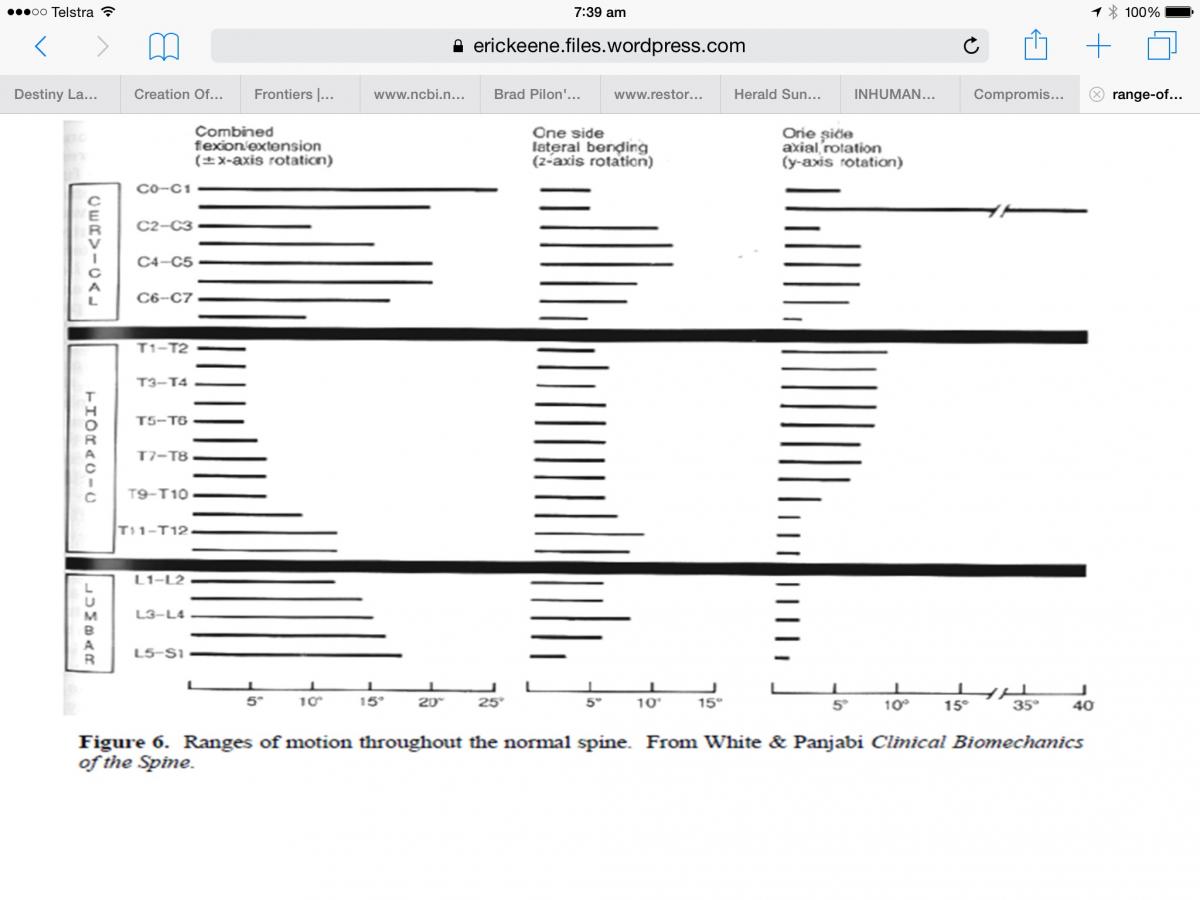
When I started working as a Physiotherapist I had the attached picture at my desk so I could look at it all day. It shows the range of motion through the spine. If you look at the lumbar spine you will see there is around 75 degrees of movement in flexion/extension and 30 degrees of rotation across 5 vertebrae. The thoracic spine has around 80 degrees flexion/extension and 85 degrees rotation across 12 vertebrae.

Just looking at normal ranges of motion shows the lumbar spine to be very mobile in a forwards/backward motion. It does not rotate that much because of the shape of the facet joints. The lack of rotation is taken up by the thoracic spine which has different shaped joints. When you look at the thoracic joints they are built for twisting.

The hip joint is very mobile and can flex up to 130 degrees and extend 20-30 degrees.

Now when you combine a very mobile hip joint and a spine that has full range you are primed for movement not for staying in neutral all the time.

If you look at young children or hunter/gatherer societies you see this wide range of movement all day. Our problem is that we stopped moving over many years and now when we try to restore what is normal we get afraid of injury. Rightly so as we are so stiff and deconditioned.

The power of Foundation is that it is restoring us back to good and full range of movement. Then once we have this we build upon this Foundation.It is all about loading correctly so we adapt in a beneficial way rather than breaking us down.
post-4880-0-23379800-1439713403_thumb.jp

MT Nordic

I'm not seeing attached picture, but great points nonetheless.  I couldn't agree more.  

Jason Dupree

Any chance of a write up like this about knee mobility? I know I've heard coach explain it, but I get people asking all the time isn't that bad for your knees (doing SLS mobility series).

Wes Tan

Well said Mark!

Mark Collins

Picture is now attached.

Mark Collins
Jason Dupree said:

Any chance of a write up like this about knee mobility? I know I've heard coach explain it, but I get people asking all the time isn't that bad for your knees (doing SLS mobility series).

I will eventually get one done. In the mean time look up what is normal range of motion for the ankle, knee and hip. You will see it has a rotation mobility and is not just to flex and extend.

Bro'

Should be a sticky! 

Peter Lavoie

Great post. Just to be sticky to detail though you mention in your second paragraph that there is 30 degrees of rotation in the lumbar spine, and 85 degrees in the thoracic spine. Both these areas usually don't have this much range. For the lumbar it's more around 5 degrees of rotation capacity and, in the thoracic, around 40 degrees on average (although my source is academic so average might be from a population of mostly non-movers). 85 degrees is HUGE range for one side axial rotation. Imagine: 85 degrees would imply that by sitting, you would be able, just through the thoracic vertebra (without hips, lumbar, or cervical help) to nearly end up with the head completely to the left or right while looking 'straight forward'. That's contortionist territory right there!


I really like what you said about loading correctly. Important notion for movers!

Mark Collins

Good point. That was total rotation. So 15 degrees lumbar and 40 degrees thoracic in one direction. A total of 55 degrees rotation is something you would easily see in someone whomis mobile.

Also don't forget we are held together by muscular, fascial and neural tension. These tensile forces can limit the available range of motion.

For ideal mobility I like to study what gymnasts, dancers and young children can move like. On the other end of the spectrum are the sedentary who are as stiff as boards.

Wes Tan

Yes nice post Mark.


Peter, 85 degrees thoracic rotation is quite normal, yes the majority of adults may not have this anymore but that is only from decades of not using this range. I can quite easily perform the movement you describe and my spinal mobility leaves a lot to be desired, children can easily achieve this as to most golfers. My point is, average ranges should not be confused with what is anatomically normal, avergae in most cases is very much subnormal.

Peter Lavoie

@Mark: I didn't realize that those numbers were meant to describe the range available with the bone structure not accounting for connective tissue and nervous input, thanks for pointing that out. again, nice post, I love geeking out on this stuff.


@Wes: Picture or it never happened? 

I'm just kidding man. However, I would contend that 85 degrees of functional thoracic rotation is not 'quite normal'. Golfers are an interesting group to look at and it would make sense that their rotational ability is better than most. I would be curious to see if they have the same rotation range on both sides. As for kids, well, maybe some, but can you get a kid to move it's thoracic rib cage in isolation?

I totally agree with you that we shouldn't use an 'average range' as a barometer for what's possible. I think it's healthier (and more fun) to find out for ourselves what's possible through training protocols like the one on this site and through exploration.

I don't think it's necessary, for adults to be functional, to have the same rotational capacity as a professional athlete such as a golfer who practices that movement specifically, many times a day, his/her whole life. More importantly, I don't think it's useful for someone to think that the ROM of a professional athlete in a very specific few joints (in this case the spinal rotation of the thoracic rib cage of a golfer or gymnast) of their body, developed specifically for what they do, is what they should be aiming for(especially if they are newer to movement) UNLESS they are also vying to be an athlete and perform at that level. Also, as a side note, we haven't addressed the recurrent pathologies or prevalent injuries that may result from the type of repetitive deep rotation that athletes like golfers ask of their bodies.


Anyhow, this post has got me curious about what 'average' rotation of the thoracic area is for someone who is a thorough mover. I work in the yoga world and will try to get some friends to pose for a photo or two to see wassup with those rotational ranges.

Grace Rockwell

This is really awesome information, Mark. I would also love to know more about the ROM capacity of each joint in the body. It would be fascinating to compare this capacity to what most "normal" adults can do!

Mark Collins

There is a lot of biomechanical research out there and it takes a bit of time to find out the normal ranges for each joint. Remember that normal is not necessarily optimal. We are generally comparing modern day westerners to other westerners. For example the normal range of dorsiflexion in the ankle for people today is different to what it was when we were barefoot and walking on uneven ground all day. 

I like to observe the range of motion in children as they have less of the bad adaptations that those 20+ years old have.

Grace Rockwell

Agreed. I used to be a nanny for children ages 2-6 and was always amazed at how painlessly and fluidly they could move, bend, jump, rebound, etc. 

It's also interesting to note the difference in "normal" mobility between westerners and those of other countries where positions such and the "frog" are an every sitting/working position. 

Fascinating! 

Petra Dvorak

For anybody who is interested in Biomechanics, look for Kapandji, it is THE standart book with wonderful drawings and good explanations

Cover: https://exlibris.blob.core.windows.net/covers/9783/1314/2216/3/9783131422163xl.jpg

Mark Collins

I have those in my clinic. He was ahead of his time. Some of the biomechanics have changed with more current research, but they are still a great starting point.

Petra Dvorak
8 hours ago, Mark Collins said:

Some of the biomechanics have changed with more current research

Do you have any specific examples of what has changed?

I do not own a copy yet, but whilst looking it up i just ordered one, as it has become more affordable with all the 3 parts in one book.

Mark Collins

You are better off doing a search online for specific biomechanics research articles. It would take books to discuss the changes in the last 20 years. For example 20 years ago there was 5000 research articles that were physio related and today there are 30000. 

David Eiche

Mark and Petra,

The German 6th edition available on amazon.de seems to be from 2016, so it looks pretty current.

David

Ronnicky Roy

Looking forward to the article style information on knees as well *thumbs up*