This forum is archived information and is no longer active.

HBP/PE3 question

Started by Alessandro Di Sanzo, June 1, 2015 · 12 Replies · 471 Views

Alessandro Di Sanzo

Hi all! A question about pseudo planche push ups.

I'm noticing that as I lower to the bottom position I lose a bit of protraction, so as I lift up I have a to rebuild a bit of the lost protraction at the top position.

Should I keep the same amount of protraction during the whole movement (both top and bottom position), or is it allowed to keep at least neutral at the bottom and then reconquer the protraction lost at the top position?

Thank you!


Alessandro Mainente

IT is the hardest part, you need to understand that ppp 2 combined pushing: serratus anterior for protraction and shoulders pushing for movement. try to practice the protraction in the lower part of the movement. 

Alexander Egebak
mauler said:

Hi all! A question about pseudo planche push ups.

I'm noticing that as I lower to the bottom position I lose a bit of protraction, so as I lift up I have a to rebuild a bit of the lost protraction at the top position.

Should I keep the same amount of protraction during the whole movement (both top and bottom position), or is it allowed to keep at least neutral at the bottom and then reconquer the protraction lost at the top position?

Thank you!
Protraction naturally fades as you hit the floor with your chest. Your focus point should be maintaining protraction as long and as much as possible (along with the other cues).

Alessandro Di Sanzo
Alexander Egebak said:

Protraction naturally fades as you hit the floor with your chest. Your focus point should be maintaining protraction as long and as much as possible (along with the other cues).

After almost two months I've started to focus on this point.

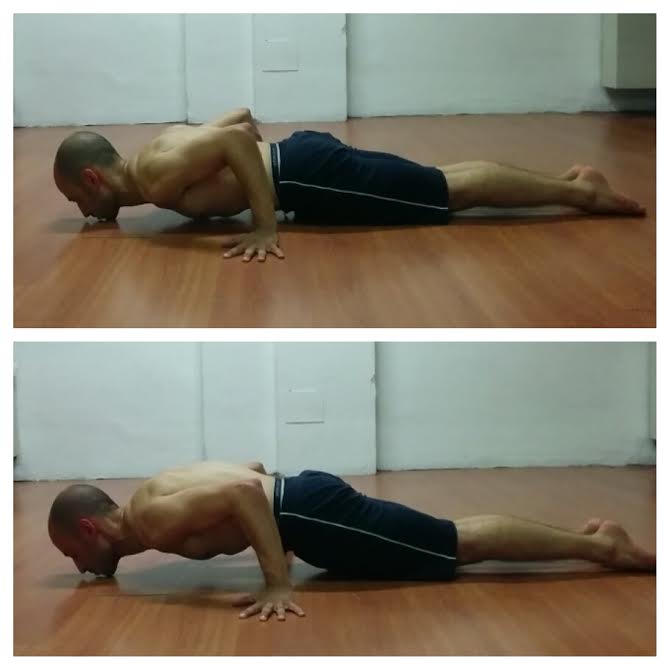
It looks to me that if I focus to touch the ground with chest and quads on the bottom position I have to lose protraction (top pic).

if instead I focus more on keeping the protraction, I touch the ground only with the chin/face (bottom pic).

post-10847-0-86817600-1437637959_thumb.j


Which form is better? If I should focus on maintaining protraction as logn as much as possible, like Alexander  and Alessandro suggested, I guess the bottom one is better, even though I do not hit the floor with chest! Am I right?

LateStarter@46

My vote goes to the top pic  :)


(As a minor point, change your head position to face the floor - like in the course video)

Alessandro Di Sanzo
LateStarter@46 said:

My vote goes to the top pic  :)


(As a minor point, change your head position to face the floor - like in the course video)

Maybe I'm only paranoid :D...

With the form on the top I can increase a bit the ROM  (judging the angle between humerus and forearm)... but the cost is the loss of protraction, which I should regain at the top. I know that a bit of loss is allowed on the bottom position, yet basing to the rule of keeping as much as possible protraction I still have doubts.

Perhaps the second form is more correct and easier as well!

Bro'

Don't worry about retracting, just worry about regaining protraction when you go up.

Alessandro Di Sanzo
Bro said:

Don't worry about retracting, just worry about regaining protraction when you go up.


Zach Armijo said:

You are missing the a dominating key point and that is chest top floor. You are creating an unnecessary road block for yourself by focusing on an unnecessary form in the bottom portion.


Hi! :)

I tried to follow your advices, so yesterday I recorded a video.

Here it is:


I hit the ground with my chest and I try to reconquer protraction as I lift up.

Maybe I lose a bit of PPT at the bottom as well...


How do you find this form?

Thanks to all!!

P.S. this element is devastating! :D

Alexander Egebak
mauler said:

Hi! :)

I tried to follow your advices, so yesterday I recorded a video.

Here it is:


I hit the ground with my chest and I try to reconquer protraction as I lift up.

Maybe I lose a bit of PPT at the bottom as well...


How do you find this form?

Thanks to all!!

P.S. this element is devastating! :D

More depression and less rounding in the spine.

Alessandro Di Sanzo

Alexander, how do you judge the scapular depression? I thought that a good depression was due to lat activation, so from a side view dorsale muscle should be clearly visible. Judging from the video, at least af the first reps I think my lats are clearly visibile, so are activated,am I right?

I guess you see something that I still don't get!

Alexander Egebak
mauler said:

Alexander, how do you judge the scapular depression? I thought that a good depression was due to lat activation, so from a side view dorsale muscle should be clearly visible. Judging from the video, at least af the first reps I think my lats are clearly visibile, so are activated,am I right?

I guess you see something that I still don't get!

You move your elbows forward in the bottom position in some of the reps. Although it is not a big deal some instability is being caused because of that.

chuchodani

Nice ! Just keep the same degree of PPT during all the movement.