Hello all!
Is this good enough to increase lean by a few inches?
This forum is archived information and is no longer active.
Started by Nash, May 17, 2015 · 19 Replies · 614 Views
Hello all!
Is this good enough to increase lean by a few inches?
definitely more than a couple of inches.
Alessandro Mainente said:definitely more than a couple of inches.
Thanks Alessandro.
What I meant to ask was: is my form, at this lean, good enough?
If it is, then I'll increase the lean and I'll go back to Block 2.
-Nash
Nash said:Thanks Alessandro.
What I meant to ask was: is my form, at this lean, good enough?
If it is, then I'll increase the lean and I'll go back to Block 2.
-Nash
Take my comments with a grain of salt, since I'm no pro.
** The hands. The way I think one should do planche leans is to have the armpits pointing forwards. The way you have your fingers pointing forwards, your armpits are at a slight angle and need to be rotated out a little bit.
Great work with the foam roller. I need something too to help me track my lean progress.
Nash said:
What I meant to ask was: is my form, at this lean, good enough?
I think overall it looks good, but the lean is extremely limited. It looks like you're essentially still doing a plank position.
I'd be curious what a deeper lean looks like, at least with your hands half way to your waist.
Here it is with more cowbell:

I just realized that that's a 15 year old reference. 
I'd say that as you lean more your hips seem to sag perhaps indicating a lack of active ppt and lower body tension.
While your upper back is rounded, it may be lacking depression?
Instead of talking about 'more' or 'less' protraction and depression as is often the case, I'm curious if your upper body and shoulder position contributes directly to a feeling of lift and lean? While you have a rounded upper back, my instinct is telling me you have a lack of head to toe tension in this position which might limiting your lean forwards. I don't see any significant activation in your traps, lats or abs.
In my humble and still limited experience, protraction is useful only insofar as it contributes directly to creating lift off the ground. And depression is usefully when it contributes directly to stabilizing the shoulders and pulling the body forwards in a stable position. Otherwise you're just putting lipstick on a pig and rounding for the sake of rounding.
I may be completely mistaken, this is as much a question as it is a statement.
Ha ha ha ha! Thanks man.
> I don't see any significant activation in your traps, lats or abs.
That's mainly because my muscles are not big enough to convey activation. And they won't grow. When I hit the gym in the past, I was at 195lb squat (I weighed 160lb) and my legs were more or less the same size before and after. I just gain strength, and a little bit of muscle.
> In my humble and still limited experience, protraction is useful only insofar as it contributes directly to creating lift off the ground. And depression is usefully when it contributes directly to stabilizing the shoulders and pulling the body forwards in a stable position
Hm, not sure how to translate that into my practice. In my next try, I'll put in more activation of abs and glutes and make sure that I'm 100% pressed into the ground to create protraction.
> While your upper back is rounded, it may be lacking depression?
Depression of shoulders?
---
Currently, my back rounds as soon as I push my hands into the ground and tighten my abs (I don't round it intentionally). That drop in lower body that you see in the video is because I used to over-pike in the past and this is a cue for me to straighten up. Maybe that causing me to loosen up my abs more than I should.
Thank you Zach.
> Fix the depression and a lot more will fall into place.
Fix it by pushing the shoulders away from the ears? In a down motion if I were vertical?
-Nash
You'll loose a bit of the rounding in your back when you focus on depression, but that's ok.
Personally I need for focus on glute tension. I don't focus too much on my abs, though I do draw my stomch in slightly.
Nash said:And they won't grow. When I hit the gym in the past, I was at 195lb squat (I weighed 160lb) and my legs were more or less the same size before and after. I just gain strength, and a little bit of muscle.
I'm in the same boat. 
Hey guys,
The first video below is my attempt. I can't push any higher or round anymore when my shoulders are depressed at 99% like so.
Below that video is another of me attempting this on the wall with barely any weight. I wanted to see if it's my weight/lean that's preventing more elevation or if it's something else. With 99% shoulder depression I"m getting the same form.
Attempt:
Wall comparison:
It looks much better like this, to my eye. You don't have that Quasimodo hump, but you still look protracted and stable. And if you go back and check the course video, this form is actually much closer.
Like you pointed out, I think muscle mass can really change how rounded the back looks. I'd work on increasing lean with this form.
How does it actually feel to you?
Here are two videos I made this morning to try and give you a better idea of what just protraction, vs depression and protraction. To me your first video is more inline with this form:
I'm focusing on protraction and while my lean isn't terrible, it gives me the distinct feeling I'm about to fall on my face!
Here it is again with a strong depression (these are both PE-6 obviously)
I lock in the position at the 13-14 second mark, that's the form I look for (I didn't bother to hold the position). In this position my entire upper body feels 'packed' and stable. The depression helps keep pulling my upper body towards my hands. Without it there's nothing to keep me from falling forward as I lean, especially with my feet raised.
I think focusing on the form in your second video will help you work towards this form. If you focus on doing it like your original video, you'll develop form closer to my first video. In my view, working this way is the only way to work on rounding the upper back between the shoulders where it looks like you need it the most.
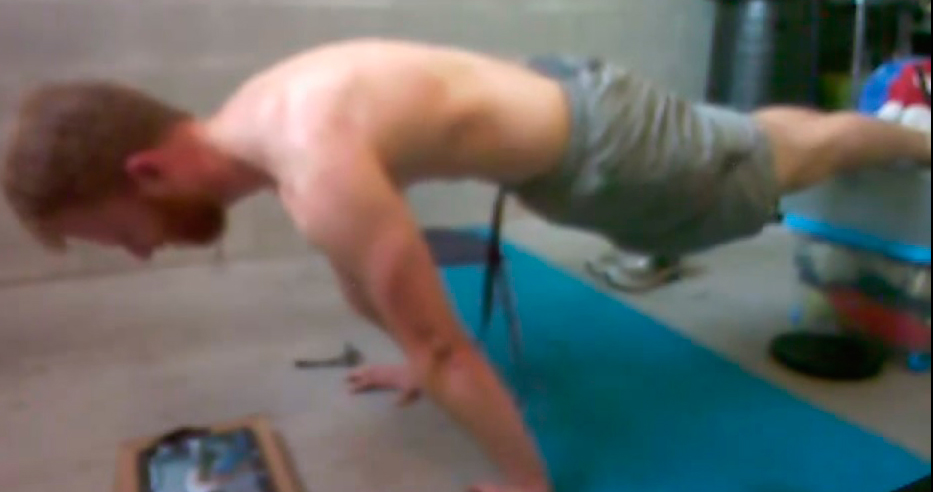
I think this incorporates everything I've mentioned.
I think my ppt could be better though...  it's hard to keep track of all those cues at once!
PS: Comments and criticism on my form are very welcome from anyone else reading this thread!
Colin,
Thank you so much for all this. Great info.
> How does it actually feel to you?
It feels like a completely different movement, particularly because I'm trying hard not to fall forward. It feels heavier on the wrists. I think the rounding before the depression was distributing my weight differently. My wrists were twitching the morning after. It's definitely more stable and feels in one piece vs. before where it felt a bit wobbly.
Hey Nash,
Try rotating your hands slightly outward (like in the course video) so that your wrists are not your limiting factor for how far forward you can lean. I would also recommend doing lots of unweighted (just arms out in front of you in the air) reps of retraction --> protraction as well as depression --> elevation just to refine the movement pattern. Good luck!
Best,
Chris
I've found that the more you lean, the more you'll need to concentrate on pushing off the ground. Don't just lean on your joints... even if it is called a planche lean. 
Colin, I've just noticed that you real-time video yourself. I was thinking about that for quite some time but have not set it up yet. What's your setup (hardware, software) for doing that?
I've got a cheap (hence the video quality) web cam hooked up to a tablet.
I had to get an app to connect the two, the one I use is called 'CameraFi' on android.
And I needed an micro usb adapter to plug it into the table.
thecolin said:I've got a cheap (hence the video quality) web cam hooked up to a tablet.
I had to get an app to connect the two, the one I use is called 'CameraFi' on android.
And I needed an micro usb adapter to plug it into the table.
Where did you get a table with USB ports? Tell me your secret!