Do I need to raise my hips more to gain a flatter back? I feel like my scap protraction and depression are solid, but seems like the addition of PPT makes my back round.
Thanks,
Ian
This forum is archived information and is no longer active.
Started by Ian Barth, November 5, 2014 · 26 Replies · 1,001 Views
Do I need to raise my hips more to gain a flatter back? I feel like my scap protraction and depression are solid, but seems like the addition of PPT makes my back round.
Thanks,
Ian
It looks good to me. You want a slightly rounded back in a Planche Lean. I would suggest the following though:
- Try working on a more slippery surface. It seems you have to work to slide your toes. The less friction you can generate the more lean you will generate and thus increase the load
- Focus on depressing the scaps now in conjunction with the protraction. This will aid you greatly down the line.
Don't take my word as being anything official, but I would actually say that you seem to lack the ability to fully PPT once your hips extend and instead are pulled into more of an APT (Anterior Pelvic Tilt) most likely by tight hip flexors or at least a "neutral" pelvic position.
This is evident by noting that your lumbar spine/lower back is flat (no concave curve) at the beginning of the video when your hips are high/piked/flexed and again once you rock back to your knees (thus again flexing your hips) at the end of the video. Contrast that to once you start to extend/straighten your hips and you can see that your lower back arches.
What does your sPL/PE2, sPL/PE3, and sPL/PE4 look like? It may simply be that the additional difficulty of being on the tops of your feet rather than the balls of your feet is resulting in a longer lever, this your core is having a hard time pulling you into PPT, but I would go back and double check that you in fact mastered the ability to PPT with those earlier/easier variations.
^Also what Gavin said about using a more slippery surface.
Looks like your lacking tension in your core
Agreed.
Your scaps are solid as so your hand position and feet. The thing is that although you are engaging your hips they are not fully engaged without a strong abs and glutes tension, which is nonexistent.
Overall form is good though. More work on proper engagement and youre done.
Thank you all. I got a hold of a slippery plastic sheet that should help me go from plank into planche lean. I think that will help lock in a strong core throughout the transition. Do you get notified of my replies to your replies? I would very much like additional critiques with new videos.
Thanks again
Ian
Thanks all, I'm liking the critiques. I added some slippery feet to this next attempt, and subbed pbars to give my wrists a break. Camera angle updated to the demonstration vid.
I feel like locking in the core then sliding into the lean position gave me more rigidity.
Thanks again,
Ian
Very nice! The addition of the foot slider definitely helped you maintain core integrity.
Regarding the wrists, remember that Coach has cautioned about the need to allow them time to adapt. You are putting them under a lot of load on this exercise compared with previous sPL progressions, so don't underestimate the need to let your connective tissues slowly adjust. Every degree of forward lean represents a greater load placed on the wrists. From physics we know that doubling the lever doubles the load placed experienced at the fulcrum, so...
If (many of these numbers are theoretical, but the starting point is a fairly common estimation of BW lifted/supported while in a push-up position, and the numbers do serve to illustrate the considerable increase in forces experienced by the wrists in such a disadvantaged leverage position):
-shoulders over wrists (zero leverage) represents around 70% of bodyweight at the wrists
-shoulders 2 inches in front of wrists might be somewhere around 100% BW
-shoulders 4 inches in front of shoulders would equal 200% BW
-shoulders 8 inches in front of wrists would equal 400% bw
Again, these are by no means verified numbers, but they do accurately show the huge increases in forces that decreased leverage can produce. If your wrists are bothering you it may be a sign that you have been too over zealous with your rate of lean increase on these.
Keegan said:Very nice! The addition of the foot slider definitely helped you maintain core integrity.
Regarding the wrists, remember that Coach has cautioned about the need to allow them time to adapt. You are putting them under a lot of load on this exercise compared with previous sPL progressions, so don't underestimate the need to let your connective tissues slowly adjust. Every degree of forward lean represents a greater load placed on the wrists. From physics we know that doubling the lever doubles the load placed experienced at the fulcrum, so...
If (many of these numbers are theoretical, but the starting point is a fairly common estimation of BW lifted/supported while in a push-up position, and the numbers do serve to illustrate the considerable increase in forces experienced by the wrists in such a disadvantaged leverage position):
-shoulders over wrists (zero leverage) represents around 70% of bodyweight at the wrists
-shoulders 2 inches in front of wrists might be somewhere around 100% BW
-shoulders 4 inches in front of shoulders would equal 200% BW
-shoulders 8 inches in front of wrists would equal 400% bw
Again, these are by no means verified numbers, but they do accurately show the huge increases in forces that decreased leverage can produce. If your wrists are bothering you it may be a sign that you have been too over zealous with your rate of lean increase on these.
I agree with the conclusion – give your wrists plenty of time to adapt – but not the reasoning.
Most of the stress experienced by the wrists comes from the wrist extensors and finger flexors, since all these tendons run through the wrists. The amount of stress will vary depending on how much you are pressing into the ground with your fingers and with your palm. The maximum amount you can press into the ground will be somewhere between 70% of bodyweight and 100% of bodyweight depending on how much you lean (any more than this and you would take off).
If you have very good wrist flexibility, then you will be able to vary the amount you push with your palms and fingers between the upper limit just given and more or less zero - since it would be theoretically possible to bear all of your weight on the heel of your hand/ base of your wrist.
If you have limited wrist flexibility, most of your weight will be borne by the palms and fingers (finger flexibilty will also play a role in exactly how the weight is distributed), but the maximum load will be the same. This situation is hazardous, since you are operating at the limit of your ROM with a heavy load. Having said this, planche leans are safer than planche progressions which involve balancing (since there is no dynamic loading) and increasing the lean slowly will give the connective tissue chance to adapt.
Btw Ian, nice planche lean!
KibboKift said:
The amount of stress will vary depending on how much you are pressing into the ground with your fingers and with your palm.
That's very interesting. With handstands it's easy to feel how much "press" is needed, probably whatever is necessary to keep balanced. But with planche leans, pressing isn't necessary to maintain the hold. With that said, is there a best practice for finger and wrist activation for this exercise? Or does is depend on personal preference and mobility?
Sorry Kibbokit, but you simply don't understand physics if you think the maximum amount of forces experienced by the wrists is equal to bodyweight.
To illustrate this point, try this experiment:
1) put a 10 lb plate onto a broomstick at one end (secure it so it won't slide), alternatively you could use a barbell if you can't figure out how to secure the plate on a broomstick.
Now let's all agree that the plate weighs 10 lbs and let's say the broomstick weighs 3 lbs (just for the sake of illustration, obviously if you were using a barbell and knew the weight to be different then that number would change) and let's all agree that these weights will not change at any time.
Next, take the loaded broomstick and place it over the end of a chair so that the lever (distance between the end of the distal/far end of the bar to the top of the chair/fulcrum) is 1 foot. Grab the stick close to the other side of the chair (right on the other side of the fulcrum from the lever) and push down/laterally extend your wrist to raise the weighted end of the stick. Easy right?
Now slide the stick out so that only enough stick is over the proximal/near end of the chair for you to get your hand on. If you did this right the lever you must now overcome should have significantly increased (which represents a significant decrease in your leverage). Try to push the end of the stick down. You will find that the force required to move the weight is now significantly (exponentially even) greater to move the other end of the stick and you may have to use all of your bodyweight and pushing muscles at this point, or if using a barbell will probably be completely unable to move the other end of the bar if you can even stop it from coming crashing to the floor.
What changed? The weight of the broomstick/barbell and weight plate have remained constant, but because of the significantly decreased leverage/increased lever length the forces experienced at the other end/required to move the distal end of the bar have increased by several magnitudes.
The same applies to Planche leans. The wrist is the fulcrum, the length of the hand from the tips of the fingers to the wrist is the lever on the near side of the fulcrum that you can use (the similar to the end of the stick on the near side of the fulcrum in the above experiment, except that it's length is fixed), and the distance between your wrist and the shoulder (if you drew a plum line straight down to the floor and then measure that point to your wrists) is the length of the lever that you must overcome. So while the weight of your body remains constant, the forces experienced at the wrists do increase significantly beyond those experienced when you have no lever to overcome (shoulders stacked directly over the wrists, which most exercise sources generally suggest is around 70% of bodyweight, whether that's true or it's closer to 50% is irrelevant to the increase in forces due to disadvantaged leverage and it's going to be well beyond bodyweight).
This is basic physics, and regardless of whether you possess the requisite strength to produce this new greater force, the fact remains that it increases exponentially as your leverage decrease. This is why Planche push-ups, front lever pull-ups, and other disadvantaged leverage gymnastics exercises produce such significant strength increases without the need to add external resistance to the body and also why people who don't respect these laws of physics or follow well planned and thought out progressions often wind up injured.
Looks a lot better.
Keegan said:Sorry Kibbokit, but you simply don't understand physics if you think the maximum amount of forces experienced by the wrists is equal to bodyweight.
...
That's cool that you are a mechanical engineer, so I apologize about the not understanding physics comment.
But you are still incorrect about what is happening in a Planche/Planche lean. As someone with a degree in exercise science and somewhat of an anatomy, physiology, and kinesiology junky I can tell you that your understanding of biomechanics is incorrect.
You disagreed about the arm being a rigid lever, but in fact that is precisely what the skeletal structure is (specifically the "long bones" like the Radius, Ulna, and Humerus which comprise the arm) a collection of rigid levers which the skeletal muscles pull on to create or resist movement.
Now, technically it's the angle between the Radius/Ulna and Carpal Bones which constitutes the forces placed on the wrist, but by extending the elbow and thus lengthening the lever that is the entire arm you are in fact increasing the length of the output lever. So while yes technically the body's center of gravity is balancing over the wrist there is significantly greater forces occurring at the wrist than the compressive force of the body weight if the lever were directly in the line of gravity (like a handstand), and far, far more force.
What you are talking about would be more akin to the forces at the wrist during an elbow lever or bent arm Planche where the elbows are allowed to bend to maintain the forearms in the line of gravity. This is considerably less stressful on the wrists and requires far less wrist strength than a Planche, even though in both positions the weight of the body is being bested solely by the hands/ wrists.
Regarding Newton's laws, all that this means is that the force that the hands (from finger tip to wrist) must produce must be be equal to the forces being exerted at the other end of the fulcrum (several times bodyweight) in order to prevent to body from continuing to fall forward. This is a lot of force, but not impossible and this need for such forces is why so many people wind up with wrist issues while performing planches without proper preparation.
Keegan said:That's cool that you are a mechanical engineer, so I apologize about the not understanding physics comment.
No offence taken
Keegan said:You disagreed about the arm being a rigid lever, but in fact that is precisely what the skeletal structure is (specifically the "long bones" like the Radius, Ulna, and Humerus which comprise the arm) a collection of rigid levers which the skeletal muscles pull on to create or resist movement.
I didn't disagree. This characterisation makes perfect sense.
Keegan said:Now, technically it's the angle between the Radius/Ulna and Carpal Bones which constitutes the forces placed on the wrist ...
I don't like to split hairs, but an angle can't constitute a force. Wouldn't it be more accurate to say that the tendons which attach to the carpal bones constitute the force placed on the wrist? This force is reacted by the reaction force from the ground - transmitted through the structure of the hand - and the reaction at the wrist joint itself - the fulcrum. I am willing to accept that these forces may change with different degrees of wrist extension, thus reducing the effective lever length, so I don't deny that the angle between the radius/ulna and carpal bones has an effect.
Keegan said:What you are talking about would be more akin to the forces at the wrist during an elbow lever or bent arm Planche where the elbows are allowed to bend to maintain the forearms in the line of gravity. This is considerably less stressful on the wrists and requires far less wrist strength than a Planche, even though in both positions the weight of the body is being bested solely by the hands/ wrists.
No, what I am talking about is the external forces acting on the body in a planche. We may be talking at cross purposes since you seem to be talking about the force at the wrist joint itself. I suppose that would be the compressive force experienced by the articular disc. I accept that this may well be several times bodyweight, since the attachments of the wrist tendons are very close to the joint compared with where the reaction forces would be acting on the hand.
However, it is a fallacy to consider the weight of the rest of the body acting on the shoulder as a point load. If we consider the torso as a 3rd class lever then the shoulder joint becomes the fulcrum, bodyweight becomes the load, and the force exerted by the shoulder girdle becomes the effort. The force exerted upwards on the torso by the shoulder girdle is large, since the lever length is comparatively small. This large force is balanced by bodyweight and a large force acting downwards on the torso at the shoulder joint. So, employing Newton's second law, we have a large upward force acting on the arm at the shoulder joint and another large downward force acting through the shoulder girdle on the arm. These two forces must both be incorporated if we wish to treat the arm in isolation. It is much simpler to treat the gymnast's body as a single rigid body, as in my previous analysis.
If you feel that any of the conclusions I came to in my previous post are wrong, please feel free to point out errors in my analysis or logic.
Ok, yes, if you are talking about the shoulder joint, then we are in agreement that the forces exerted on it would be essentially the equivalent of holding a bodyweight barbell at a similar angle and that this force cannot exceed bodyweight (or else you would be pressing through to handstand).
I was purely talking about forces at the wrist joint, which we seem to now both be in agreement can exceed bodyweight.
Thanks for the intelligent and insightful conversation. :-)
Is there a "correct" way to position the upper back during the lean? I've seen threads emphasizing a straight body, and others saying a rounded or slightly rounded back is preferred.
The two attached images are what I believe to be good PPT and shoulder protraction+depression; the only difference is in the upper back curve and body line. Any help is much appreciated!
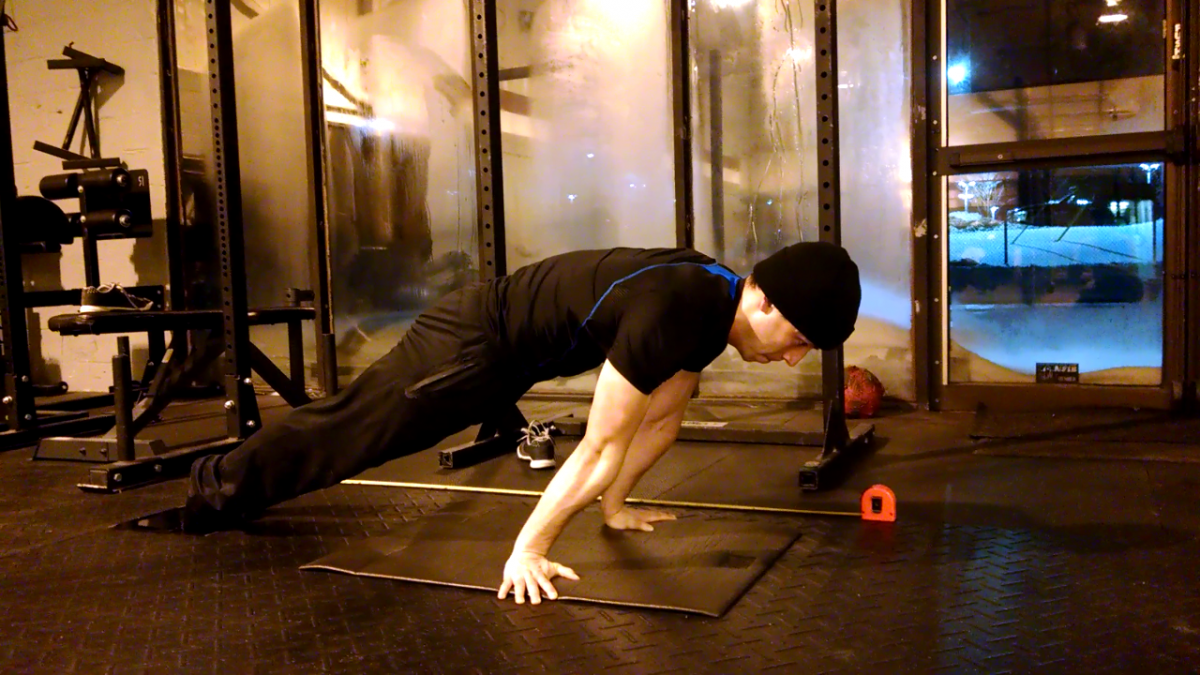
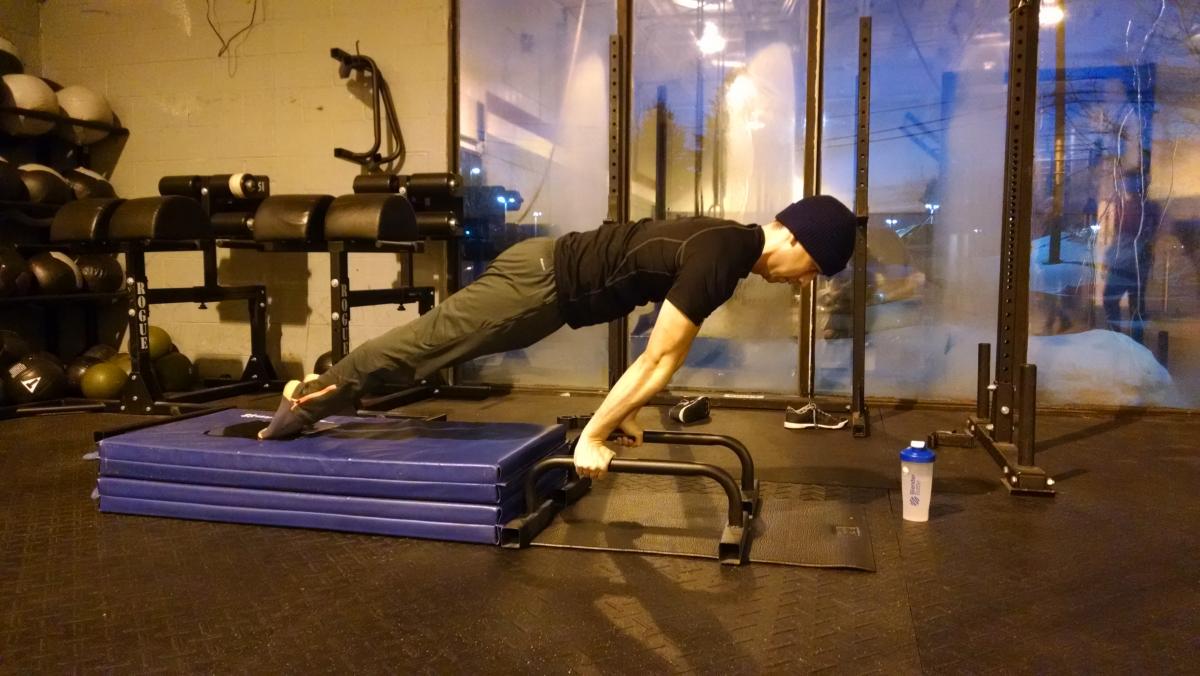
1st one looks better to me
Which one feels like a stronger position to you?
Ian Asquith said:Is there a "correct" way to position the upper back during the lean? I've seen threads emphasizing a straight body, and others saying a rounded or slightly rounded back is preferred.
The two attached images are what I believe to be good PPT and shoulder protraction+depression; the only difference is in the upper back curve and body line. Any help is much appreciated!
PL Slight round.png
The correct way is to maximally protract the shoulders which makes the upper back round and keep a flat lower back (a bit of PPT required). The overall body line can still be pretty straight even if the upper back is rounded.
Those 2 planche lean forms you posted look the same to me. Both do not have much scapular protraction, but everything else is pretty good. The body looks a bit piked or has a bit more PPT (can't really tell if pike or PPT with his shirt and long pants on) than being straight so try to reduce those if you come across that small problem.
Feels like I learn something new every week on this one. Wrists are feeling solid, it's been a long recovery. But I think the protraction has gotten solid. Please let me know what you see!
Zach,
Thank you for the view. The comment about needing more protraction was not expected. In the vid during the initial setup is where I protract to the limit. Is it the case that upper-back rounding and protraction are different items? I can certainly post a clip of scap pushups.
When I hold max PPT, it curls my mid-back due to the 100% effort on abs. I can flatten that portion of the back if I ease up on the ab effort. As for the upper-back, would you say that I need to consciously curl that segment IN ADDITION to max protraction? I'm stuck here; I don't know if I should drop this exercise to work on spine flexion. Or maybe I'm missing a vital cue.
Thanks again,
Ian
Scap pushups (Sorry for the low res).
I did read through Dillon's planche megathread. I've definitely come across it a while back while researching. But I'm hung up on the idea that protracting alone will not achieve a rounded upper-back that people say is necessary, and that maybe I just have an inflexible spine...I guess that's the gist. Again, thanks for watching.
Latest lean. Been focusing on Pro-Dep and External Rotation.
One cue that really helped me, was draw the sternum in to the spine. That made the rounding come from the upper back. It feels much more stable too. You look like you have as much protraction as possible with a flat upper back, with mid back rounding. Rounding the upper gives so much more protraction.