Hi 
When I train for planche, I have this :

Does it mean that my scapula position (fully depressed with some protraction) is incorrect or is it just about morphology ?
Thanking you in anticipation.
This forum is archived information and is no longer active.
Started by Krel, October 10, 2014 · 10 Replies · 15,879 Views
Hi
When I train for planche, I have this :
Does it mean that my scapula position (fully depressed with some protraction) is incorrect or is it just about morphology ?
Thanking you in anticipation.
Your scapula is retracted and it should be the opposite, protracted. Search on youtube : "Scapula protraction". You'll see a lot of information there.
Edit: Oh and point your toes!
I forgot to precise that I am not the one on the picture. I guarantee you that my scapula is not retracted (shoulder blades together), and I think this is the same with the guy on the picture. If you retract, it is impossible to have the scapular moutain, which is caused by scapular depression :/
I found this picture here :
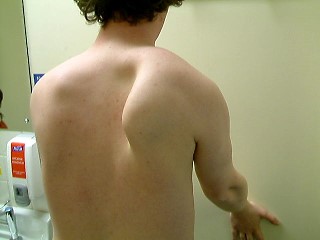
As you can see there is no retraction, the scapula is depressed and neutral. I have the exact same thing :/
I think is a winged scapula.
If your scapula is fully protracted, it will not stick out like that at all...
It wings out like that when the serratus anterior isn't being recruited, and you are using your upper traps to rotate the shoulder blade instead of the lower traps.
visual:
https://www.gymnasticbodies.com/forum/topic/5959-scapula-position-for-basic-and-static-exercises/
I'm not supposed to do this because I'm only at sPL/PE5 but I tried a tuck planche to show you the thing :

On this picture (perfect angle to explain), we can see that Yuri Van Gelder is winging out :

I made some research and I found this : https://www.gymnasticbodies.com/forum/topic/15260-full-planche-shoulder-blade-sticking-out/
According to alex87, it is possible to do planche with slight degree of protraction and full depression.
What do you think ?
Well from the first photo we can distinguish two forms :
-stacked position and nothing more (typical of gymnasts who perform handstand to recover energy)
-stacked and pushed off. this means bones alignment and sensation of not been crushed by its own weight.
for the nature of the rib cage, when a strong depression is held it's not possible achieve the same level of protraction as the elevated scapulas. btw as i stated in the other post the straight body planche is an ADVANCED version, beginner should focus on protracted.
on the straigth body planche you will see a little, i said LITTLE winged scaps, this is quite different from retracted scapulas.
DO not confound them.
If I look to your photo it's clear a loss of protraction.
alex87 said:Well from the first photo we can distinguish two forms :
-stacked position and nothing more (typical of gymnasts who perform handstand to recover energy)
-stacked and pushed off. this means bones alignment and sensation of not been crushed by its own weight.
for the nature of the rib cage, when a strong depression is held it's not possible achieve the same level of protraction as the elevated scapulas. btw as i stated in the other post the straight body planche is an ADVANCED version, beginner should focus on protracted.
on the straigth body planche you will see a little, i said LITTLE winged scaps, this is quite different from retracted scapulas.
DO not confound them.
If I look to your photo it's clear a loss of protraction.
Tell me please if I understood it right. What you say is that a gymnast should first master full planche with protracted scapula before he can hold it with " retracted " scapula(not really retracted , but not full protracted too). In conclusion, A straight planche is the correct and harder way than a planche with protracted scapula. Am I correct?
HB_Ron said:Tell me please if I understood it right. What you say is that a gymnast should first master full planche with protracted scapula before he can hold it with " retracted " scapula(not really retracted , but not full protracted too). In conclusion, A
straight planche is the correct and harder way than a planche with protracted scapula. Am I correct?
I think it would be :
- Beginner planche : a strong degree of both depression and protraction
- Advanced planche : higher degree of depression with less protraction (nearly neutral ?)
I have seen a retracted planche one time :
And Coach Sommer reaction was epic :
Coach Sommer said:The first planche shown above is @#$% and the result of completely incorrect preparation and training. And no it will never get better unless he basically starts over to correct the physical deficiencies.
Well here you can here one of the most strongest straight body planche in the world.
The basic idea is that you achieved an high level of protraction , you need to fully express it during the planche and you can easily manage the position of the upper body and the PPT will far less effort, paired with them there is a very strong lower traps to maintain the link between the upper body joints.