I don't have a full pancake. How much flexibility is a minimum to achieve the mastery ROM?
This forum is archived information and is no longer active.
MN:PE 2 - full pancake a prerequisite?
Started by Murray Truelove, September 3, 2014 · 26 Replies · 1,087 Views
My guess is, from what emerged discussing with Kit, that the answer to your question is YES. But this is just my opinion, and notice that I trained PE2 for a short period only so please listen to more qualified people here 
Handstand 2 has pancake as an end goal. F2 is a prerequisite, so certainly the second Manna exercise doesn't require full pancake.
https://zp130.infusionsoft.com/app/storeFront/showProductDetail?productId=90
Master the pike press to handstand while developing pancake flexibility in this web-delivered course by Coach Christopher Sommer.
This is the mastery image for MN/PE2. It's definitely not a full pancake -- only about 45 degress.

Of course, the better your static pancake, the easier this active flexibility gets.
Thanks Tex, however in the PE:2 video the athlete is much closer to 90°.
Also PE:2 is active flexibility, passive flexibility tends to need to be higher. Is a full passive pancake necessary for a 45° active flexibility.
Murray Truelove said:Thanks Tex, however in the PE:2 video the athlete is much closer to 90°.
In fact, this is the reason why I said that most likely you need to get close to a full pancake to be successful. Recently I saw somewhere in this forum a very nice discussion on this subject with some pics as well, elaborated out of the course material.
I looked back at the video, and you're right -- it's definitely tighter compression than the still image. However, unlike a true pancake, his torso is quite rounded. In the still image, his lower back makes a 90 with his legs, and then the rest of the back rounds. This would be the equivalent of sitting in a straddle and lowering down until resting on elbows. A full pancake lowers all the way so navel and chest are on the ground.
You're right that your passive flexibility needs to surpass the active flexibility. I wouldn't think it would have to be too much beyond though. It just needs to be enough that your body can relax into the top position.
I used this weighted pancake stretch to make huge gains...and coincidentally (?) got my full pancake around the same time as mastering PE2.
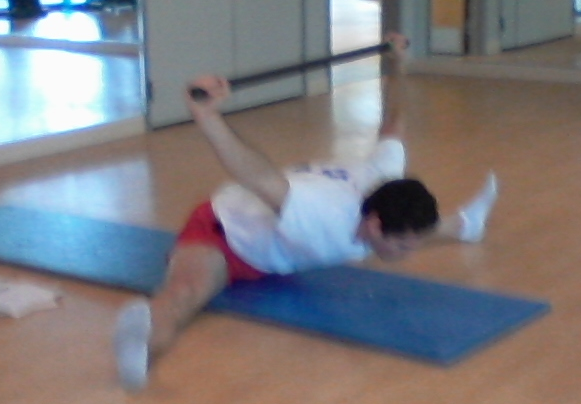
Interesting, could you elaborate a bit on the stretch?
^^^This. MN/PE2 is absolutely not a full active pancake and does not require a full pancake to perform. Not saying that being able to do a full pancake would hurt of course, but it's not a pre-requisite.
The biggest difference between MN/PE2 and a full pancake has to do with the pelvic tilt/spinal position. In MN/PE2 the athlete has a posterior pelvic tilt and flexed spine (particularly lumbar but some thoracic as well), this makes sense as the MN progressions are building up to a Manna, which requires a rounded lumbar spine to execute. During a full pancake on the other hand the pelvis is anteriorly tiled and the lumbar spine is thus in it's natural lordotic (or at least neutral) curve.
Sit in a straddle and hold a bar overhead with a wide grip.
Lean forward, keeping your arms vertical and weight directly over shoulders.
Keep your torso straight the whole time.
Get to a comfortable stretch and use your groin/hamstrings to pull your body back up to seated.
Perform 5-10 reps.
Treat this as a mobility and slowly add weight to the bar.
MN/PE2 doesn't need a full pancake since you're using a lot of lumbar flexion to get that required ROM in Straddle-Ups.
A Straddle-Up with a "full" pancake would have the spine arched (no lumbar flexion), and that's not required for MN/PE2
Murray Truelove said:Thanks Tex, however in the PE:2 video the athlete is much closer to 90°.
Also PE:2 is active flexibility, passive flexibility tends to need to be higher. Is a full passive pancake necessary for a 45° active flexibility.
I don't think there's a direct correlation of active flexibility being a percentage of passive flexibility.
The video clearly shows more flexbility than the pictures to the side, but it seems people are doing mastery with ROM closer to what the photo shows. I think I've seen maybe one guy a long time ago who posted a video with ROM which matches the actual course video.
What's your compression like now?
I always figured that the picture demonstrates mastery requirement and the video is what the athlete is capable of. Just because that athlete who has been training for years can do that doesn't necessarily mean it's the requirement for mastery. That's my take on it
kimura said:I always figured that the picture demonstrates mastery requirement and the video is what the athlete is capable of. Just because that athlete who has been training for years can do that doesn't necessarily mean it's the requirement for mastery. That's my take on it
That's not the case as far as I'm aware. I think the video is generally the official form to observe and follow. Though I'm under the impression that most people are moving ahead with ROM closer to that of the photo in this specific case. But you should really strive to improve your pancake with additional work even after you move on.
It was pointed out that the pictures for PE2 are from the old BtGB book. I don't know if the video was done later, but that might explain the discrepancy.
kimura said:I always figured that the picture demonstrates mastery requirement and the video is what the athlete is capable of. Just because that athlete who has been training for years can do that doesn't necessarily mean it's the requirement for mastery. That's my take on it
But I mean, in some exercises it is clear that even the last picture does not reflect the end of the expected ROM. I'm not sure you are interpreting this right. I personally always rely on the video.
I'm pretty sure that the video is the mastery form we should look at, trying to emulate as much as possible. With that being said, I like to remember to myself that the athletes in the photos and videos are a lot more advanced than us both in strength and mobility, so I don't think we could and should be able to always achieve their exact same rom, IMO.
Practically speaking then, at a minimum you should be able to rest on your elbows in a pancake to have the necessary passive flexibility?
Murray Truelove said:Practically speaking then, at a minimum you should be able to rest on your elbows in a pancake to have the necessary passive flexibility?
To me that sounds like a reasonable start for the second element in F1.
EdStand said:I'm pretty sure that the video is the mastery form we should look at, trying to emulate as much as possible. With that being said, I like to remember to myself that the athletes in the photos and videos are a lot more advanced than us both in strength and mobility, so I don't think we could and should be able to always achieve their exact same rom, IMO.
I disagree. It's been stated repeatedly - in the course material and FAQ's - that we must always match the ROM in the course video. Why should this element be any different? You could make the same argument for several other elements (tuck-ups, ABH...) but if these were unattainable standards we would have heard about it by now.
Murray Truelove said:I don't have a full pancake. How much flexibility is a minimum to achieve the mastery ROM?
I've written about this several times on other threads. IMO the limiting factor for most people is lack of active hip flexion. Passive flexibility is less of a factor than it's often made out to be, but clearly you must have at least enough to match the level of hip flexion in the video, since active flexibility can never be greater than passive flexibility.
How much hip flexion is required? Measuring from the video, it's around 75 degrees. So as a baseline, if you lie on your back (lower back flat on the floor) with your legs straddled against the wall, you need to be able to pull your heels off the wall by about 18cm (assuming a 90 degree straddle and legs 1 metre long). If you can do this with assistance, you have enough potential ROM to do the exercise, although a little more probably wouldn't hurt. A baseline for active flexibilty would be a similar test, but with the lower back against the wall, lifting the legs off the floor with no assistance. Clearly if you don't have enough passive flexibility then you need to work on that and chase up the new ROM with active work. But if you do have, then it would make sense to focus on active flexibilty, possibly by combining the actual exercise with auxiliary exercises to isolate the hip flexors more. Adriano has written about this in other threads.
Murray Truelove said:Practically speaking then, at a minimum you should be able to rest on your elbows in a pancake to have the necessary passive flexibility?
That sounds about right, but focusing on this as an intermediate step might lead you to focus on rounding the back too much, when what you are actually lacking may well be hip flexion. Of course there must be some rounding of the back, but it's fairly gentle.
KibboKift said:I disagree. It's been stated repeatedly - in the course material and FAQ's - that we must always match the ROM in the course video. Why should this element be any different? You could make the same argument for several other elements (tuck-ups, ABH...) but if these were unattainable standards we would have heard about it by now.
I've written about this several times on other threads. IMO the limiting factor for most people is lack of active hip flexion. Passive flexibility is less of a factor than it's often made out to be, but clearly you must have at least enough to match the level of hip flexion in the video, since active flexibility can never be greater than passive flexibility.
How much hip flexion is required? Measuring from the video, it's around 75 degrees. So as a baseline, if you lie on your back (lower back flat on the floor) with your legs straddled against the wall, you need to be able to pull your heels off the wall by about 18cm (assuming a 90 degree straddle and legs 1 metre long). If you can do this with assistance, you have enough potential ROM to do the exercise, although a little more probably wouldn't hurt. A baseline for active flexibilty would be a similar test, but with the lower back against the wall, lifting the legs off the floor with no assistance. Clearly if you don't have enough passive flexibility then you need to work on that and chase up the new ROM with active work. But if you do have, then it would make sense to focus on active flexibilty, possibly by combining the actual exercise with auxiliary exercises to isolate the hip flexors more. Adriano has written about this in other threads.
That sounds about right, but focusing on this as an intermediate step might lead you to focus on rounding the back too much, when what you are actually lacking may well be hip flexion. Of course there must be some rounding of the back, but it's fairly gentle.
Thanks for the detailed reply. Currently I have a poor pancake however my active flexibility isn't far behind.
I disagree about the back rounding only being gentle.
The demo video shows a roughly 75-80 degree angle at the hips; if you were to sit in such a position or lift to that angle with the back flat (which in actuality is already a slight rounding of the lower back since it naturally has a Lordotic curve) you would be nowhere near the level of compression needed for MN/PE2. You need considerable spinal rounding (particularly lumbar spine) in order to achieve that level of compression. And you absolutely need that lumbar spinal flexion once you start getting up into the stall bar full ROM exercises.
Murray Truelove said:Thanks for the detailed reply. Currently I have a poor pancake however my active flexibility isn't far behind.
Thanks a lot for this, I found the discussion very helpful and interesting.
Keegan said:I disagree about the back rounding only being gentle.
The demo video shows a roughly 75-80 degree angle at the hips
Looking at the 'degrees' of compression is difficult and rather subjective to measure. If you feel you want to absolutely match the compression in the video before progressing, the top of your quads need to pass the front of your lower body. It can't be more clear cut than that, no need to look at the position of the upper back or legs relative to the spine.
Do you mean the top of your quad needs to pass the front of your lower abdomen?
I still disagree that it doesn't matter where the movement is coming from as moving from different parts will mean different muscle activation and different mobility/flexibility needs, but it's not really worth nitpicking. If someone can duplicate the exercise form demonstrated in the demo video, then that's all that really matters.
Keegan said:Do you mean the top of your quad needs to pass the front of your lower abdomen?
It's probably better just to say to focus on that area and copy it, if you really want to follow the video form exactly. It's what most clearly demonstrates how much compression there is in the hips.
Though I've yet to see anyone really do that.
Keegan said:I disagree about the back rounding only being gentle.
The demo video shows a roughly 75-80 degree angle at the hips; if you were to sit in such a position or lift to that angle with the back flat (which in actuality is already a slight rounding of the lower back since it naturally has a Lordotic curve) you would be nowhere near the level of compression needed for MN/PE2. You need considerable spinal rounding (particularly lumbar spine) in order to achieve that level of compression. And you absolutely need that lumbar spinal flexion once you start getting up into the stall bar full ROM exercises.
Ok, maybe I understated the spinal flexibility requirement. I would have thought though if you have mastered tuck-ups as per the video, this shouldn't be a problem. Spinal flexion looks about the same in both to me. Plus you're going to be working Jefferson Curls at the same time, which is bound to improve your spinal mobility.
thecolin said:It's probably better just to say to focus on that area and copy it, if you really want to follow the video form exactly. It's what most clearly demonstrates how much compression there is in the hips.
Though I've yet to see anyone really do that.
Valid point about measuring the necessary compression. I was highlighting the active hip flexion requirement since that is something I see lacking in most form checks I see posted here. I believe stretching the lower back is safer and more productive after a certain level of hamstring flexibility has been reached. If lumbar flexion is your primary deficit though, by all means go after that.
It's interesting that even though quite a few people seem to have moved past this element we haven't seen anyone whose compression matches that in the video. Is there anyone who has had an official form check who would be so kind as to post a video?