This forum is archived information and is no longer active.

Mn PE2 proper way to sit

Started by Iguanus, August 18, 2014 · 20 Replies · 915 Views

Iguanus
Hey there, guys. I was looking for ways to make my MnPE2 ROM more consistent. Exploring ways to do the sit, I found out I could either sit on:


  1. My tail bone. Which is a bit less stable, has a single point of support and, I think, does not allow back straightening movements properly.
  2. My isquius. Which is a bit more stable, has two points of support and, I think, allows better back straightening movements.
 

Perhaps this figure can help understand it:

522488_4454529135892_19169496_n.jpg

Left is second form. Right is first form.


When I do the first one, my legs go higher (presumably because my chest is lower). Conversely, when I do the second, chest goes a little higher, back is straighter, but legs stay low.


What would be the proper form of doing it?

Rayne-William

For MN/PE2....first form


For better sitting posture....second form.


Remember the videos are there to show correct body posture during the full range of motion.

LateStarter@46

I think that Right is the form for MN PE2 too.


I used to think that Left was good for sitting until someone passed this article to me. PPT is everywhere!  :D

KibboKift
LateStarter@46 said:

I think that Right is the form for MN PE2 too.


I used to think that Left was good for sitting until someone passed this article to me. PPT is everywhere!  :D

Interesting article, but I find it a bit vague and inconclusive. The last two paragraphs in particular (where specific advice for seating is actually given) seem to be contradictory.


I'm also a bit sceptical about the conclusion drawn from the research. One explanation for the results might be that many people lack the ability to comfortably close their hips to 90 degrees or less. This means in either of the first two positions tested there was probably some compensation, which would manifest itself as rounding of the lumbar spine and disc shearing. It's hard to tell without some more detail. I now feel compelled to dig it out. Sitting as in the article's third picture (135 degrees) would probably be ok for the lower back, as long as it were supported, but might lead to problems further up (kyphosis etc). Going back to the OP's pictures, I think sitting like the LH picture would allow a neutral spine, so is fine, whereas the RH posture looks like a recipe for back pain. I'd be interested to hear anyone else's thoughts.


Sorry to hijack your thread Iguanus. I agree with the other two.

Iguanus

Thanks for the input, guys!


And no problem hijacking, Kibbo. It's an important point for a lot of us!

Keilani Gutierrez

the athlete on the video does do some rounding but i think its because of his back musculature. look at his hip and the angle of the legs, he's sitting on his sit bones and compressing quite a bit like the LH picture. thats what I see though, i know my eye isnt the sharpest. what do the GB coaches/athletes say? do the first 1-3 PE's with the same back support/ppt idea in our minds? because what i take as a "collapsed chest" would be the RH side picture.

Keegan

The right picture is definitely right for MN/PE1,2, and 3. It would be physically impossible to do the left picture as the center of gravity would pull you forwards off balance every time.

Also, if you watch the videos or look at any pike picture or Manna picture closely you'll see that the back must round in order to get the chest to the legs (in most cases the pelvis actually only gets to around 90 degrees to the femur and the rest of the compression comes from the spine flexing), it's physically impossible for this not to happen (unless you're in a full pancake or side split, which isn't the goal of the Manna progressions) because the abdomen and legs cannot occupy the same space.

Iguanus

Heck! If 90 degrees is enough, I should be able to start increasing reps soon! Will post a form check on next workout =)

Keegan

90 degrees of hip flexion, the torso will still flex forwards and the legs will be close to vertical (as in the course video) so your compression will be full. I'm talking about specific anatomical parts, not the level of compression as a whole.

If you pause the demo video at the top of the rep and look closely at the angle between the lower most part of the athlete's back (which is actually the pelvis/sacrum area) and his thighs you will notice that it is only very slightly less than 90 degrees to the pelvis (a greater angle would mean less hip flexion). From that point the spine flexes forwards (resulting in a smooth curve from the pelvis upwards) to produce the remainder of the compression.

I'm only pointing this out because I have realized that I actually have plenty of hamstring and hip flexion ROM, but my spinal flexion ROM is lacking from years of locking it into an arched position dead lifting, squatting, benching powerlifting style, etc... and not doing any spinal flexion strengthening exercises. Sitting at the computer and driving a lot have also shortened my hip flexors, which makes keeping the back flat at the bottom of the movement difficult, but doesn't hinder the actual compression component of MN work.

I figured that this may also be an issue for other people struggling with these and other MN progressions as well.

Iguanus

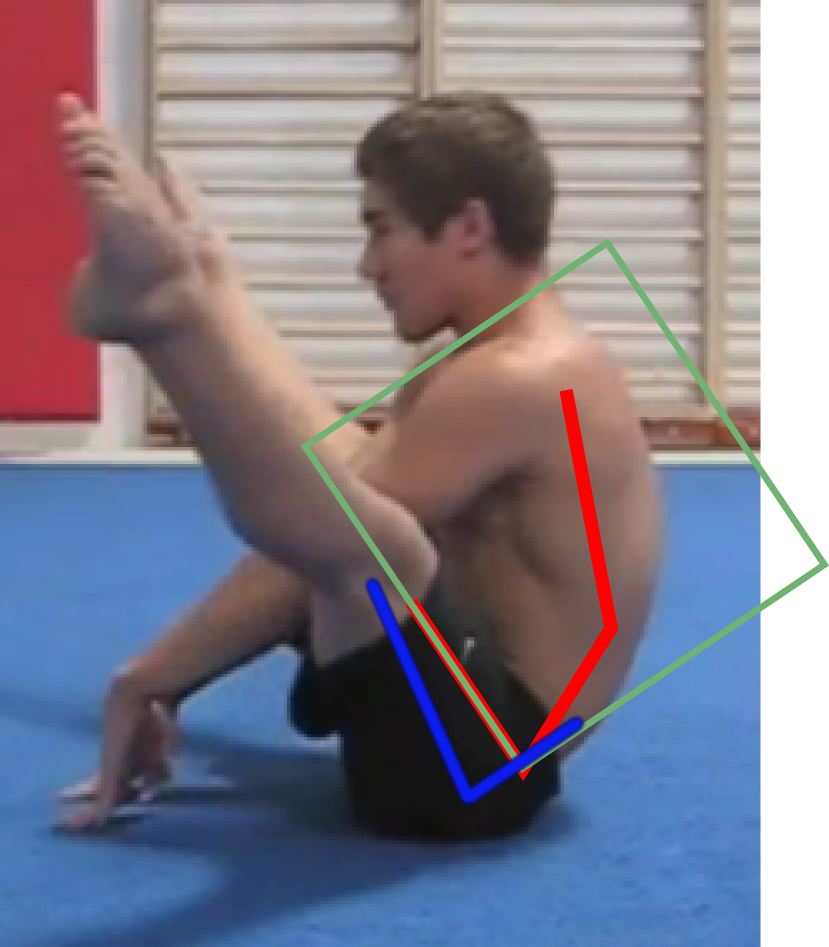
I do think he's on his coccix too. Not really sure. Anyway, the angle between his hips and back is not so close to 90 degrees, if I'm seeing it correctly. But see if you agree with me on the line positioning:


I've put a Red line for what I think it's his body line and a green rectangle in order to compare it to 90 degrees angle.


Mn%20PE2%20angles.png


It seems to me he's way closer to 60 than to 90.


Were he on his sit bones, the angle between his femur and his hips would be insanely small. But hey, that's Gymnastics, so I wouldn't discard that hipothesis.

Keegan

No, you're not seeing it correctly. The red line you drew is not his pelvis but extends up into his lumbar spine. Look at the lower most part of his back (it ends just above his shorts). This area is flat (because the pelvis/sacrum does not articulate); this is his pelvis and it is pretty close to the green line you drew (which I am assuming is 90 degrees). From there on up the back rounds.

Keegan

I edited your image and drew a line along the athlete's femur (at least from the landmarks I could somewhat see) and his pelvis (blue lines). The angle is slightly less than 90 degrees, but not much and again shows that the remainder of his compression is in large part due to spinal flexion.post-2201-0-44680700-1408590017_thumb.pn

KibboKift

I make it 75 degrees. Since I was working on CAD at the time, it was easy enough to measure the photo. See my post on a previous thread:

https://www.gymnasticbodies.com/forum/topic/13103-has-anyone-mastered-mnpe2-yet/?p=145304

This may be considered over-analysis, but I find it useful to gauge how far my current level of straddle compression is from the required standard. Since I can just about sit in a straddle with my back against a vertical surface, I know that I have 90 degrees of passive flexibility at the hips. My active flexibilty is not far behind. This means both my passive and active flexibility must still improve quite a bit. Once I get to the point when I can lift my feet 15cm or so off the ground with  a vertical back, I will be about there.

Keegan

75 Degrees of hip flexion would be abnormally good. If you can do that, then you are gifted in terms of your hip structure for hip flexion (which you very well may be). 


During my kinesiology course in college we watched a video on the Thomas test for hip extension as well as measuring hip flexion. In the video it was demonstrated that when the pelvis was secured/strapped down and not allowed to posteriorly rotate that it is very rare that someone will exhibit much less than a 90 degree angle of hip flexion. And just to demonstrate the difference that allowing the spine and pelvis to move made the woman that the demonstration was done on could easily lay her chest on her legs or pull her completely straight leg to her chest/face once her hips were no longer secured down. Even in this position though (which was again very easy for her) it was pointed out that her angle of hip flexion was still only approximately 90 degrees and the rest of her compression was achieved via her spine rounding forwards.


I will post some more pics from the course videos with lines to demonstrate my point when I get the chance.

KibboKift
Keegan said:

75 Degrees of hip flexion would be abnormally good. If you can do that, then you are gifted in terms of your hip structure for hip flexion (which you very well may be). 


I'm surprised by this. I don't think I'm particularly gifted in any aspect of flexibility, but in a Thomas test I can pull the held leg to 45 degrees or less from the horizontal. My pelvis must remain static, since my lower back remains pressed into the floor and my other leg is horizontal. What am I missing?


If we're talking about pancake flexibility though, as in the OP, it would seem there is far more scope for improvement there, since your legs are not going to get in the way of your torso. It's not unheard of to touch navel to floor in this position. I would expect the vast majority of people to be able to achieve 75 degrees or less given time - it doesn't seem like there would be anything structural to prevent them from doing so. Again, I'm willing to be proven wrong.

Keegan

Your pelvis is posteriorly tilted while you are doing the Thomas test. The point of holding the knee up towards the test is to help you maintain a posterior tilt more easily, thus testing your degree of hip extension ROM in the other hip. Also, if your lower back is flat against the floor your pelvis is posteriorly tilted as the lumbar spine has a natural lordotic curve when in a neutral pelvis position.

When the legs move into a straddle/abduction/horizontal abduction pattern then it's true that a less than 90 degree angle is possible because the legs and abdomen don't have to share the same space. But remember that the Manna progressions are designed to help us build the muscles, mobility and connective tissues specific to performing a Manna, which again involves the legs being together and thus quite a bit of spinal flexion as well as hip flexion, wrist extension, and shoulder extension ROM and strength. So doing straddle-ups with the back straight wouldn't really translate as well as the way the athlete in the video is doing them.

Again, I'll post some more pics of pikes (active and passive) to point out that most people (even very flexible ones) don't get much less tha 90 degrees of hip flexion when I get a chance. And some pics of Mannas which show the same thing and that the spine flexing makes up for the rest of the ROM.

Keegan

Also, when talking about pancake stretching, the ability to lay the navel to the floor is achieved more by hip rotation than hip flexion, that's why "turn-out" is so highly sought after in dance and gymnastics. Look at anyone doing a pancake stretch which a truly straight lower back (where the pelvis has actually anteriorly rotated far enough forward to allow the stomach to lay on the floor without the lower back rounding and you will notice that the legs are always straddled quite wide and the degree of actual hip flexion is generally not much less than 90 degrees and the remainder of the ROM is again coming from hip rotation.

Coach Sommer

Not quite, although the comment regarding externally rotating the femurs is accurate.  


A correct pancake should have a leg angle of approximately 90 degrees.  Basically you should be able to still grasp both feet simultaneously while in pancake.  If you cannot, your legs are too wide.


In order to stretch a pancake correctly, it is important to be in anterior pelvic tilt in order to properly load the hamstrings.


Yours in Fitness,

Coach Sommer

Keegan

Thanks for the clarification Coach. What do you call a pancake (for lack of a more accurate term on my part) where the legs are almost in a full side split then? Most of the pictures of tutorials I have seen on pancakes have the demonstrating athlete's legs much wider than 90 degrees, which was why I assumed that it needed to have very wide legs.

Coach Sommer
Keegan said:

?.. What do you call a pancake (for lack of a more accurate term on my part) where the legs are almost in a full side split then? ...

A mistake.

Yours in Fitness,

Coach Sommer

Keegan

Lol, straight to the point as always.

Thanks Coach.