This forum is archived information and is no longer active.

Allan/Dillon's Handstand versus Yuval

Started by Micawberian, July 5, 2014 · 11 Replies · 858 Views

Micawberian

Hello, guys


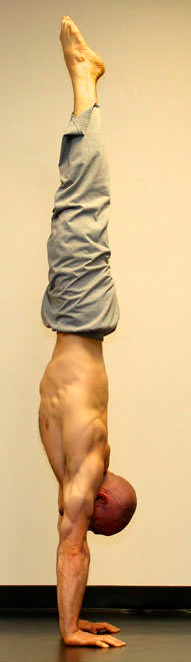
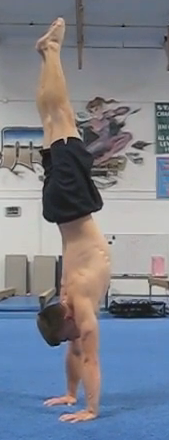
Just trying to figure some handstand stuff out. I noticed a Coach's students often have their lumbar spine sticking out of the line of the upper torso and arms, and following suit their legs are not perpendicular to the floor. I see this a lot in Dillon and Allan's handstand.


When I look at the handstand of an equilibrist like yuval and many others (and actually the boy demonstrating the 5x30 second parallel bar hs in the course), I see that the lumbar spine is not sticking out and the line of the legs stays perpendicular to the floor.


How exactly are yuval & the boy-who's-name-i-do-not-know creating this perfectly perpendicular body line? Or rather, what are Allan/Dillon doing to their lumbar spine/hip and what is Yuval doing?


I'm asking because my hs currently looks like dillon's, but I would perfer aesthetically something closer to yuval/5x30 pbar kid


Picture's attached for your convenience.
post-3655-0-38214300-1404602596_thumb.pn

post-3655-0-15303600-1404602608_thumb.pn

jules

Its probably because its a relaxed/semi lazy handstand.

If you lack shoulder flexibility and cannot get full overhead extension in the handstand, then you have to counter balance by arching the lower back. If your handstand looks like Dillion's above, then you probably need to work more on your active shoulder flexibility.

BMJD

Both of them have open shoulders and hips locked just nicely. My take would be that the gymnast isn't pulling in his ribs as much as yuval.

BMJD

I'll agree with you that Yuval's handstand that it is today is due to his emphasis on the refining of his line. I did get a chance to train with him in person for 3 days at his place and he commented that his handstand line was better than when he was a gymnast. 


The slim build? Well , that guy is huge (not tall) around 1.6+m. He actually has quite a developed lower body, it is more proportioned than it looks. When I stood beside him, felt like a malnourished kid. I made fun of his hands being tree trunks instead of limbs. He credits his tricep development to his hand balancing practice


In the gb seminar I attended this march I think, coach commented that allan looks bigger in real life than on videos. I can finally understand that now. Don't trust a video or picture when you see a 'slim' gymnast

Micawberian

Thanks for the replies guys! :)


But, even Yuval aside...comparing the boy in SE9 to Allan, you can see there is something different they are doing with the lower back/hips. I don't think it is, as Jules states, laziness or underdeveloped shoulder flexibility. If you look at Allan's pbar competition routines on Youtube, he is performing his handstand with the same form as in the courses.


My main concern here is to figure out what the boy is SE9 is exactly doing with his body to cause a completely perpendicular line that Allan and Dillon are not doing. Perhaps, yes, as BMJD says his ribs are not pulled in as much. Could there be other reasons?

jules

Sorry, I didn't mean that Dillon's had underdeveloped shoulder flexibility, I was just saying it is a common weak link in handstand development. 

And I BMJD is probably right about the ribs not being pulled down.

Handbalancer

No disrespect towards gymnastics, but from what I have seen of gymnast handstands, this is quite common. There are absolutely some beautiful lines in gymnastics, but I have also seen a lot of slightly arched handstands. I have also seen that press handstands in gymnastics often have a different form from what you work with as a balancer. Allans handstand is lacking protraction of the shoulders compared to Yuval. From all the hundreds of people I have worked handstand with I would say it probably comes from lack of active shoulder mobility or a built in habit. Moving the legs in perfect line with the torso on that handstand would mean that some sort of compensation would need to happen. Either by scapular protraction so that the sternum moves in or by angle in the shoulder. 1 arm handstand from such a form is very inefficient to learn and this is why Yuval changed his handstand when he became a balancer. This sort of alignment is the first thing you need to learn as a balancer in circus school or acrobatic gymnastics where they also use a lot of 1 arm handstands.


What is interesting about gymnastics though(take into consideration that im far from an expert on gymnastics, but these are some observations I have made) is that they often seem to correct underbalance by staying completely straight through the body and compensating by planching it slightly. Body straightness is important to not get deductions and it thus makes sense. As a balancer the most efficient way of doing this is by piking at the hips and staying completely on top of the arm, simply because planching on 1 arm is very hard and inefficient. Gymnasts do not stay to balance on 1 arm and have less to gain on piking while piking itself leads to many positions as a balancer. Handstand in rings, which i know little about, also seem to use this way of balancing since you need to move the arms underneath you to stay in balance.


Gymnasts also use the handstand a lot as a tool to generate power for swings and the like which seem to require the toes driving over the top to make the momentum move correctly. When swinging down on Pbars for example, it might be beneficial to start with the toes slightly over because you will be able to create more force in the swing as the feet whips through. On high bar as well it seems like they will move their chest slightly in front of the legs when they come over the top to generate maximum force. Like I said, Im no expert on these things so please correct me if Im wrong.

Alessandro Mainente

I think that the low difference from yuval and allan is that allan is forced to develop certain level of ring strength. all the muscles tension generated on rings (swing, transition, isometric holds) affects the joints mobility in both handstand and pommel horse. i remember during a seminar when Coach said that the work that needs to be done in order to balance the tension for proper full extension during pommel is far bigger then time you can have to train. in the beginning his circles were like Xiao Qin's circles. I can say approximately the same thing, i've stopped for a while rings strength routines in favor of foundations and my PH extension increased a lot. of course now i've restarted with some rings one but i need to admit that i'm spending about 1.5 hours of passive upper body stretching 4 days a week and 2 days with hard crack pnf plus all the handstand mobility that i'm increasing week to week. if you have to train 6 apparatus you do not have all this time

Micawberian

Enlightening answers, guys. Thank you :)

Handbalancer said:

Allans handstand is lacking protraction of the shoulders compared to Yuval. From all the hundreds of people I have worked handstand with I would say it probably comes from lack of active shoulder mobility or a built in habit. Moving the legs in perfect line with the torso on that handstand would mean that some sort of compensation would need to happen. Either by scapular protraction so that the sternum moves in or by angle in the shoulder.

Scapular protraction is not the same as pulling the ribs in correct? I have seen some people use these terms interchangeably, but if I understand correctly pulling the ribs in refers to thoracic flexion and is independent of scapular movement, yes? I have in the past experimented with protracting in handstand and I must say it is quite difficult.


alex87 said:

I think that the low difference from yuval and allan is that alla is forced to develop certain level of ring strength. all the muscles tension generated on rings (swing, transition, isometric holds) affects the joints mobility in both handstand and pommel horse. i remember during a seminar when Coach said that the work that needs to be done in order to balance the tension for proper full extension during pommel is far bigger then time you can have to train. in the beginning his circles were like Xiao Qin's circles. I can say approximately the same thing, i've stopped for a while rings strength routines in favor of foundations and my PH extension increased a lot. of course now i've restarted with some rings one but i need to admit that i'm spending about 1.5 hours of passive upper body stretching 4 days a week and 2 days with hard crack pnf plus all the handstand mobility that i'm increasing week to week. if you have to train 6 apparatus you do not have all this time


So it is the simple case that, due to time constraints, the pursuit maximum strength at advanced levels like Allan will negatively impact mobility?

Alessandro Mainente

I think this is something very usual in gymnastic, look to brandon wynn and his pbars hs (rings specialist), juri chechi and his pbars hs (rings specialist), matteo morandi's hs is quite open but not as yuval (rings specialist), yang minyong (rings specialist), van gelder (ring specialist), Igor Radivilov (rings specialist)...then look for max withlock rings hs.

Allan is still quite open in handstand and he has strong upper back for press to hs variation. So on the time you pass to maintain your shoulders healthy is far more important then full flexibility. I'm not say that rings is the key of loss of flexibility, but it really plays a big big role.

BMJD

From my own feel when I try to work towards the alignment of yuval (mine tends to look closer to the left pic), it is almost like a cascade of movements. So after protraction/elevation of shoulders, sternum / ribs in, ppt and the other stuff, I would think of bringing in the sternum / ribs more (slightly). What tends to happen here for me is that the shoulder angle closes, so I need to elevate more (without losing protraction). In the hip area, it needs to be more open without losing ppt. And that is when the alignment looks a bit straighter. I'm not sure if a getting a better alignment can truly ever be boiled down to just 1 thing. The way I see is, maybe 1 cue could be more strongly engaged leading to the subsequent changes needed to get that better alignment. Just correct me if I'm wrong on this.

Micawberian

Well, I figured out after a week straight of non-stop handstands that (at least in my case) the problem was forgetting to contract the abdominal muscles. So there was PPT and ribs in, but lack of abs contraction made the lower back stick out. decent straight line now hehe. forever a work in progress.