Hey guys,
Today I came up with an interesting question. What differences does the length of your arms make when performing strength elements? I came up with a theory after doing some research on the subject.
First of all, I compared my full planche with someone who has remarkably longer arms. What I noticed is that the amount of lean required was significantly different between us. I had to lean much more than he had to. Of course many more factors play a role in this matter, but I still believe that it does make a difference. Longer arms mean that the angle between your wrist and arms becomes greater, meaning less lean. Here is the picture:
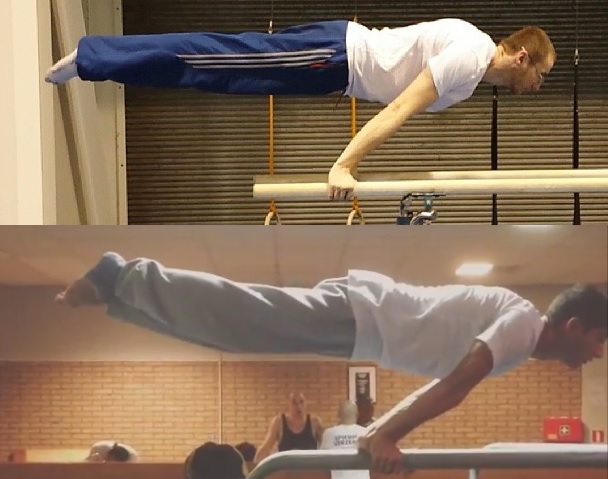
After doing some thinking I came to the following conclusion, longer arms make static straight arm holds like the planche, front lever and back lever significantly easier to hold. However, this is not the case with malteses and iron crosses, Coach Sommer explains this perfectly in this post:
Coach Sommer said:Torque, or inch pounds, is determined by multiplying the applied force by the distance from the pivot point to the point where the force is applied. For an iron cross, in plain english that means half the bodyweight times the length of the arm from the shoulder down to the wrist times two.
Given the angles involved between the upper arms and the torso the general equation for an iron cross is relatively straight forward;
(sleeve length x half bodyweight) x 2 (you have two arms after all) = Inch pounds for an iron cross. Obviously different people will have slightly different attachment points, but for a rough overall estimate of the forces involved the equation as is works fine.
The specific examples below should help you to clearly understand why the great ring men of the world have shorter arms; note that the 180lb gymnast with 21" sleeves needs to generate more than 1,000 additional in.lbs during an iron cross compared to the 150lb gymnast with 18" sleeves!
It also provides a clear illustration as to why ring strength builds such incredible physiques; even though it appears that the gymnasts are "only" manipulating their bodyweight.
For a 150lb gymnast with 18" sleeves:
(18" x 75lbs) x 2 = 2,700 in.lbs
For a 150lb gymnast with 21" sleeves:
(21" x 75lbs) x 2 = 3,150 in.lbs
For a 180lb gymnast with 18" sleeves:
(18" x 90lbs) x 2 = 3,240 in.lbs
For a 180lb gymnast with 21" sleeves:
(21" x 90lbs) x 2 = 3,780 in.lbs
Yours in Fitness,
Coach Sommer
Furthermore, I believe moves such as push-ups, pull-ups or any other move that requires your arms to bend are also harder for people with longer arms. They have a much larger range of motion when performing these moves.
This is what I currently think. I’m interested in what you guys think about this subject.

