This forum is archived information and is no longer active.

MN/PE2 Straddle Ups cause lower back pain

Started by IcedDante, June 26, 2013 · 23 Replies · 864 Views

IcedDante

I'm no stranger to injuries, but my lower back has usually been pretty immune. The few times it flared up were usually from sitting in front of the computer too long and rushing over to Capoeira without a proper warm-up. Resting for a day or two would alleviate the problem and I was back to normal.


About two months ago, I got some real gnarly lower back pain. I have a stand up desk at work and thought it might be related to this, but I noticed that Straddle Ups really seemed to set it off. I was doing 4 sets of 12 at the time and I would start to feel it in the 3rd set. Then moving onto SLS/PE3 (side2side squat) really set it off because the forward lean during the movement seemed to be putting a lot of pressure on my back.


Over the next few days the pain persisted and I was miserable. Trips to the chiropractor proved fruitless, doing stuff like putting on socks became a chore, etc. Taking a muscle relaxer, however, really disappeared the problem for a couple of days.


Before F1, I used to do a bunch of V-Ups so I was wondering what was so different between V and Straddle that could be causing this problem. To be fair, I didn't do anywhere near the volume of V-Ups as I do the Straddle, usually just 2 sets of 15 reps, and I don't know what other external factors could be contributing to this but I really instinctively feel that Straddle Ups are the main culprit.


Does this injury reveal some sort of weakness that I need to attend to? Should I drop down to MN/PE1 (which are pretty easy for me)?

Alessandro Mainente

people with low hips flexor flexibility can suffer from lower back pain with exercises like V-ups. if the hips flexors are tight the body is compensating the movement by arching the lower back. so do some lower back stretch and ileopsoas stretch.

the fact that with PE1 you are not suffering is a proof of that. less leverage needs less hips flexors elongation.

MvdB

How is your compression (pike/pancake)? I'm asking because if you also feel pressure in the lower back when leaning forward during the side to side squats, it sounds to me like a lack of mobility in the lower back and hip region (i.e., you're bending from the lumbar spine instead of from the hips). I trained capoeira for more than seven years and the ginga can make your lower back pretty tight, trust me!


I'm sure someone better qualified than me will chime in but this is my gut feeling.

Keilani Gutierrez

i don't want to sound like a broken record, but do you actively use your glutes with this move? 


I have a similar situation with my hip flexors that Alex and Michael have clearly pointed out. 


poor hip mobility causes these kind's of things. I pointed out the Glute activation because my snapping hip, no longer snaps during this movement (when i do a rep or 2 every once in a while) actively recruiting certain muscles alleviates the load on the surrounding musculoskeletal structure. 


I hope you get well soon and have a speedy recovery :)

IcedDante
KeilaniG said:

i don't want to sound like a broken record, but do you actively use your glutes with this move? 

I read a lot of your posts but don't remember you saying this. Nor do I really understand what it means. Do you mean that to lift/separate my legs I should be using my glutes?

Keilani Gutierrez

yes and no. 


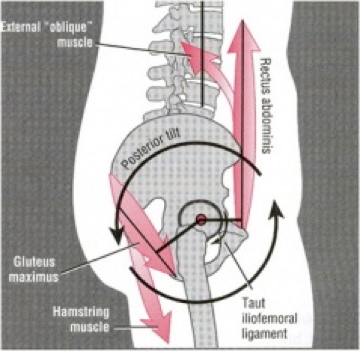
a glute muscle does a hold host of movements, what you will be doing is since you start the tuck ups, straddle ups and V-ups from from PPT, you are using your hamstrings and glutes to pull your pelvis downwards and your abdominals and obliques to pull the top or anterior part of your pelvis upwards.


you can visualize it with this: http://bretcontreras.com/wp-content/uploads/posterior-pelvic-tilt11.jpg


see? so you start from here on the ground and then compress upwards, while maintaining some degree of tension or "consciousness" throughout the movement to use your butt/hamstring, abs/obliques. this is what's been helping me avoid lower back pain during tuck ups(which yes, i used to get a bit of due to not knowing this bit, my anterior pelvic tilt was that bad) 


I do a few sets every now and then to see how "engaged" my mind is in the movement. sometime's i get it, sometimes i don't. 


when I warm up with Tuck ups(or finish my Mn/SL/SLS days, ill try out a few reps to see how my progress is doing)

Joshua Naterman

We tend to have this idea that if we are not shortening a muscle, it should be relaxed. This is not accurate... we should feel connected to, and aware of, the muscles crossing a moving joint whether they are shortening OR lengthening.


What Keilani is describing is basically muscle control. In other words, developing an active connection to your muscles. There is a big difference in allowing your glutes to lengthen as you flex the hips and simply just focusing on hip flexion while letting go of everything else... you may THINK that letting go is the right thing to do, but it is not.


I know it sounds silly, but try this:


1) lay on your stomach. This is the prone position, just in case you ever hear the term "prone" thrown around.


2) While prone (didn't take long, did it?), externally rotate the left leg at the hip as far as you can, and, while continuing to hold the external rotation, try to lift the leg off of the floor without arching the back.  Focus on making a mental connection with those muscles.


3) repeat with the right leg.


4) After a few rounds of 2 and 3, get into position for straddle ups.


5) focus on LIGHTLY recruiting the muscles you used in 2 and 3, which will also involve actively externally rotating the hips, while you do the straddle up.


If you do this correctly, over time you will learn not to tense your lower back muscles to stabilize your pelvis, because your glutes and hamstrings will be taking care of a lot of that job for you, leaving the lower back muscles free to lengthen slightly as you perform the straddle ups. This will alleviate your lower back pain by allowing your lumbar spine to avoid arching during the movement.

trw

Something like this happened to me a couple months ago. Had a sudden and serious back spasm during a warm-up one day which took me out completely. Could hardly stand for days, couldn't go to work for a week, couldn't work out for two weeks until the pain had mostly disappeared.


What felt best for me were hip flexor stretches, like Alex said. I was doing these quite a bit while recovering since I felt so much better afterwards. I still try to do them every day, and always in my warm-ups now without fail.


I think I also do what Keilani advises, or something along those lines. Though I think less about tensing the glutes and more about initiating a hollow at the start of each rep. It makes everything much smoother. But stretching my hip flexors helps me the most. Anytime I feel some discomfort in my back, usually from sitting down for a while, a quick stretch restores me.

FredInChina

All of the above, PLUS the Jefferson Curls that are really working many small deep inter vertebral muscles that need a lot of time to recover.

Take it easy on that one, you are not exercising prime movers, but a multitude of very small very deep stabilizer muscles :)

trw

I second what Fred says too. I actually forgot to mention that after my back spasm I also began to include Jefferson Curls in my daily warm-ups, starting light and slowly increasing weight over time.

Keilani Gutierrez

wait you feel the olympic bar weight gives you cramps.

IcedDante

KeilaniG, Joshua, et al: Thanks for the advice. I tried employing into Straddle V-Ups with a low number of reps. I never have had an "aha" moment where I felt that I really made that mind-muscle connection, however, so I do these sparingly.


Do you think, based on the description of the weakness, that I'll run into similar issues with the next progression, V-Ups?


Joshua, I've been doing the rotated leg lift you described for reps in the morning now to try to develop that muscle. I can definitely feel a big difference between my left and right side. The right side is weaker, and that is also where a lot of the pain has localized. Do you think doing these for reps is a good idea or is there another exercise that is more suitable (I have been doing 3 sets of 10 reps each leg, lifting slowly and pausing at the top).

Keilani Gutierrez

oh man, straddle ups are a lot challenging to me than V-ups due to the active flexibility bottleneck.

sounds like you need some soft tissue work. I rarely get ghost pains in my glutes but

thats when i sit for long duration which I do my

best to avoid nowadays. cant escape it when I drive but I have noticed a diff.

Joshua Naterman

I would work on your standing split and straddle pike.


Hold each one at a GENTLE level of tension for 3-4 minutes. You'll notice that the tension basically disappears somewhere in there, and that's what we want. That means the body has accepted the new ROM. Do NOT try to push further, you have just made progress! Hold there for the rest of the 4 minutes.


Do this 1-2x per day and you will see regular progress. Remember, virtually all of your flexibility needs are met in the Foundation programming, but you will need to do some specific work for these two.


Make sure you're maintaining a neutral pelvis, don't let the lower back arch like crazy. You will be well served to also perform Kit Laughlin's hip flexor stretch afterwards. Always stretch the hip flexors after any pike work.

FredInChina
Joshua Naterman said:

(...) virtually all of your flexibility needs are met in the Foundation programming (...)


Really?

I don't doubt it, but it is the first time this is stated that clearly. :)

Jon Douglas
FredInChina said:

Really?

I don't doubt it, but it is the first time this is stated that clearly. :)

I would imagine that is, all the flexibility required by the Foundation elements (which is still fairly extreme).

IcedDante

I believe that I have an inactive glute. I had a massage therapist try to have me do some side leg lifts  from the table position (on all fours) and it was very hard to do from my right side.


I really strained my back badly trying to do something... well embarrasingly outside of my abilities (negative handstand press!) and threw my back out. I rested for a couple of weeks and I'm now coming back into F1 training. Tumbling and Capoeira are outside of my capabilities now as they just reignite the back injury. I'll report back as I heal up. Josh, I'll be working the split and pike stretches as per your recommendation, thought I do want a doctor or some such qualified pro to look at it too.

FredInChina

Be well soon Icedante :)

IcedDante
Joshua Naterman said:

I would work on your standing split and straddle pike.


Hold each one at a GENTLE level of tension for 3-4 minutes. You'll notice that the tension basically disappears somewhere in there, and that's what we want. That means the body has accepted the new ROM. Do NOT try to push further, you have just made progress! Hold there for the rest of the 4 minutes.


Do this 1-2x per day and you will see regular progress. Remember, virtually all of your flexibility needs are met in the Foundation programming, but you will need to do some specific work for these two.


Make sure you're maintaining a neutral pelvis, don't let the lower back arch like crazy. You will be well served to also perform Kit Laughlin's hip flexor stretch afterwards. Always stretch the hip flexors after any pike work.

Hey Josh: I know it has been a while but I'm going through PT, seeing some progress and am revisiting this advice to start incorporating it into my training. Some questions about it:


How do the standing split and straddle pike benefit this problem I am having?


and what is the proper way to do the standing split: is the body straight up in a line with the hips in line with the feet, or is it okay to put the hands on the ground and try to get that deeper stretch?

IcedDante

Well, I have returned to foundation training fully after many weeks of physical therapy. I think some of the soft tissue damage is still there as my lower back still gets sore from time to time but it's no where near as bad.


One of the accomplishments in Physical Therapy came near the end when my P.T. had me attempt to do 5 sets of 15 reps of the Straddle ups (without the integrated mobility). This was a pretty scary moment for me, but to my surprise I was able to pull it off (I took 1 to 2 minute rests between sets to be safe).


One concern he had was with the Jefferson Curls themselves. I never thought about this: I just assumed it was the Straddles that were causing the injury but maybe it was the Jefferson Curls. Maybe both? I'm not really sure.

Joshua Slocum

How much weight were you using? 

IcedDante

10 pounds

Joshua Slocum

That's pretty insubstantial. Did you have a pre-existing back condition? 

IcedDante

No... I never did. But like I posted earlier I think I've been moving around with a weak/inactive glute muscle and probably a host of hip and hamstring flexibility & strength issues