This forum is archived information and is no longer active.
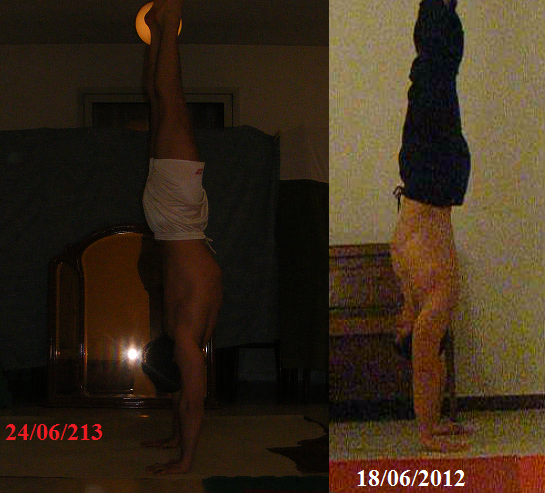
handstand comparison approximately 1 year ago
Started by Alessandro Mainente, June 26, 2013 · 13 Replies · 4,684 Views
That's nice, well done and thanks for the alignment tip. Also a good reminder to take 'before' and 'after' pictures.
One year difference? Looks more like about 1800 years to me.
i'm maintaining all my progress in photo or video. if i show you my handstand 2 years ago. oh no..wait...it wasn't an handstand
Looks pretty decent. Im picky and would say you can round your upper back even more to make the ass stick out less. Working on tuck handstands, and looking at your toes in both straight and tuck is very beneficial to achieve this because you will be forced to work your traps hard to stay on top of your shoulders while rounding your back/pulling in your chest(which is the same thing and essentially scapular protraction). Both moving the head in front and tucking tends to force you to round the back to compensate for placing more weight in front of your body
nice tips handbalancer thank you, i love picky people, they let to wonderful result.
my ass is quite big...and it can give the impression of being far out.
probably proceeding with H1 development i'll reach more upper back rounding..
i've never though about work over tuck handstand for now. do you mean with knee as close as possible to the chest ang knee at 90°?
thanks again
Still, I can see that your push can come more from your scapuiar area. Tuck handstands and presses are good to build this, but they need to be done with good form. I mean a tuck where you bring your knees towards your chest while keeping your torso completely stacked above your shoulders. Requires a lot of trapezius and scapular strength and active flex. Work on it every time you go down from your handstand. Lower through tuck, hold, and then straighten your legs to pike as you descend to the floor. Making this a habit(or straddling/piking down with good form) when you go down from your handstands is a great way to practice and you get a lot of free negatives.
wonderful!
sometime i used to do them on handstand facing the wall. simply i'm doing handstand far from the wall of about 20-30 cm then i slide the feet on the door until the tuck handstand is achieved and then i reverse the movement. the biggest part of the time i have to left from the position due to the cramps.
Forearm wall slides with your face on the wall are also a good way to get a feel for the serratus anterior activity that you'll need to keep opening up. They make a good warm up, but to work properly they require you to protract the whole way up. Done properly, this will eventually end in a pretty ideal handstand alignment. It should feel like you're pointing your arm pits more and more towards the ceiling as you continue to slide the forearms up the wall... you can literally feel higher and higher portions of serratus anterior start working, which is why I think it is such a great warm up for handstands (and other overhead activities).
kind of like a "face to the wall" wall extension? they seem highly related. how would you be in a handstand line and protract while keeping the forearms gliding on the wall? i can see it happening in wall extentions, but ive never seen them with face to the wall. is there something i'm not capturing here that confused me or?Joshua Naterman said:Forearm wall slides with your face on the wall are also a good way to get a feel for the serratus anterior activity that you'll need to keep opening up. They make a good warm up, but to work properly they require you to protract the whole way up. Done properly, this will eventually end in a pretty ideal handstand alignment. It should feel like you're pointing your arm pits more and more towards the ceiling as you continue to slide the forearms up the wall... you can literally feel higher and higher portions of serratus anterior start working, which is why I think it is such a great warm up for handstands (and other overhead activities).
I'm not certain, but what I'm picturing is this: You stand upright, facing the wall, with your shoulders flexed to 90 degrees and elbows flexed to 90 degrees, such that your forearms rest against the wall, as if you're in a forearm plank position. Then, keeping your forearms parallel, you slide them up and down the wall.KeilaniG said:kind of like a "face to the wall" wall extension? they seem highly related. how would you be in a handstand line and protract while keeping the forearms gliding on the wall? i can see it happening in wall extentions, but ive never seen them with face to the wall. is there something i'm not capturing here that confused me or?
Edit: I'd missed the 'face on the wall' part. I'd read it as 'face to the wall'. Although, in the one I'd described, once your hands are high enough and the angles at your elbows and shoulders have opened up enough, you'll have had to lean in pretty close to the wall.. so maybe I am still thinking of the right thing. (c:
Alex at what PE are you now?
Can we get more clarification on the "Forearm wall slides with your face on the wall"?
I think I got it today. I was failing heavily at doing them on the wall with any perceived level of work but when I was doing HS/PE1>iM, I can feel the feeling of pointing my armpits out to the sides and what it feels like pointing them forwards, it actually looks like the way the armpits look in the Handstand/Press handstand segment of BTGB.
feels a little....wierd... is the armpits out feeling what we're going for on Wall Extensions as well?